




Transparent Sustainability in Logistics and Supply Chain
May 5, 2022 at 1:00 PM
EMI: Production Suffers from Supply Shortages and Weak Demand
May 8, 2022 at 1:05 PM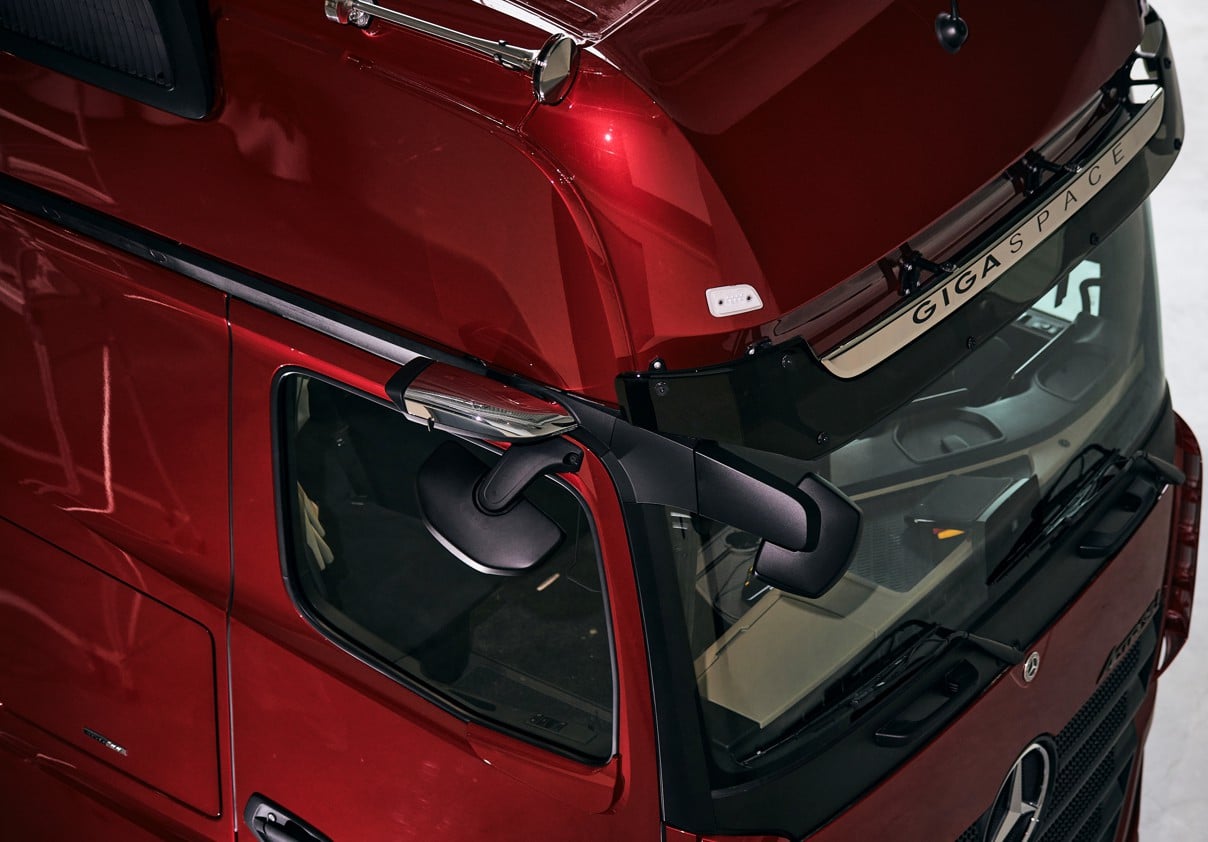
Mercedes-Benz Trucks is already sending the second generation of the MirrorCam onto the road. Ten centimeters shorter camera arms on each side and new image parameters support the driver even better in many traffic situations. The drip edge on the housing keeps rainwater away from the lens. This results in an even more realistic representation of the surroundings and even more image information.
(Stuttgart) Now, Mercedes-Benz Trucks has given the MirrorCam its first update: With the second generation available since April 2022 in the Actros and Arocs series as well as in the eActros, Mercedes-Benz Trucks has further developed the award-winning system in important details. “The close exchange with our customers and their experiences from daily practice were the foundations for us to adjust certain technical parameters again and thus generate even greater added value, especially in terms of representation and safety,” says Prof. Dr. Uwe Baake, Head of Product Development at Mercedes-Benz Trucks.
Shorter Camera Arms are Beneficial
Visually, the second generation of the MirrorCam stands out with camera arms that are shortened by ten centimeters on both sides. This applies to both the narrower and the wider cab and brings the advantage that drivers find it easier to drive straight back compared to the first generation of the MirrorCam. This is particularly due to the fact that the perspective of the MirrorCam is now even more similar to that of the familiar glass mirror. The shortening brings another advantage. At the 2.50-meter-wide cab, the camera arm now does not extend beyond the vehicle contour any further than the ramp mirror, which is clearly visible to the driver. Collisions with objects at the roadside are now almost excluded. This also applies to the 2.30-meter-wide cab variant due to the same width of the chassis.
Further Optimization of Image Parameters and Drip Edge
As part of the revision of the camera-based system, Mercedes-Benz Trucks has also made adjustments to other features. For example, a drip edge has been added to the bottom of the MirrorCam to prevent rainwater from reaching the lens and causing unwanted optical effects. Dirty glass mirrors, which in the worst case are viewed through unclean side windows, are now a thing of the past with the MirrorCam system.
Furthermore, the engineers at Mercedes-Benz Trucks have further optimized tone mapping – a process in which an image is adjusted so that a wide range of tones is displayed correctly on a medium – which is now particularly evident in improved contrast representation. The evolution in color and brightness adjustment of the already very light-sensitive camera system ensures that the displays, for example when reversing into a dark or poorly lit hall, depict the area relevant to the driving situation even more accurately.
Committed to Safety and Driver Comfort
The revisions lead to an even higher added value of the MirrorCam overall. Due to its supportive effect, the further developed system can help to handle situations such as overtaking, maneuvering, driving in poor visibility and darkness, cornering, and passing narrow passages even more safely and stress-free. In addition, the existing advantages such as wide-angle mode when reversing, distance lines on the display for better estimating the distance to objects behind one’s own vehicle, the camera image panning during cornering, or monitoring the vehicle’s surroundings during breaks remain.
Interaction of MirrorCam and Turn Assistant
The interaction of the MirrorCam with the turn assistant from Mercedes-Benz Trucks has already proven to be helpful, especially in complex traffic situations and unclear intersections. If there is a risk that a truck driver may unexpectedly not see a cyclist or pedestrian when turning right, the system can intervene supportively within its system limits, warn the driver through a multi-stage process, and, in the case of the optionally available Active Sideguard Assist, initiate an automated braking action at its own turning speed of up to 20 km/h. For the optical warning signals, the turn assistant continues to use the display of the MirrorCam.
Photo: © Mercedes-Benz Trucks