





Radia partners with Latecoere & Stirling Dynamics
Jul 10, 2026 at 1:39 PM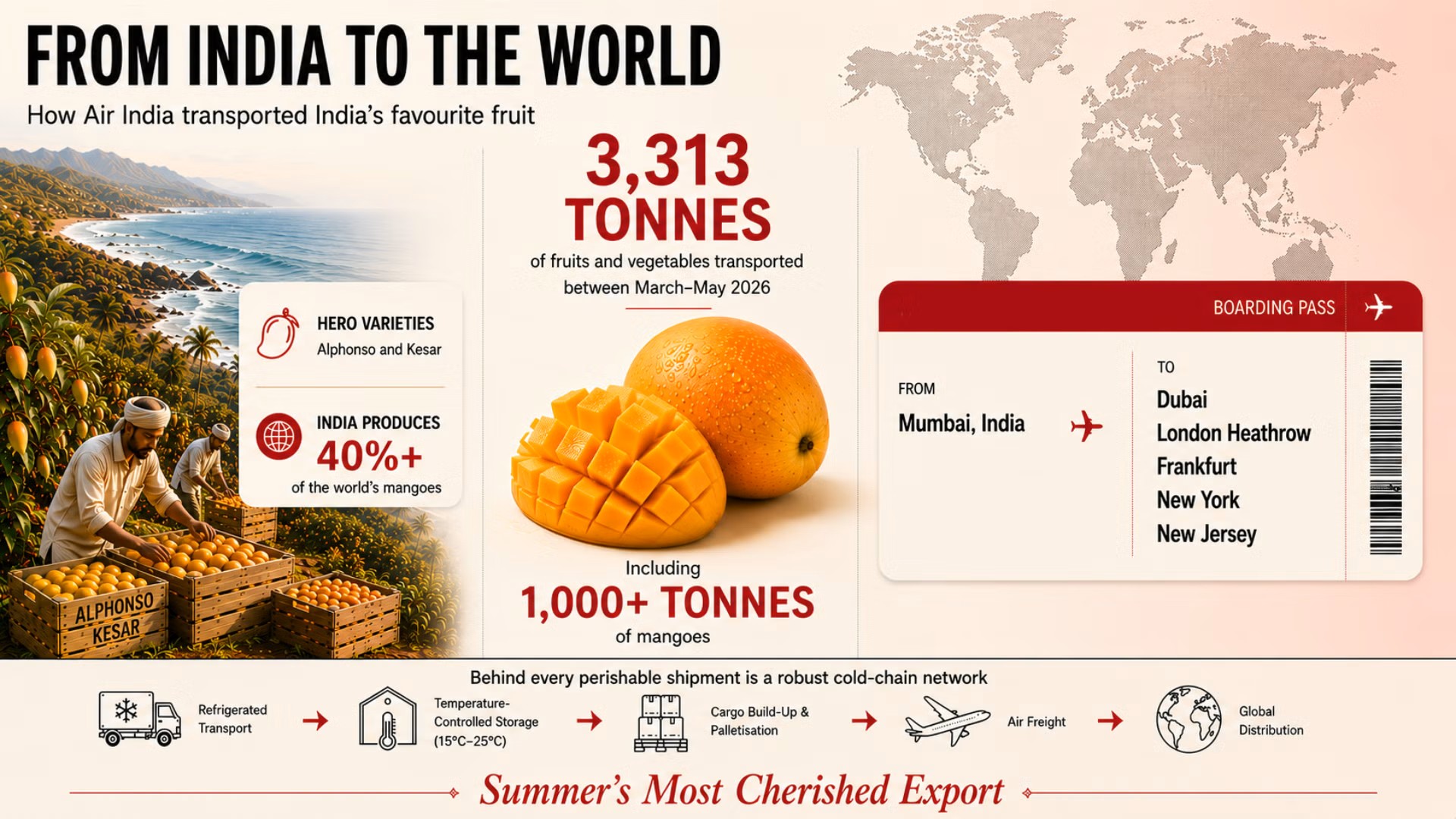
With the onset of the Indian summer, an annual ritual begins, which will take place on a large scale in 2026. Between March and May 2026, Air India transported over 3,300 tons of fresh fruits and vegetables, including more than 1,000 tons of mangoes. These fruits hold great significance in Indian cuisine and culture and are highly valued in the diaspora.
A seasonal event
For many people in distant cities, the arrival of mangoes is more than just a delivery; it is an important event. Transport figures are steadily increasing. In March, 805 tons of fruits and vegetables were transported, rising to 1,275 tons in April, and stabilizing at 1,233 tons in May. Most shipments come from the western states of India, particularly from the mango farms in Maharashtra and Gujarat, where the Alphonso and Kesar varieties are grown.
Mumbai, located near this agricultural hub, serves as a logistical center. From the city’s cargo terminals, shipments are distributed worldwide. During the peak weeks in March and April, London Heathrow Airport recorded up to 180 tons of weekly deliveries from Mumbai. Frankfurt received about 40 tons, while Dubai, Newark, and New York JFK each took around 30 tons per week.
Global connections through mangoes
The transport routes illustrate a connection between migration and taste. In cities like Dubai, Indian mangoes reach markets that are familiar with them. In London and New York, their appearance signals the start of a short sales window, during which specialty stores stack the boxes high and customers buy in large quantities, often to share with friends and family.
From Delhi, Air India transports perishable goods to cities like San Francisco, Toronto, Paris, Hong Kong, and Sydney, integrating Indian products into global supply chains. The airline carries over 400,000 tons of cargo annually, making it the largest international cargo provider in India.
The importance of the cold chain
The journey of a mango from the field to the shelf abroad requires not only time but also careful temperature control. Long before the airplane doors close, the cold chain is already in motion. The products arrive at the airports in refrigerated trucks, coordinated by IATA-certified agents. At the point of origin, they are stored in temperature-controlled environments before being loaded into special pallets and containers.
After landing, temperature-controlled handling continues. Air India has invested in expanding this infrastructure and now operates cold and active container capabilities at 14 airports, including major hubs like Delhi, Mumbai, Bengaluru, London Heathrow, and Frankfurt.
“The transport of over 1,000 tons of mangoes in just three months demonstrates both the demand and the efficiency of our cold chain processes,” said Ramesh Mamidala, Head of Cargo at Air India. “Perishable goods require careful handling, and our teams work closely with partners to ensure quality at every step.”
More than just logistics
Viewing this movement as merely an operational achievement would miss its deeper significance. Each shipment carries more than just products; it also transports the seasonality that is increasingly rare in a globalized food economy. For members of the Indian diaspora, the first mango of the season often marks a return to familiar flavors, while for others, it represents an introduction to a fruit that has traveled many miles.
In cities like London and New York, the mango season is short, yet during this time, demand rises rapidly. Conversations in households, markets, and online often revolve around the question: “Have the mangoes arrived?”
Ultimately, Air India’s cargo figures reveal more than just volume. They highlight the connection between Indian farms and global markets, shaped by both identity and commercial aspects. In the span of a single night flight, fruits harvested in West India reach kitchens on the other side of the world, fresh and full of flavor.