





Northstarr acquires X2 during a phase of growth
Jun 25, 2026 at 8:46 AM
AD Ports Group raises GFS stake to 81 %
Jun 25, 2026 at 9:06 AM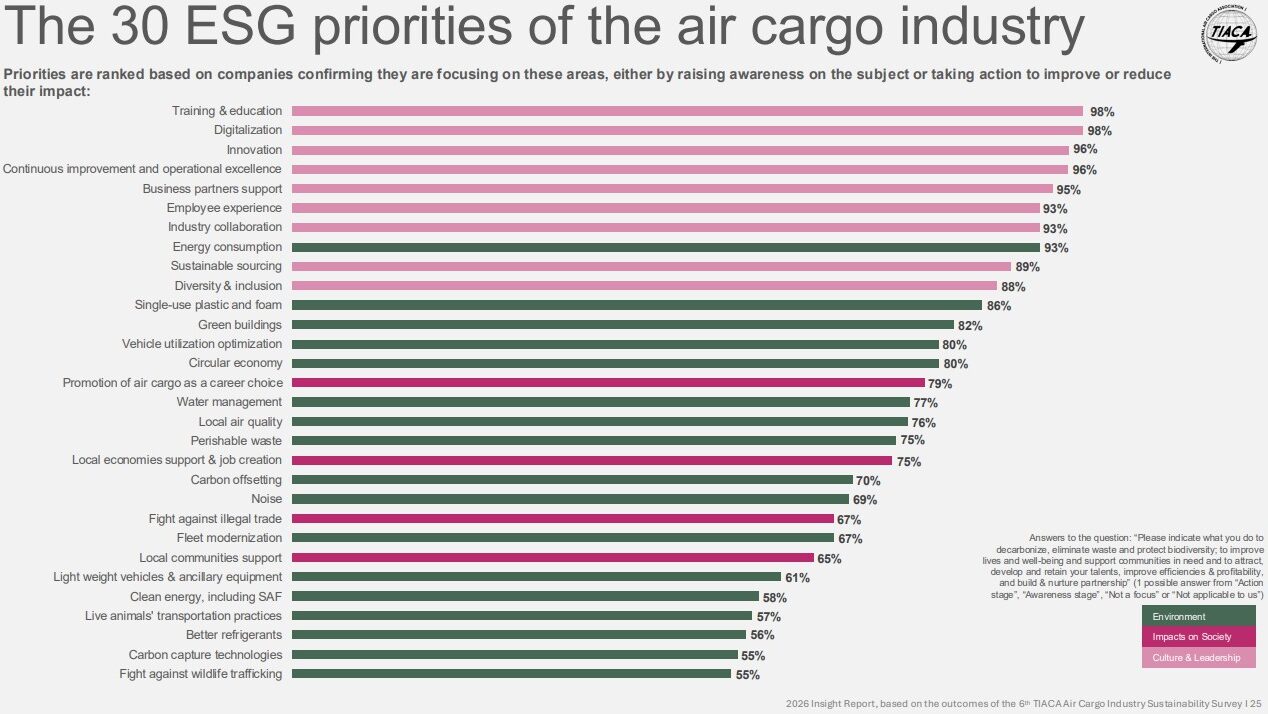
The International Air Cargo Association (TIACA) has published its report on sustainability in the air freight sector for the year 2026. This comprehensive report provides an overview of the priorities, progress, and challenges in the global air freight industry. The findings are based on feedback from companies operating in various areas of the industry, including airlines, airports, freight forwarders, and technology providers.
Sustainability as an internal priority
One of the key findings of the report is that sustainability is increasingly driven by internal corporate priorities rather than external expectations. The pressure to comply with sustainability standards has decreased to 53%, marking the lowest level since 2021. Nevertheless, support from corporate leadership remains strong. TIACA Chair Roos Bakker emphasizes:
“It is encouraging that sustainability is no longer determined solely by external pressures or regulatory requirements. 95% of respondents confirm their CEOs‘ commitment to sustainability.”
Additionally, the report shows that 72% of companies have implemented a formal sustainability strategy. 60% of respondents identify both employees and customers as essential drivers of their sustainability efforts. Pressure from regulators has significantly eased over the past two years, particularly in North America (-14 percentage points) and the Middle East (-12).
Growth of sustainability programs
The relevance of sustainability has evolved within the industry. 73% of respondents state that sustainability is part of their corporate identity. Furthermore, 65% integrate environmental, social, and governance (ESG) criteria into their risk management processes. 70% consider sustainability aspects in procurement decisions.
TIACA Director General Glyn Hughes highlights that the industry increasingly views sustainability as a strategic necessity.
“The results show that sustainability in the air freight sector has grown beyond mere compliance. Organizations are investing in climate adaptations and integrating ESG principles into their business processes.”
Connection between sustainability and resilience
A central theme of the report is the growing connection between sustainability and resilience. 41% of respondents now define sustainability through ESG principles, while 33% incorporate resilience into their definitions of sustainability. The report also shows that 68% of companies have already begun integrating climate adaptations into their business strategies.
In the area of decarbonization, companies are focusing on practical and measurable actions. Leading initiatives include reducing energy consumption (73%), improving the utilization of vehicles and equipment (59%), and investing in environmentally friendly buildings and infrastructure (55%).
Focus on innovation and education
The report also highlights the increasing importance of innovation and education as essential components for sustainable growth. The top sustainability priorities of respondents are training and education (98%), digitalization (98%), and continuous improvement and operational excellence (96%).
Regional differences continue to shape progress in sustainability. Companies based in Asia report the strongest integration of sustainability into corporate culture, while in Europe, 73% and in the Americas, only 44% confirm this.
In summary, the report shows that despite moderating external pressure, internal commitment to sustainability in the air freight industry continues to grow. Companies are increasingly integrating sustainability into their governance structures and strategic planning, leading to a more resilient and forward-looking sector.