




Descartes study on AI in transport management
May 5, 2026 at 11:24 AM
BCS Argentina appoints new Commercial Director
May 5, 2026 at 1:30 PM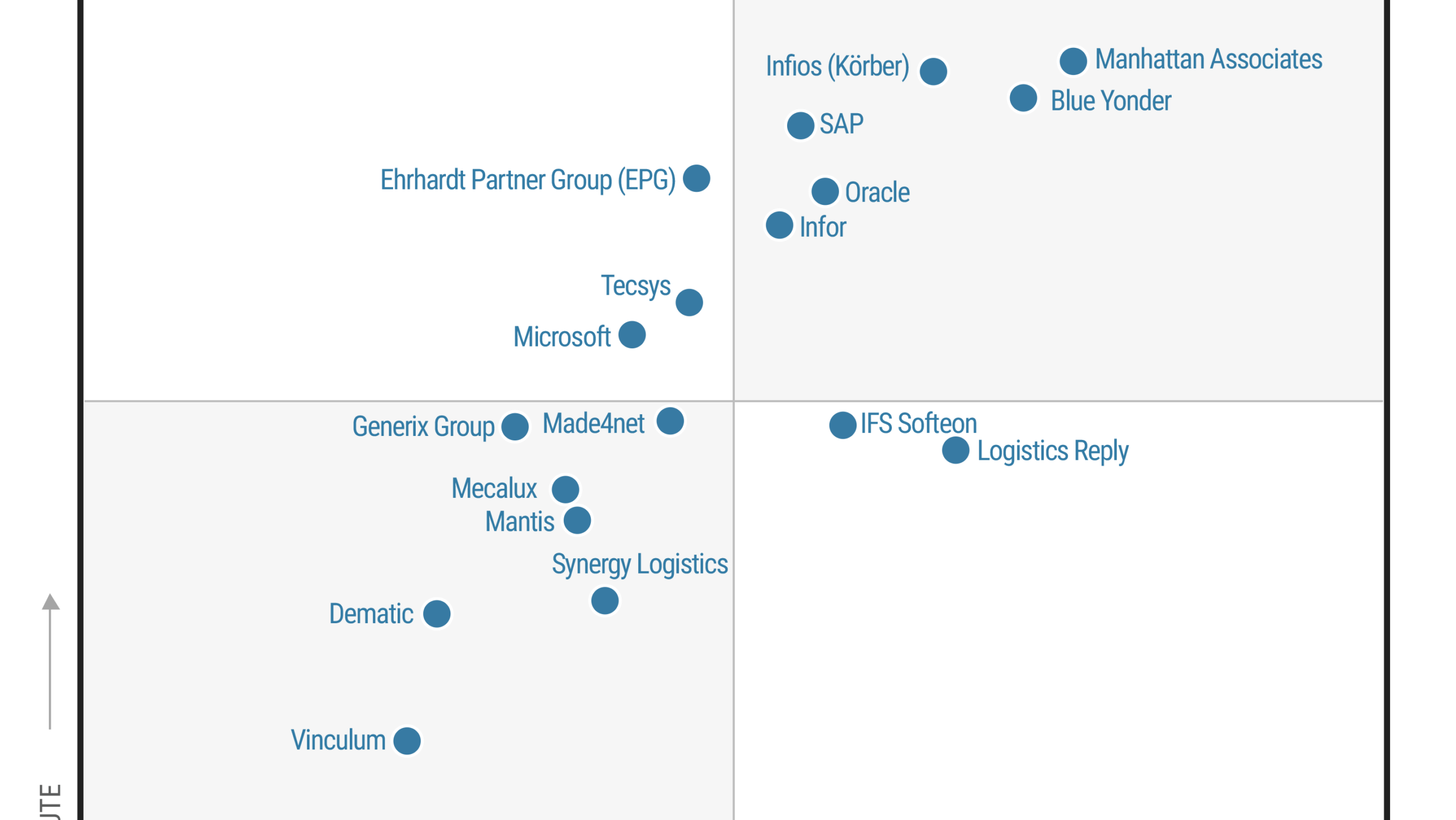
The requirements for Warehouse Management Systems (WMS) have changed significantly in recent years. Factors such as increasing complexity, volatile supply chains, and a growing degree of automation mean that WMS must no longer merely represent operational processes but increasingly function as active control systems. In this context, EPG (Ehrhardt Partner Group) has once again been ranked as a Leading Challenger in the current Gartner® Magic Quadrant™ for Warehouse Management Systems, marking the fifth consecutive recognition of this kind. The company has continuously improved its position and has led the quadrant for five years.
Evaluation Criteria and Market Position
The ranking in the Gartner® Magic Quadrant™ is based on the criteria of „Ability to Execute“ and „Completeness of Vision.“ These criteria assess providers regarding their implementation capabilities and strategic development in the market. For companies, this classification provides valuable guidance in an increasingly dynamic technology environment, where aspects such as performance, integration capability, and speed of development are crucial. Dennis Kunz, Chief Marketing Officer of EPG, commented on the renewed positioning: „The renewed positioning as a Challenger confirms that we are consistently developing our solutions in line with the operational reality of our customers.“ He emphasized that in complex logistics environments, it is essential to provide systems that not only operate stably but can also flexibly adapt to changing requirements.
The Role of the Warehouse Management System
At the center is the Warehouse Management System LFS, which serves as the core of the EPG ONE Supply Chain Execution Suite. This software not only represents classic warehouse processes but increasingly takes on a coordinating role within complex system landscapes. Material flow, shipping, transport planning, and personnel management are integrated into a unified environment and connected to existing IT systems via standardized interfaces. This development reflects a fundamental shift in the market. Modern WMS must today be capable of representing different levels of automation, integrating heterogeneous system landscapes, and simultaneously providing a stable foundation for data-driven decisions. The ability to monitor processes in real-time and adapt flexibly is increasingly becoming a critical differentiating factor.
Context-Based Decision Support
Another aspect of development is context-based information processing. With EPG AURA, EPG expands its system landscape with an additional AI-native environment that links operational data across systems and translates it into concrete action contexts. This technology enables faster interpretation of information and supports decisions in ongoing operations more effectively.
The Gartner® Magic Quadrant™ for Warehouse Management Systems was published on April 29, 2026, and authored by Simon Tunstall, Rishabh Narang, and Federica Stufano.