


The German Logistics Congress of BVL with a View to the Future
Aug 10, 2023 at 5:27 PM
Logivest brokers large logistics space in Rheda-Wiedenbrück
Aug 11, 2023 at 5:32 PM
With the largest media campaign in a decade, the Federal Association of Goods Transport, Logistics and Disposal (BGL) e.V. from Frankfurt am Main is responding to the plans of the traffic light coalition to drive countless German family businesses in the logistics sector to the brink of economic ruin or beyond with a quasi-doubling of the truck toll starting from 01.12.2023.
(Frankfurt/Berlin) Together with the Berlin agency “dreissig24”, BGL aims not only to highlight the economic impact of the annual additional burden of 7.6 billion euros but also to inform the public about how indispensable the work of the around-the-clock employees of German transport companies and freight forwarders is for the daily supply of the population and the economy with essential goods: https://www.mauteverest.de
According to dreissig24’s managing director Rebekka Csizmazia, the campaign aims to draw attention specifically to the issue of this dramatic toll increase and to increase pressure on politics. The performance of the industry should be brought to the forefront and communicated positively. Politics should be shaken awake but also invited to dialogue.
In parallel to the toll campaign, the focus will be directed towards an image campaign for the industry that portrays truck drivers as system-relevant cornerstones of society. “Many citizens are not even aware of how many goods MUST be transported by truck and that these transports are merely a reflection of our consumption behavior. It is about an industry with relevance and radiance.”
BGL Spokesperson Prof. Dr. Dirk Engelhardt: “The measure is full!”
BGL spokesperson Prof. Dr. Dirk Engelhardt: “The measure is full! We must now not only act internally within the industry but also specifically bring the performance of our industry into the public spotlight. This massive toll increase will not bring any measurable benefit to the environment because there are only very small numbers of trucks with alternative drives available for purchase. Currently, according to TollCollect, there are just 300 in operation. And one thing is already certain: Not every transport company can bear the additional burden, and the railway will not be able to fill the supermarket shelves that may remain empty in the future.”
It is important for Engelhardt to emphasize in the current demands that the industry is not trying to block sustainability efforts but rather to work together on socially acceptable and realistic solutions for the future. The expansion of truck charging infrastructure is particularly significant. Pitting transport modes against each other is also not a viable approach, as only cooperation is sustainable.
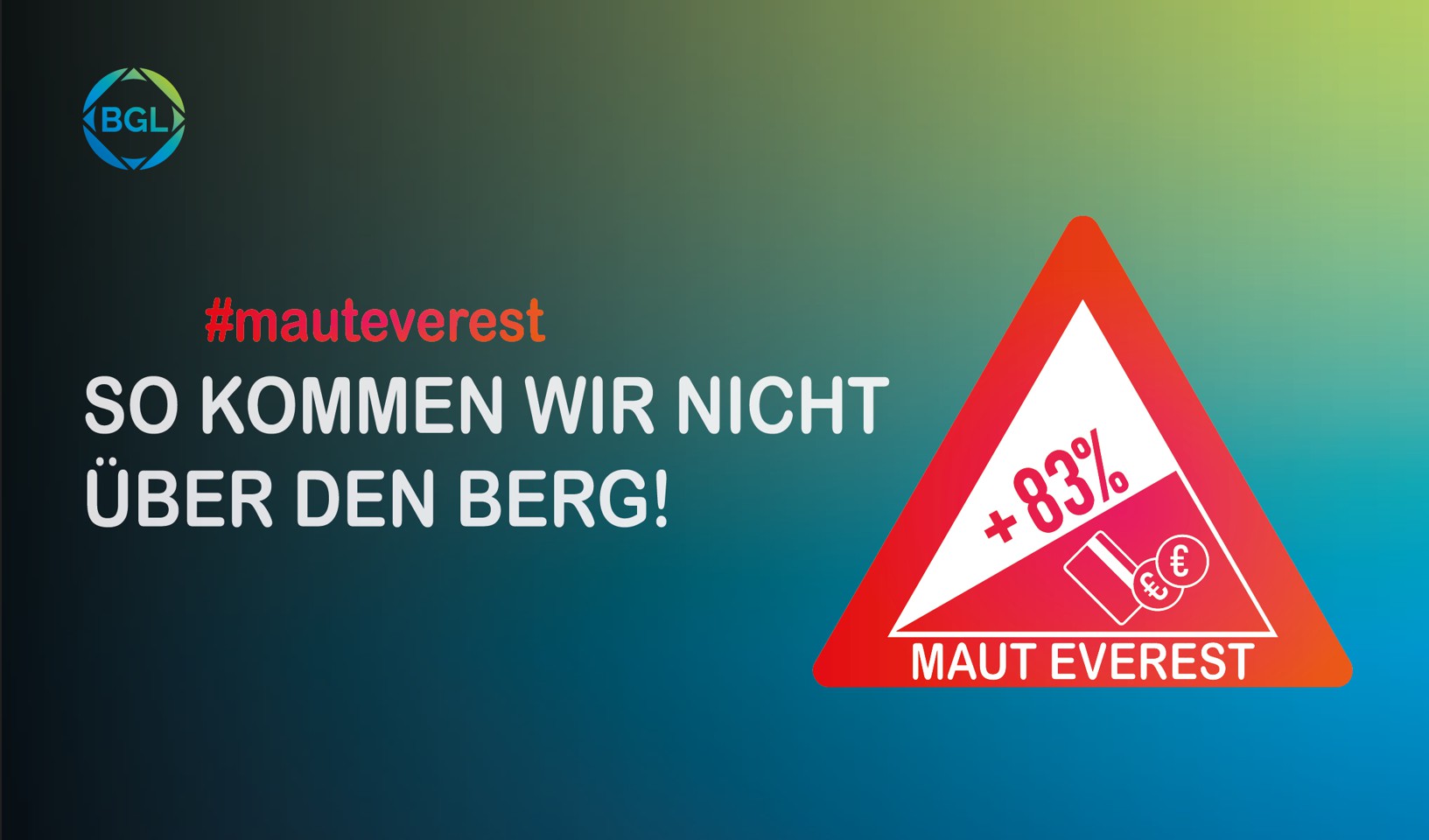 Therefore, the association demands instead of a sudden quasi-doubling of the toll during the Advent season – without the possibility of switching to alternatively powered trucks – a gradual increase in the truck toll, which is oriented towards the increasing availability of these vehicles and corresponding charging infrastructure over the coming years. Only in this way can the climate-friendly transformation of road freight transport succeed in the long term.
To ensure that this wish for a gradual adjustment is successful, BGL is now hoping for greater public attention and more understanding for its industry.
One point Engelhardt emphasizes particularly: “We drive for the people and for a stable and economically strong society. Many people are not yet sufficiently aware of this in terms of their own consumption.”
Further information and the current demands of BGL can be read on the campaign page www.mauteverest.de.
The Demands of BGL at a Glance:
1. Gradual Introduction of the CO2 Toll!
Adjustment of the introduction of the CO2 toll to the actual availability of alternatively powered vehicles on the market.
2. Postponement of the Start Date!
In light of the fact that many transport companies have annual contracts with their clients, a postponement of the toll increase to 01.01.2024 is indicated.
3. Maintenance of the “Closed Financing Cycle Road”!
Without the “Closed Financing Cycle Road”, the funds for the climate-friendly transformation of road freight transport (construction and expansion of tank/charging infrastructure!), the renovation of bridges and the dilapidated German long-distance road network, as well as the indispensable expansion of truck parking spaces, of which approximately 40,000 are currently missing, will be lacking.
4. No Double Burden from CO2 Pricing at the Gas Station and via Truck Toll!
From the coalition agreement of the federal government, there is still a commitment that is enormously important for the competitiveness of German transport companies: The introduction of a CO2 toll only “…on the condition of excluding a double burden from the CO2 price.” This double burden from CO2 pricing at the gas station and CO2 pricing via the truck toll affects almost exclusively German companies, as their trucks predominantly have to refuel in Germany. Foreign trucks operating in Germany rarely refuel in Germany due to the ranges of modern diesel vehicles of 3,000 kilometers and more, thus having another significant competitive advantage on their side.
Graphics: © BGL