



ELVIS and SNAP cooperate in truck parking search
Jun 24, 2020 at 10:08 AMHGK Group Achieves Record Results in Fiscal Year 2019
Jun 24, 2020 at 11:40 AMThe logistics service provider trans-o-flex has comprehensively measured the temperature in non-temperature-controlled delivery vehicles across Germany – Result: No transport is safe without temperature control. Approximately 153,000 measurements were taken in summer and winter.
(Weinheim) Those who do not monitor and control the temperature at which medicines are transported take the risk every day of the year in Germany that a medication may lose its effectiveness during transport. This is the conclusion drawn by the logistics service provider trans-o-flex, which specializes in the transport of pharmaceuticals and other sensitive products, based on several nationwide test series. The results of its evaluation are presented daily in relation to the current daily temperatures on its website. “No matter what time of day and regardless of whether it is summer or winter: Our measurements have shown that there is no outside temperature at which medicines can be transported risk-free without temperature control within the room temperature range of 15 to 25 degrees,” says Wolfgang P. Albeck, CEO of trans-o-flex, during the presentation of the test results in Weinheim. The lowest risk occurs at an outside temperature of 12 degrees. Here, the probability that a shipment is transported in an untempered vehicle at below 15 or above 25 degrees Celsius is 16 percent. Above and below this temperature, the risk increases sharply (see graphic).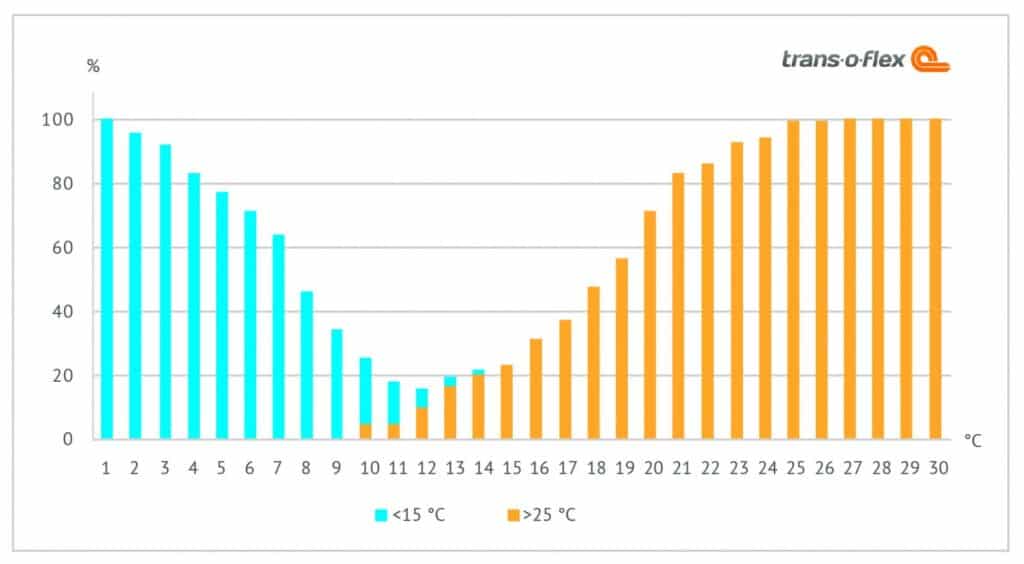 The graphic indicates how high the risk is when shipments are transported in an untempered delivery vehicle at a certain outside temperature below 15 or above 25 degrees Celsius. Reading example: Already at an outside temperature of 18 degrees, the risk is almost 50 percent. One in two shipments is likely to be transported at more than 25 degrees Celsius.
Measurement Series Across Different Seasons
“Based on our experience, shippers of temperature-sensitive medicines know very well how easily their sensitive products can leave the required range of 2 to 8 degrees Celsius without appropriate temperature control in the supply chain and thus lose their effectiveness. To prevent this, they use the service of the trans-o-flex subsidiary ThermoMed,” Albeck continues. “However, the risk in the room temperature range of 15 to 25 degrees created for other medications is still underestimated to this day. Therefore, we wanted to show with data collected in practice how high the risk actually is.” To this end, trans-o-flex has launched extensive measurement series across different seasons. During the measurement periods, delivery vehicles equipped with temperature loggers were deployed at 17 trans-o-flex locations distributed across Germany. At each location, three operational scenarios were tested: a long-distance tour, a city tour, and a mixed tour. The measuring devices (temperature loggers) recorded the temperature every 15 minutes with an accuracy of 0.5 degrees Celsius and stored it along with the time and date of the measurement. A total of 152,920 measurement values were collected during the test periods. Each of these temperature values was related to the outside temperature recorded simultaneously at a weather station of the German Weather Service that was closest to the vehicle. To reduce the evaluation effort, trans-o-flex focused its analysis on 40,151 measurement values that were collected from Monday to Friday between 8 AM and 4 PM.
Temperature Alarm: Service Quantifies Risks of Uncontrolled Transport
“We selected these time periods because our delivery vehicles are typically on the road during these times,” explains Albeck. “And based on this data, our IT department developed the website tool Temperature Alarm. From now on, anyone can quantify the risk of uncontrolled transport.” The Temperature Alarm service on the website www.trans-o-flex.com provides daily information on the expected maximum and minimum temperatures and how high the risk is that a shipment will be transported in an untempered vehicle at more than 25 degrees or below 15 degrees.
At 23 Degrees Outside Temperature, More Than 50 Degrees on the Loading Area
“The test results lead to only one conclusion: There is no day without significant risk,” emphasizes Albeck. “The investigation has confirmed several general findings.” First, the temperature in the cargo area of an untempered vehicle follows the rise in outside temperatures throughout the day without any significant time delay. Second, the cargo area does not heat up slowly and in parallel with the rise in outside temperature; rather, the temperature inside rises exponentially in relation to the outside temperature. Already at an outside temperature of 16 degrees, temperatures of more than 40 degrees were recorded in the cargo area in ten percent of all measurements. “Thus, even at normal outside temperatures, there are significant deviations when no actively temperature-controlled vehicles are used.” At an outside temperature of 23 degrees Celsius, peak temperatures of over 50 degrees were measured in the vehicles, and at an outside temperature of 30 degrees, even over 60 degrees Celsius. The color of a vehicle is, according to the findings of the trans-o-flex study, not decisive for how much a vehicle heats up. “The differences between white and anthracite-colored vehicles averaged only one or two degrees.”
Risk in the Sorting Hall
Further investigations by the pharmaceutical specialist trans-o-flex have shown that, in addition to the temperature in the vehicles, the temperature in the sorting halls also poses a high risk for medication transports. “If not actively monitored and counteracted, the temperature in conventional sorting centers continuously rises throughout the day,” says Albeck. “According to our measurements, the peak temperature is not reached at noon, but in the late afternoon, exactly when the customers’ shipments arrive.” Once the heating process has started, a temperature increase, for example, above the 25-degree threshold of the room temperature range, cannot be quickly prevented without active air conditioning due to the large mass of the buildings. “Cooling must begin early, usually still in the morning. And to know exactly when and how strongly intervention is needed, continuous measurement, documentation, and evaluation of temperature logs are necessary.”
Photo/Graphic: © trans-o-flex
www.trans-o-flex.com