



First car delivery from Vietnam to Kazakhstan
Mar 30, 2026 at 6:59 AM
New train connections to Poland planned
Mar 30, 2026 at 7:47 AM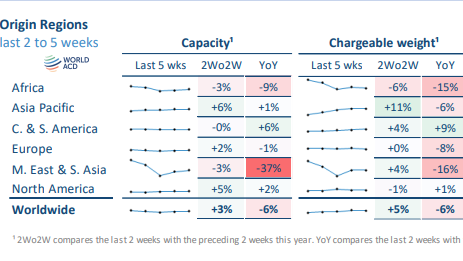
The global air freight rates continued to rise in the week of March 16 to 22, 2026, as market participants adjusted to the challenging conditions following the military attacks on Iran by the USA and Israel, as well as the subsequent retaliatory strikes by Iran. According to the latest data from WorldACD Market Data, global tonnages decreased by 1% in week 12 compared to the previous week, representing a decline of 6% compared to the same period last year. This development is attributed to ongoing restrictions on air freight capacity in key markets.
Price Increase Despite Stable Tonnages
Average global air freight rates rose by 7% in week 12 compared to the previous week, reaching 2.84 USD per kg. Previously, there had been an increase of 10% in week 11 and 8% in week 10. Spot rates also increased by 6% to 3.38 USD per kg, with markets in the Middle East and South Asia, as well as the Asia-Pacific region, significantly contributing to this rise. Compared to the same period last year, spot rates globally increased by 26%, with prices from the Middle East and South Asia rising by 70%.
Major air freight providers continue to face significant capacity and operational disruptions, affecting price trends. Spot rates from Africa, Europe, North America, and the Asia-Pacific region also remain significantly elevated compared to the same week last year.
Capacity Development in the Middle East and South Asia
Following the attacks on Iran since February 28, capacity from the Middle East and South Asia region fell sharply in weeks 8 to 10 but stabilized in weeks 11 and 12 with moderate increases of 6% and 2%, respectively. Compared to the corresponding weeks of the previous year, capacity from the MESA region in weeks 11 and 12 had decreased by 37%. Capacity from the Gulf region also showed slight increases but remained 20% below pre-attack levels. In contrast, capacity from South Asia has nearly recovered to pre-conflict levels.
Spot rates from the MESA region increased by 8% in week 12 compared to the previous week, with the largest increases observed in transports to Africa and within the region. Operational restrictions mean that most European and North American providers are currently not operating to and from the Gulf markets.
Rising Demand from the Asia-Pacific Region
Spot rates from the Asia-Pacific region to Europe rose by 8% in week 12, averaging over 5 USD per kg. This represents an increase of 26% compared to the same period last year. Demand from the major air freight markets in the region remains high, while available capacity is extremely limited.
Despite a slight increase in capacity in week 12 of 3%, the situation remains complex. Rising jet fuel costs and fuel availability in some countries, particularly in parts of Asia, are leading to further flight and capacity restrictions. The persistently high demand for capacity, combined with these supply issues and rising costs, could lead to further increases in spot rates in the near future, even if there is no further escalation of the conflict in the Gulf region.