


Panattoni City Dock Hamburg Welcomes Two New Tenants
Nov 28, 2024 at 8:29 PM
LogCoop’s Storage Network Covers 3 Million Square Meters
Nov 30, 2024 at 5:47 PM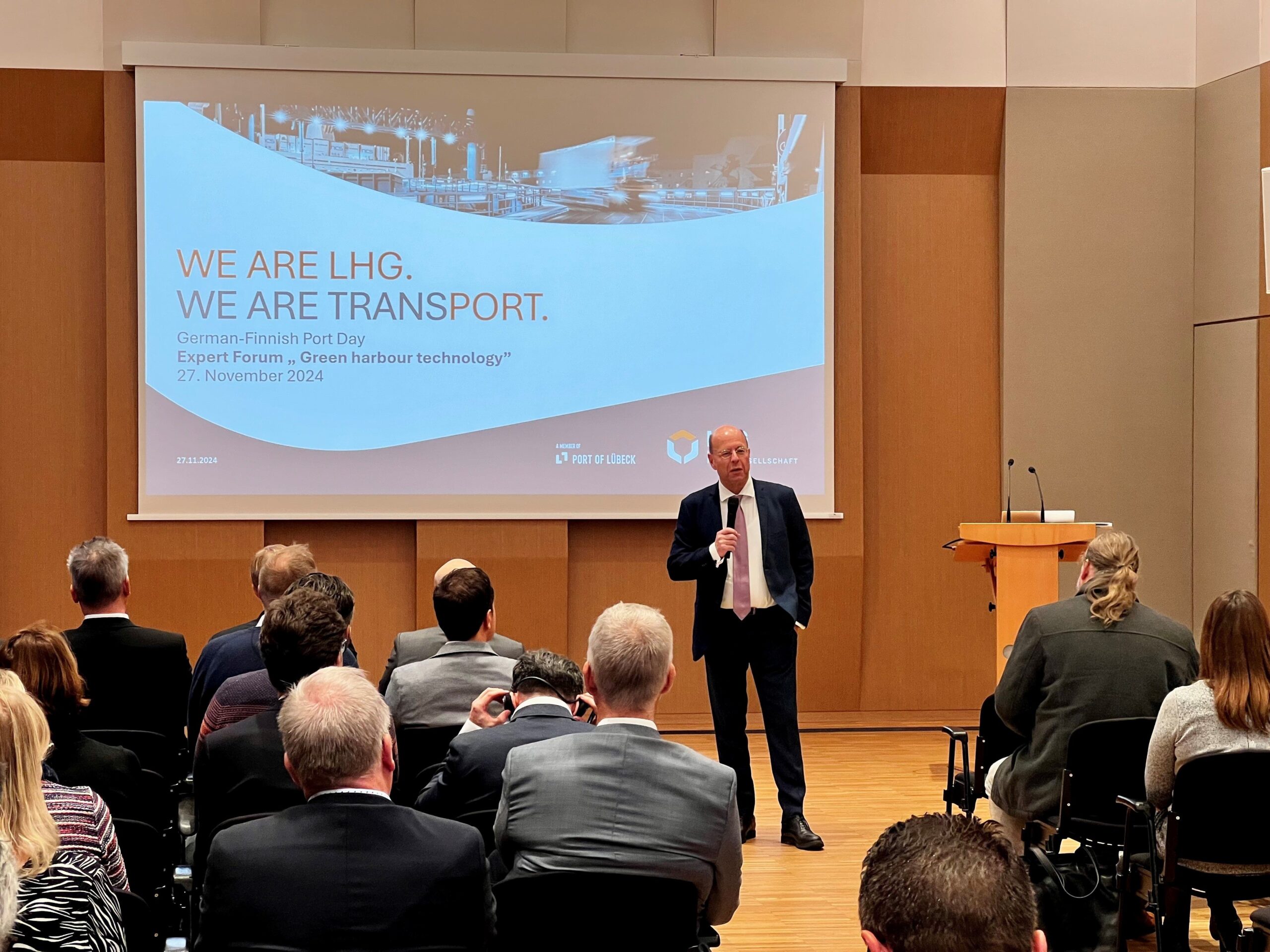
At the specialist forum “Green Port Technologies” in Lübeck, logistics experts from the Baltic Sea region met for an active exchange. Sebastian Jürgens, managing director of the Lübeck Port Company LHG, called for not solely relying on electric mobility. The motto of the subsequent German-Finnish Port Day, which enjoyed record participation, was: “The Baltic Sea region is the future region of Europe”
(Lübeck) “We have significant changes ahead of us and must consciously consider the topic of green port technologies from various perspectives,” explained Sebastian Jürgens, managing director of the Lübeck Port Company LHG, at the start of the namesake specialist forum prior to the German-Finnish Port Day. “We must not make the same mistake as the automotive industry and only rely on electric drives. That leads to a dead end.” Terminal operators like LHG would operate in a 24/7 mode, and with the currently required charging cycles, this would result in twice as many large devices compared to conventional drives, necessary to maintain operations on board ships, at the quay, or in warehouses – “and that at significantly higher vehicle prices,” Jürgens continued. He urged vehicle manufacturers to continue investing in the development of fuel cell technology.
Nevertheless, vehicle manufacturers Terberg, Movella, Linde, Still, and Kalmar made it clear at the now third specialist forum “Green Port Technologies” how advanced e-drive technologies for large equipment in demanding port applications have already become. Two hours of charging time for an eight-hour shift at moderate use is apparently no longer a utopia. In fact, the modular design of terminal tractors or forklifts increasingly facilitates the seamless use of fuel cells.
Andreas Frye, managing director of the Society for Environmental Services (GUD) from Bocholt, demonstrated how pragmatically a company can approach the topic of electrification. His company carries out contracts for port handling with excavators, including for coal in the Duisburg port. Frye’s conclusion: “The availability of electric excavators is gigantic compared to diesel machines.” Oil changes, replacement of alternators or starters – all of that is eliminated and ensures high operational safety. For power supply, Frye pragmatically relies on longer cables.
Creating Necessary Infrastructures for Green Port Technologies
Jürgens concluded by calling on politics to create the necessary infrastructures for the use of green port technologies such as hydrogen networks for fuel cells or e-charging points: “These infrastructures are a core issue for an export nation like Germany – and they must also be financed accordingly!”
German-Finnish Port Day in Lübeck
“The Baltic Sea region is the future region of Europe,” stated Finnish honorary consul Bernd Jorkisch in his welcome at the German-Finnish Port Day in Lübeck. Above all, the close cooperation between Germany and Finland drives the positive development in Northern Europe. “Germany is Finland’s most important trading partner. My country is a reliable partner in trade, politics, and security,” said Kai Sauer, Ambassador of the Republic of Finland in Germany. Finland’s NATO membership offers new options for cooperation between both countries and the Baltic Sea states. The European Green Deal also opens up opportunities, the diplomat emphasized before more than 400 participants.
For the ninth time, Finnish honorary consul in Lübeck, Bernd Jorkisch, the Lübeck Port Company mbH (LHG), and the Hanseatic City of Lübeck invited to the Port Day. This year, the focus was on the topic of “Green Technologies.” But security in the Baltic Sea region was also an important topic. “The alarming news about damaged cables has made us aware of how important the protection of underwater infrastructure is,” said Sauer. He called on Germany and Finland to ensure the security of critical infrastructure and to work closely together.
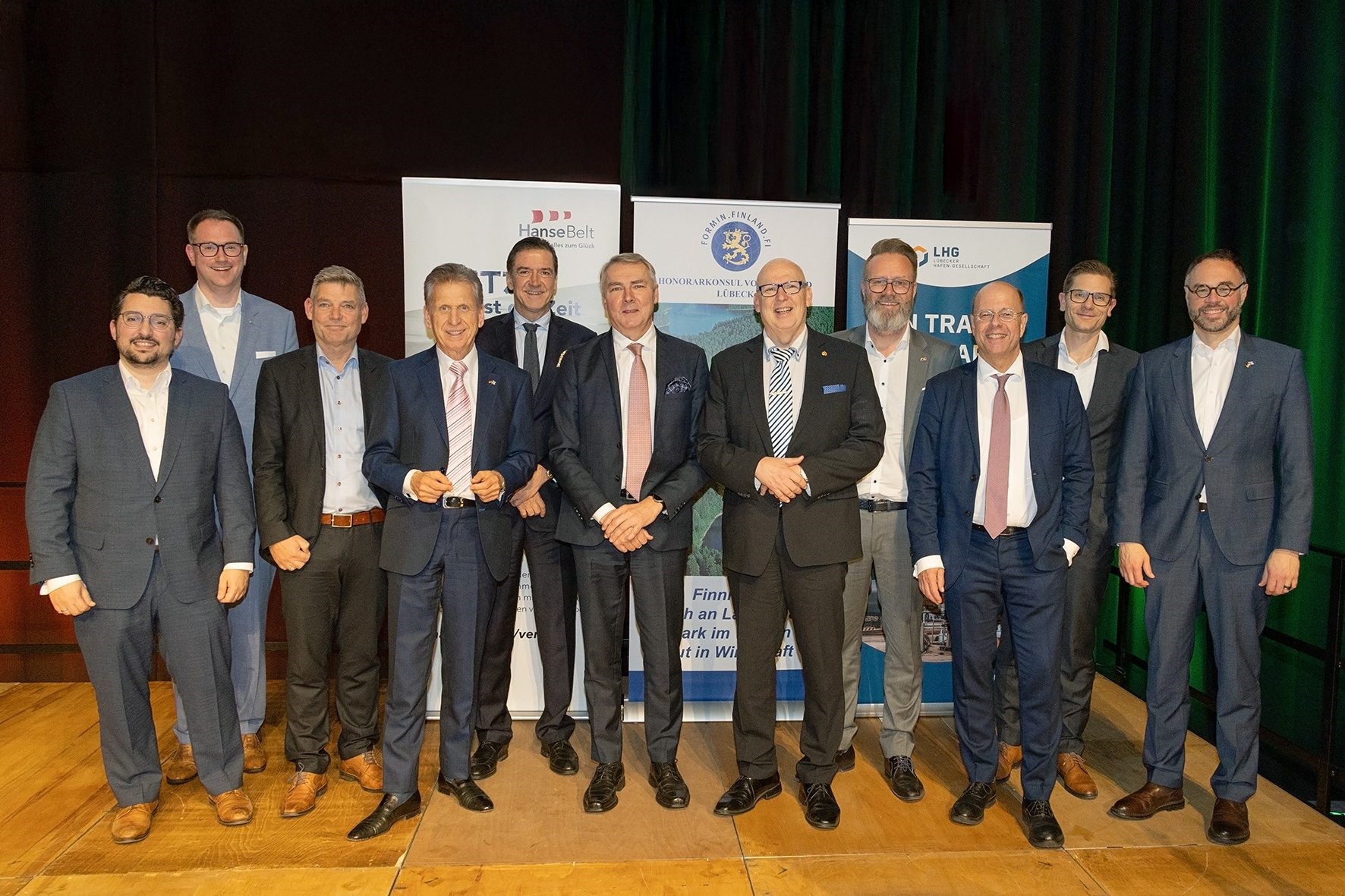
German-Finnish Port Day (l. to r.): Andreas Tsioulakis (Vice President of the Kion Group), Lübeck’s Mayor Jan Lindenau, Jan Meier (SSAB), Finnish Consul General Bernd Jorkisch, Ambassador Kai Sauer, Tom Pippingsköld (President and CEO Finnlines), Kimmo Naski (Port of HaminaKotka), SH Minister of Economic Affairs Claus Ruhe Madsen, Sebastian Jürgens (LHG), Moderator Sebastian Reimann (DVZ), and Jan Feller (German-Finnish Chamber of Commerce)
Thanks for the Close Cooperation
Claus Ruhe Madsen also emphasized this. Schleswig-Holstein’s Minister for Economic Affairs, Transport, Labor, Technology, and Tourism thanked Finland for its NATO membership, the close alignment with Germany, and the close cooperation with Lübeck in particular. “The Finns are among the most innovative people in the world. We can learn from each other and work together. That is what ports stand for, which also secure growth and prosperity,” he said. It is therefore important to particularly improve the fragile underwater infrastructure. “On a day like today, it becomes clear how important it is that we stand together.” The Port Day also has an internal effect: “If we were to close our ports for four weeks, no one in southern Germany would believe that they are only of northern German interest,” he added regarding the urgently needed federal funds for the expansion of the North and Baltic Sea ports and their connections to the road and rail networks.
LHG managing director Sebastian Jürgens also called for significantly higher federal investments in the ports. “38 million euros are far too little; the port industry demands at least 500 million euros per year.” Lübeck is a core port in the European TEN-T network. The EU prioritizes these corridors and provides funding for them. International trade requires international transport routes. “The federal government is aware of this, but then it must also pay more to secure the participation of German ports in these routes in the future.”
Finland has long recognized the importance of its ports. “The Baltic Sea is our home sea. It is the transport corridor between Scandinavia and Central Europe,” said Kimmo Naski in the traditional port speech. The managing director of the Port of HaminaKotka, chairman of the Baltic Ports Organization, and the transport committee of the German-Finnish Chamber of Commerce emphasized that Finland closely integrates its ports into its green strategy to achieve climate neutrality.
Large Areas and Plenty of Clean Water
This was also confirmed by Jan Feller, managing director of the German-Finnish Chamber of Commerce: Finland has large areas and plenty of clean water for the production of green hydrogen and has many other raw materials. Since the country has the second-lowest electricity price in the European Union, it is even more attractive for Germany as a partner than before: as a production site for intermediate products and supplier of cheap, sustainable energy.
Lübeck is the best partner for cooperation in the energy sector, emphasized Sebastian Jürgens and elaborated: “At our location, we have so many shipping movements that we must be aware that the necessary energy must also be available here.” Lübeck’s Mayor Jan Lindenau agreed. “Lübeck is strategically located: Here lies the hub for supply cables from all directions,” said Lindenau. In the competition of locations, energy supply will increasingly determine who is at the forefront. Lübeck is already specializing and is paying attention to the contribution of new companies to climate change when settling them. Many things would go faster and easier if there were fewer regulations: “The regulations also burden the municipalities. Sometimes we sit in front of the regulations and ask ourselves what this is supposed to be? We didn’t even submit an application for the construction of a hydrogen filling station because it was so complicated,” he said, calling for a significant reduction of regulations to facilitate cooperation with companies.
Close Cohesion in the Baltic Sea Region
The basis for this is the close cohesion in the Baltic Sea region, emphasized Consul Bernd Jorkisch. “Together, Germans and Finns want to develop the Baltic Sea region as a leading location for hydrogen production. Finland is already far ahead with currently 40 hydrogen projects, and Germany is called upon to utilize this competence as a trading partner.” He also emphasized the significant role of the Lübeck port for the green transformation. At the same time, he called for urgent and sustainable expansion of the infrastructure on the German side. This also concerns the Elbe-Lübeck Canal, which, as the only federal waterway, connects the Baltic Sea with the continental inland waterways and is therefore an essential part of the transport chains.
Photo: © LHG / Christiane Braune