

Saxony’s CDU Faction Visits WP Holding in Zwickau
Sep 15, 2023 at 9:17 PM
HGK Integrates neska into HGK Logistics and Intermodal
Sep 15, 2023 at 9:42 PM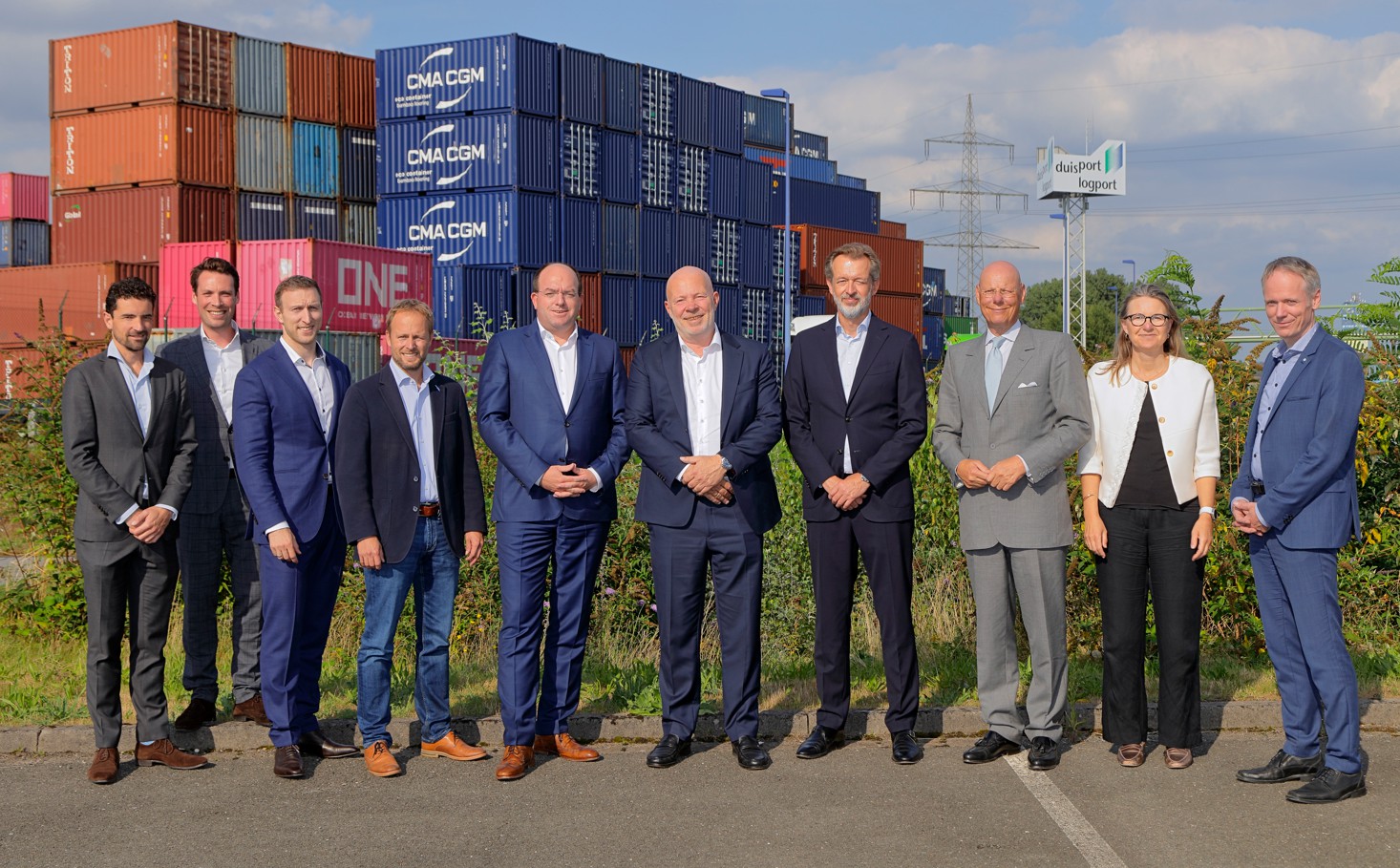
duisport and the Port of Rotterdam announce the next step in their partnership and emphasize their leadership role in developing European hydrogen transport chains. A jointly commissioned feasibility study underscores the importance of both ports in meeting the growing industrial demand for hydrogen and its derivatives, as well as in facilitating communication between politics, industry, and future players in the hydrogen market.
(Duisburg/Rotterdam) OCI Global, the publicly traded Dutch world leader in ammonia, methanol, and hydrogen, is collaborating with both ports to demonstrate that the planned hydrogen corridor between Rotterdam and duisport is already in place and offers good conditions to meet the high demand for low-carbon and renewable hydrogen from the industrial cluster in the Ruhr area.
OCI Global and the Port of Rotterdam already have a long-standing partnership and are working together on a number of initiatives for decarbonization. OCI Global operates the only ammonia import terminal in the Port of Rotterdam and is on track to triple its throughput capacity to meet the rising demand for ammonia as a clean fuel for hard-to-abate sectors such as the steel industry. OCI also operates a methanol import terminal and announced two new partnerships for green methanol in the Port of Rotterdam earlier this year: with Unibarge to develop the world’s first bunker barge powered by OCI HyFuels’ green methanol with dual fuel capability, and with X-Press Feeder Lines to supply green methanol for their newly built dual-fuel methanol ships for joint feeder services. Both projects are set to go into operation next year. Last month, OCI fueled the world’s first container ship powered by green methanol from A.P. Moller – Maersk in the Port of Rotterdam.
The feasibility study highlights that a significant increase in demand for low-carbon hydrogen in North Rhine-Westphalia is expected to exceed 3 million tons per year by 2045. The demand for methanol is also projected to rise significantly, exceeding 2.5 million tons per year. Therefore, duisport and the Port of Rotterdam aim to strengthen their mediation between politics and business to better align supply and demand and accelerate necessary investments and subsidies. They are supported by the hydrogen initiative “Hy.Region.Rhein.Ruhr e.V.,” co-founded by duisport, which the Port of Rotterdam has now also joined.
Contribution to Market Activation and Acceleration of the Energy Transition
To meet the expected demand, suitable areas must be provided, and the corresponding infrastructure must be expanded. The study emphasizes that the first hydrogen pipeline between the two ports should be completed by 2027 to meet the growing demand for green hydrogen in North Rhine-Westphalia in the medium term. Hydrogen derivative pipelines and pipelines for CO2 export are to follow. Inland shipping and rail transport will also remain essential elements to kickstart the hydrogen chains and enable the first imports. According to the study, multiple hydrogen pipelines will ultimately be needed to meet the demand in North Rhine-Westphalia and beyond.
The largest seaport in Europe – the Port of Rotterdam – and the largest inland port in the world – duisport – have been connected for decades through rail, inland shipping, truck, and pipeline connections. The existing collaboration was expanded last year through a memorandum of understanding on digitalization and the energy transition to jointly explore opportunities for transporting green hydrogen, methanol, and ammonia.
Local Hydrogen Production in Duisburg Starting in 2025
Both ports are already taking measures to build the necessary infrastructure to support the hydrogen economy. A key component for a resilient supply to industry is the expansion of storage capacities for hydrogen derivatives in Duisburg. duisport recently announced plans to build a storage facility for tank containers with green energy carriers and a storage facility for liquid renewable fuels and raw materials such as ammonia in the Port of Duisburg. The operation of a first hydrogen electrolysis plant for local production of green hydrogen is planned for mid-2025.
Together with the city of Duisburg and the Essen power plant, the first hydrogen training center in the region is currently being built. From 2025, employees can then be trained for the entire hydrogen value chain to meet the growing demand for skilled workers.
Green Hydrogen from Wind Energy in the North Sea
Several projects for hydrogen import terminals and local hydrogen production have been announced in the Port of Rotterdam, including the expansion of OCI Global’s ammonia terminal and the construction of a 200 MW electrolyzer by Shell. Space has been reserved for several electrolyzers that are to produce green hydrogen from wind energy in the North Sea. The gas transmission system operator Gasunie recently decided to invest in the national hydrogen network, the construction of which will begin in Rotterdam.
Photo: © duisport/krischerfotografie / Image Caption (l.r.): Wouter Demenint (Port of Rotterdam), Koen Jellema (Port of Rotterdam), Alexander Garbar (duisport), Martin Murrack (City Director of Duisburg), Markus Bangen (CEO duisport), Robert Simons (Port Alderman of the Municipality of Rotterdam), Boudewijn Siemons (acting CEO & COO Port of Rotterdam Authority), Werner Schaurte-Küppers (President IHK Niederrhein), Annemarie Houtman (Municipality of Rotterdam), Ocke Hamann (Managing Director IHK Niederrhein)