



Zeitfracht Expands Print-on-Demand Services for Publishers
Apr 19, 2022 at 7:01 PM
Logistikum Switzerland with ReThink Offer for Logistics
Apr 19, 2022 at 7:15 PM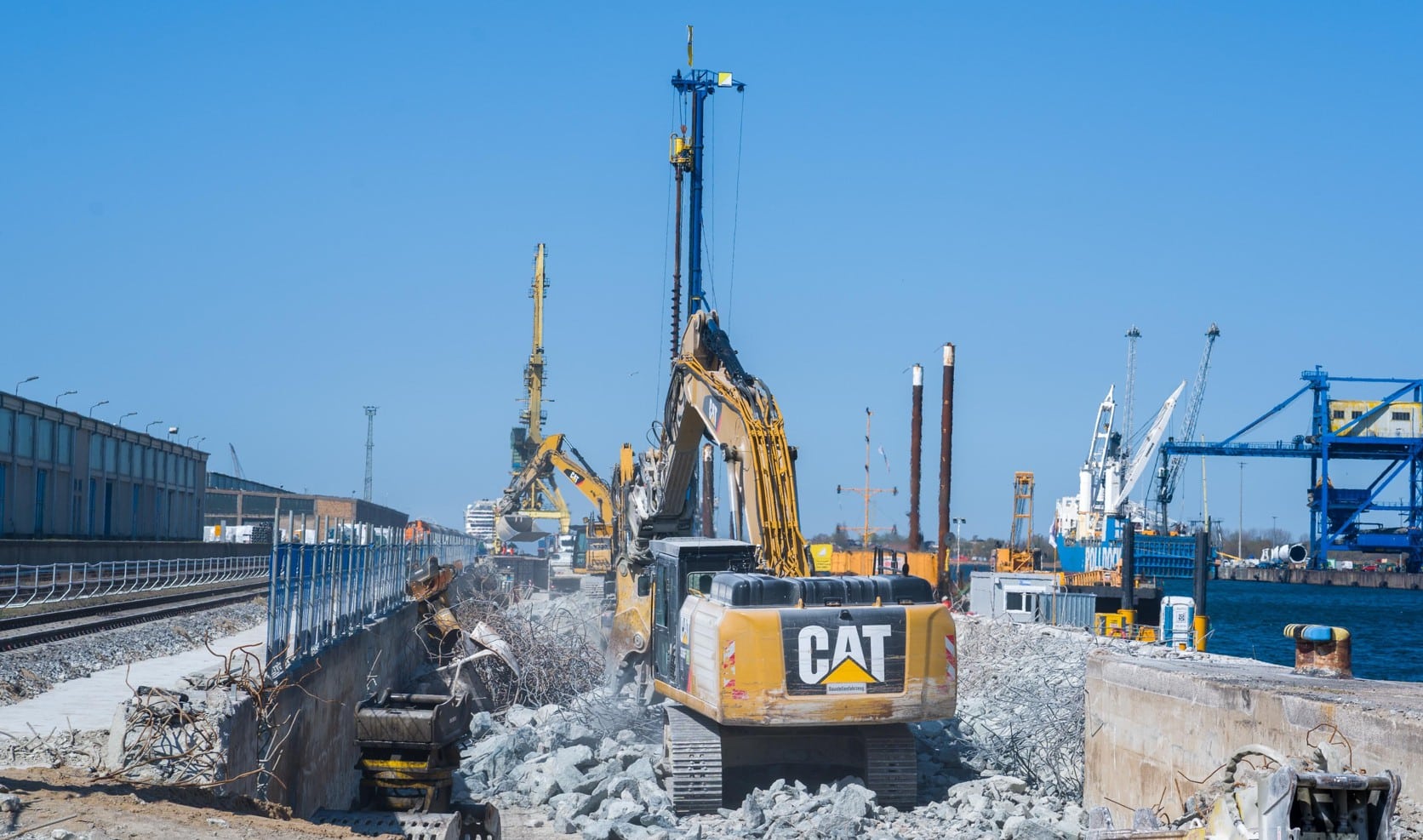
The replacement construction of the two oldest berths in the Rostock Overseas Port, 31 and 32, was officially launched on April 19, 2022, in the presence of the Minister of Economic Affairs of Mecklenburg-Vorpommern, Reinhard Meyer, the Social Senator of the Hanseatic and University City of Rostock, Steffen Bockhahn, as well as the two managing directors of the port operator ROSTOCK PORT, Jens Scharner and Dr. Gernot Tesch.
(Rostock) ROSTOCK PORT GmbH is the client of the approximately 22 million euro port infrastructure project, which is expected to be completed by October 2023.
“The 62 and 58-year-old berths 31 and 32 on the east side of Pier II in the harbor basin B will be newly constructed over a total length of 400 meters, a width of 18 meters, and a water depth of 12.50 meters,” says Jens Scharner, managing director of ROSTOCK PORT GmbH. Approximately 12,000 cubic meters of concrete, fill material, and steel will be demolished and disposed of. With the help of 650 loosening drillings, the new and a total of 3,200-ton heavy steel sheet pile wall will be vibrated in several sections up to 27 meters deep into the harbor floor. 245 piles with a length of up to 37 meters will anchor the new sheet pile wall diagonally into the ground. The quay facility will be designed for a load capacity of five tons per square meter and equipped along its entire length with new crane tracks that can accommodate a load of 30 tons per meter. The construction execution is the responsibility of a joint venture consisting of the construction companies Züblin AG from Rostock and Tiefbau GmbH Unterweser from Oldenburg.
“Berths 31 and 32 will be built as multifunctional berths for the handling of both project cargo and general and bulk goods, where transit calls from cruise ships can also take place in the future,” says ROSTOCK PORT managing director Dr. Gernot Tesch.
First Call on January 15, 1960, Still in the GDR
The GDR holiday ship “Völkerfreundschaft” docked on January 15, 1960, as the first ship at the only completed berth 31 of the still under-construction overseas port. On February 24, 1960, the motor ship “Völkerfreundschaft” set off on its first holiday trip to Romania with selected workers. The ship, formerly MS “Stockholm”, was purchased by the GDR and put into service at the beginning of 1960. In early April 1960, trial operations began at berth 31. The first construction phase of the Rostock Overseas Port was inaugurated on April 30, 1960, in the presence of a government delegation led by Walter Ulbricht. Over 20,000 people attended the port inauguration in Rostock-Petersdorf, where the first lift from the motor ship “Schwerin” was unloaded at berth 31.
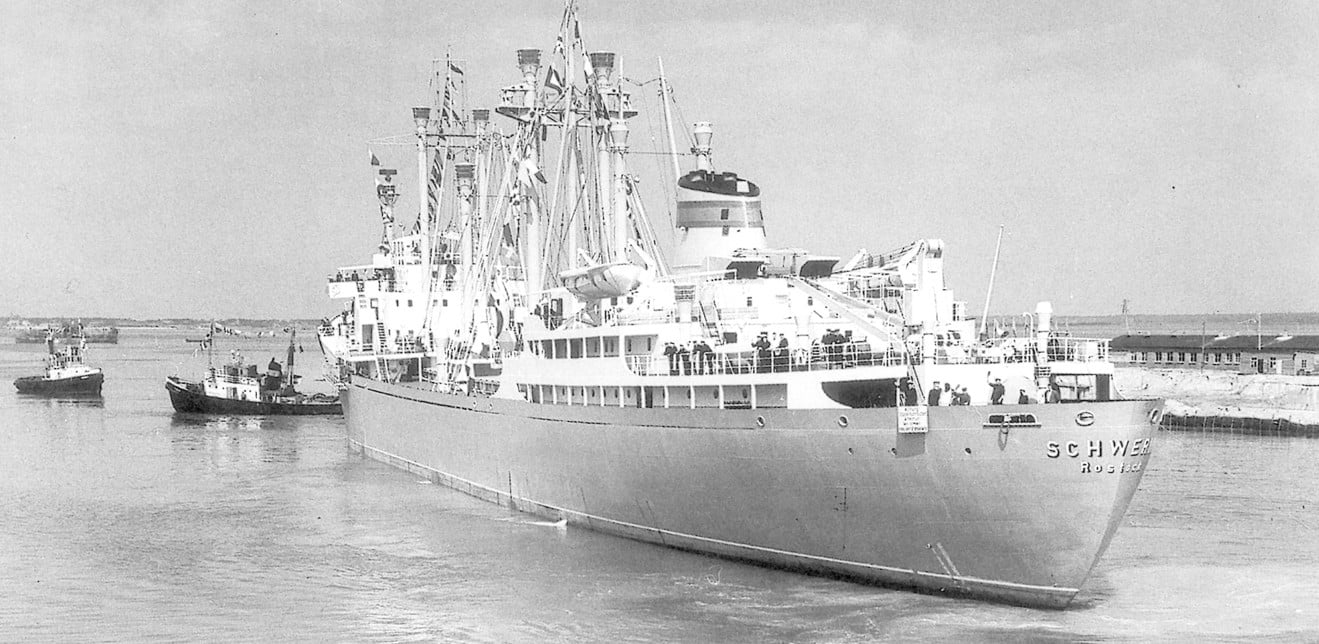
On April 30, 1960, during the port inauguration, the first lift from the motor ship “Schwerin” was unloaded at berth 31.
The ship brought cotton, silk, silver, fruits, and meat from China. The unloading took five days. On the day of the inauguration, the following facilities in the Rostock Overseas Port were operational in addition to berth 31: the quay hall 1, four cranes of the type “Petersdorf”, the port station with shunting tracks, and the connecting tracks to quay hall 1.
Until 1990, mainly general cargo was handled at the quay edges of the two berths. In early 1992, TT and DSR Lines jointly started ferry services from Rostock to Trelleborg at berth 31 under the name TR-Line, before this was moved to berth 66 on Pier I four years later. The ferry company Easy Line operated a Rostock-Gedser service from berth 31 for a short time from 1998 to 1999.
Handling of General and Bulk Goods
At berth 32, the “Rostock Sugar Terminal” was established in the late 1990s using quay hall 1, where until 2006, sugar produced from domestic sugar beets was exported to the Middle East, Africa, and the Baltic States. With the change in the sugar market regulation in the European Union, business operations had to be discontinued. In recent years, the two oldest berths of the overseas port have mainly been used for the handling of general and bulk goods, but also for transit calls from cruise ships that could not dock in Warnemünde due to already occupied berths.
Photos: © Rostock Port