





Logistics Space Platform LogiVisor.com Celebrates One Year
Mar 1, 2022 at 7:19 PM
Schwarzmüller Transports Trailers on the Danube to Passau
Mar 1, 2022 at 7:33 PM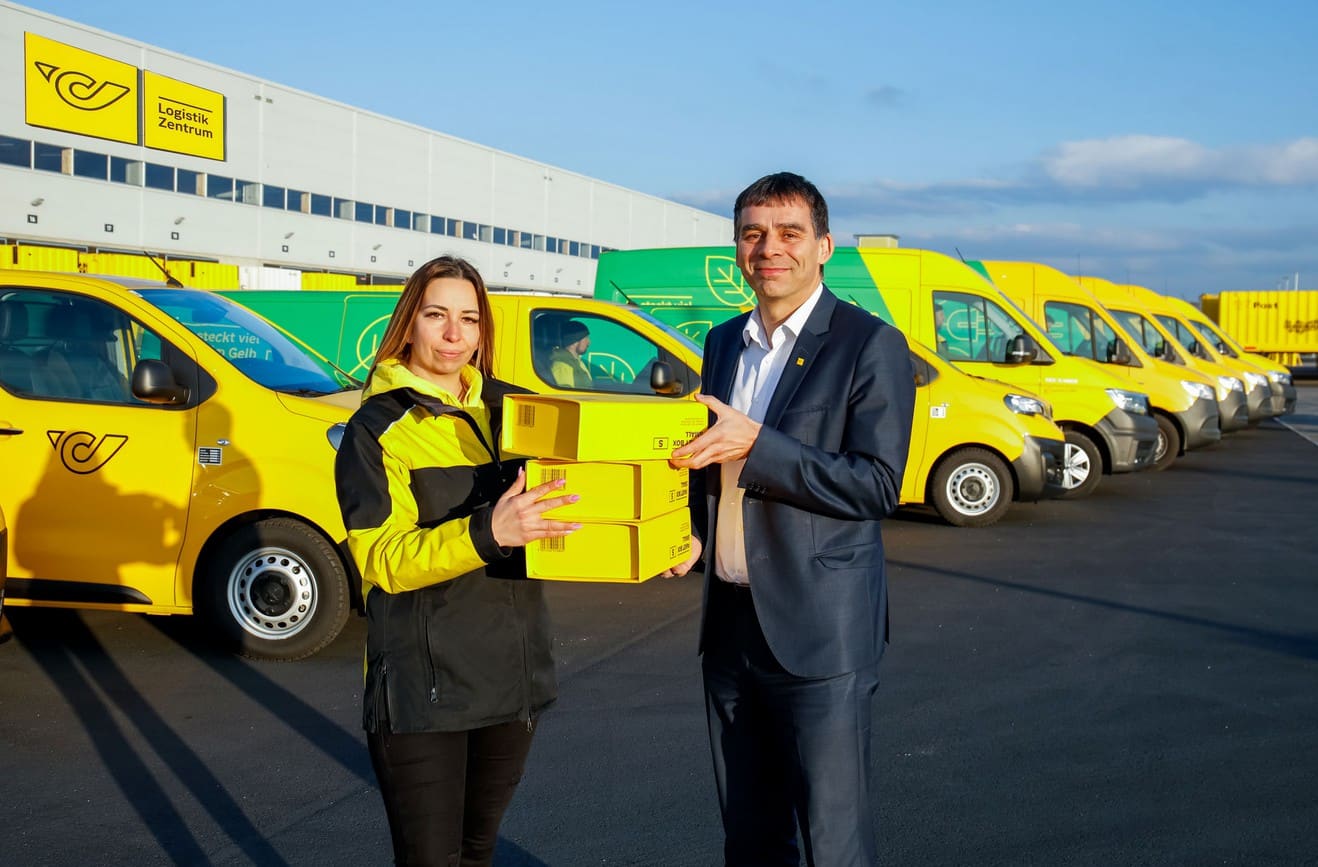
The Austrian Post has set itself the goal of exclusively acquiring E-vehicles for delivery starting in 2023. Due to advancements and developments in the vehicle market, it will achieve this goal significantly earlier: From now on, the leading postal and logistics service provider in the country will only order vehicles with electric drives for delivery.
The fleet of the Austrian Post will grow by an additional 800 E-vehicles this year alone, with up to 1,300 E-vehicles expected to be added next year. The first tranche of the new E-vehicles has now been put into operation.
“From now on, we will no longer acquire vehicles with combustion engines for delivery; instead, we are investing over 80 million euros in E-vehicles and charging infrastructure in 2022 and 2023. The progress and developments in the vehicle market allow us to significantly accelerate the ramp-up of our E-fleet. This commitment solidifies our position as a true pioneer of E-mobility in Austria,” explains DI Peter Umundum, Board Member for Parcel & Logistics, Austrian Post AG.
Largest E-Fleet in Austria
With around 2,500 E-vehicles, including about 1,100 E-bikes, E-cargo bikes, E-mopeds, and E-trikes, as well as nearly 1,400 E-vans, the Austrian Post already operates the largest E-fleet in the country. By 2030, it will deliver all packages, letters, print media, and advertising mail emissions-free throughout Austria.
E-cargo bikes from Draisin and other solutions from manufacturers like Kyburz and Jet Flyer are suitable for smart city logistics in urban areas, while for small trucks with a loading volume of around 4 m³, the Post relies on manufacturers Citroën, Opel, Nissan, and Renault. Larger E-vans with a loading volume of over 11 m³ come from MAN and Mercedes. The E-vehicles now taken over from Peugeot have a loading volume of 6 m³ and a significantly increased range, making them ideal for use in more rural areas. With the vehicle models currently available, the Post is able to operate more than 90 percent of all delivery areas in Austria purely electrically.
Since 2011, the Post’s E-vehicles have not only proven themselves in daily use but are also ideal for stop-and-go operations and are extremely popular among delivery personnel. The lifecycle of an E-vehicle is already more cost-effective for the Post than that of an equivalent vehicle with a combustion engine, and they also have significantly lower wear and energy costs.
Creating 6,000 New Charging Stations
In addition to the number of E-vehicles, the Post is also advancing the expansion of charging infrastructure, with a total of 6,000 additional charging stations needing to be created. All new Post bases will already be equipped with the corresponding charging points as standard, and photovoltaic systems for electricity generation will be prepared for rental properties or constructed as part of their own projects. Only green electricity from Austria will be purchased. The use of smart charging software enables the charging of a large number of vehicles overnight, and intelligent load management means that no increase in connection capacity is required at the same time.
Wear Prognosis for Batteries in Planning
The Post is also considering the entire lifecycle of the E-vehicles and their batteries, and a software-supported monitoring system for the batteries, including wear prognosis, is in planning. With a focus on the second-life use of used vehicle batteries after upgrades, repairs, or recycling, these can also be used as stationary energy storage in the Post bases.
Photo: © Austrian Post / Image Caption: Peter Umundum, Board Member for Parcel & Logistics, received the first tranche of the new E-vehicles at the logistics center in Styria in Kalsdorf. Behind the wheel of the new E-vehicles will also be delivery person Vivien Süle.