




DHL, Shell, and Grundfos Test of Bio-LNG is Promising
Nov 16, 2021 at 6:45 PM
Bühler-Haas Waffle Machines Digitized with ZetesMedea
Nov 17, 2021 at 6:34 PM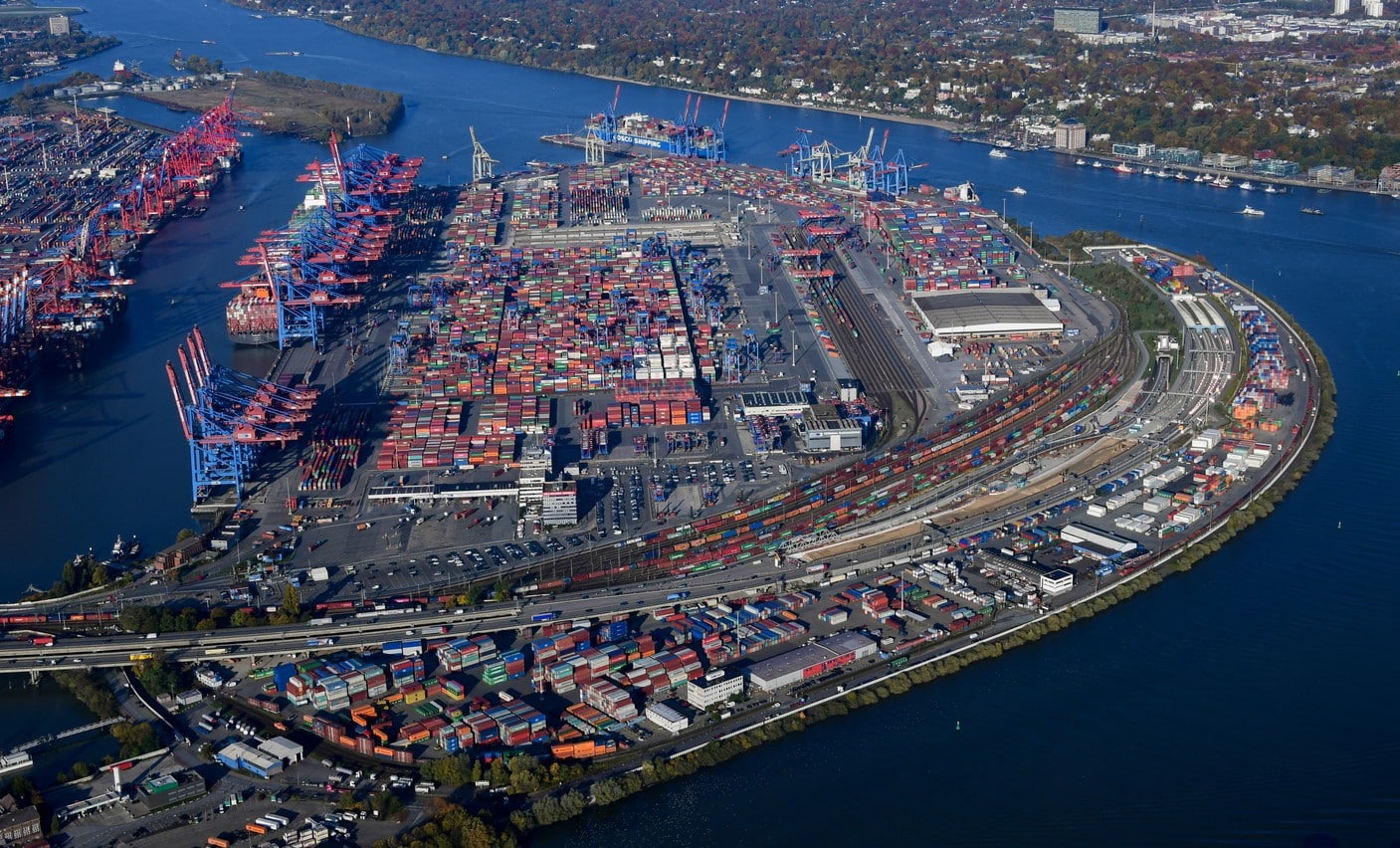
The Port of Hamburg recorded a total of 95.8 million tons in seaport cargo handling in the first nine months of the year, an increase of 2.9 percent. The bulk cargo handling developed particularly strongly, reaching a total of 29.7 million tons, which is an increase of 6.1 percent. The general cargo handling recorded a slight increase of 1.6 percent with a total of 66.1 million tons in the first three quarters.
(Hamburg) The upward trend also continued in container handling. A total of 6.5 million TEU (20-foot standard containers) were handled at the Hamburg container terminals. This corresponds to an increase of 2.4 percent. Despite the positive handling development, the Port of Hamburg has not yet fully recovered from last year’s decline due to COVID-19. Therefore, the executives of Hafen Hamburg Marketing (HHM), Axel Mattern and Ingo Egloff, are particularly pleased that the container transports handled by rail in the Port of Hamburg reached a new record result of 2.1 million TEU. “This corresponds to an increase of 8.3 percent,” emphasizes Egloff. “The third quarter of 2021 was even the strongest quarter in the history of the Hamburg port railway in terms of transported containers, with 709,000 TEU,” adds Mattern. The Port of Hamburg is thus further strengthening its leading position as Europe’s largest railway port.
Seaport Cargo Handling
The handling of containerized general cargo amounted to a total of 65.2 million tons in the first three quarters of 2021. This is an increase of 1.5 percent. Conventional general cargo handling increased significantly again with 908,000 tons (+5.2 percent). In the container handling segment, exports developed stronger than imports, with 3.2 million TEU (+2.9 percent) exported. In this segment, 3.3 million TEU (+1.9 percent) were handled. The growth in the handling of loaded containers, which contribute more to value creation in the port than empty containers, was above average at 3.2 percent (a total of 5.8 million TEU). In contrast, the handling of empty containers saw a decline of 3.2 percent compared to the previous year, with 731,000 TEU.
Mattern points out that among the main shipping areas of the Port of Hamburg, all other container shipping areas, except for Australia/Pacific (-0.1 percent), recorded positive handling developments: America (+6.7 percent), Asia (+1.4 percent), Africa (+4.5 percent), and Europe (+1.6 percent).
For the liner services calling at Hamburg, the initial approval of the fairway adjustment brought more draft and better meeting opportunities on the Elbe. This particularly benefited the large number of container ships calling at Hamburg. In the first three quarters, the number of Megamax container ships in Hamburg increased. A total of 163 calls of these particularly large container ships with a slot capacity of 18,000 TEU or more were handled in Hamburg. This is an increase of 19.9 percent. “With the implementation of the fairway adjustment of the Elbe, we are already offering larger ships improved calling conditions. With the final approval expected in the next six months, we will then be in a significantly better position compared to competing ports,” says Egloff.
The growth in bulk cargo handling is primarily due to the strong development in the grab cargo segment. Particularly, imports of ore and coal led to a handling result of 16.3 million tons (+17.8 percent) in this area. The handling of liquid cargo remained stable at 8.7 million tons (+0.9 percent). In the suction cargo segment, the handling of grains and oilseeds with 4.7 million tons (-15.1 percent) fell below the strong previous year’s result.
The Top 10 Partner Countries in Seaport Container Handling
In the container handling of the ten most important partner countries in the container handling of the Port of Hamburg, the development varied. In seaport container handling with China, Hamburg’s by far strongest partner country in container handling, an increase of 6.4 percent was achieved with 1.9 million TEU. The handling volume in container traffic with the USA, still Hamburg’s No. 2, remained on a record course with 459,000 TEU (+4.5 percent). Other countries among the top 10 with positive container handling developments in the first nine months were Sweden (+9.9 percent), Poland (+18.8 percent), Brazil (+6.7 percent), and Denmark (+4.5 percent). “The upward trend in seaport container handling, already visible in the first half of the year, continued in the third quarter,” says Mattern, noting that the countries following in the ranking, India (+21.3 percent), Canada (+17.8 percent), and Turkey (+7.8 percent), also showed significant growth in the first nine months.
Further Outlook for 2021
Global transport chains will remain volatile for the rest of the year. “Delayed ship arrivals and associated delivery delays are also burdening the ports. At the interface of land and sea transport, the problems of disrupted supply chains will continue to be visible. Even at the Hamburg terminals, despite 24/7 service, the processing situation remains tense,” says Mattern. Egloff adds: “Large parts of the industry have been suffering from supply shortages since the beginning of the year. This leads to reduced production despite full order books.”
The ifo Institute estimates the value creation losses in the German industry caused by supply shortages so far at nearly 40 billion euros. For the fourth quarter of 2021, the ifo Institute now expects only 0.5 percent growth instead of the previously estimated 1.3 percent. According to the marketing organization of the Port of Hamburg, a slight upward trend in seaport cargo handling is expected to continue in the fourth quarter despite the current situation. A handling result of around 130 million tons and 8.7 million TEU is still achievable for the Port of Hamburg in 2021.
Photo: © Hafen Hamburg