



Sachsenland Opens New Location at Leipzig/Halle Airport
Sep 13, 2021 at 7:53 PMThomas Bissels is the new Country Manager for Austria at LetMeShip
Sep 14, 2021 at 5:35 PMThe Network of European Railways (NEE) criticizes the plans of the Federal Ministry of Transport and Digital Infrastructure (BMVI) for a new e-highway in Bavaria. The network calls on the federal government to abandon the electrification of long-distance road freight transport and to focus on rail.
(Berlin) Last week, the BMVI presented its plans for a new e-highway in Bavaria, where overhead lines and electrically operated trucks are to be tested. Three railway lines, which are already electrified and could take on freight transport, run alongside it. Freight railways are urging the federal government to abandon its misguided plans for the electrification of road freight transport.
The presentation of the first three innovation clusters for climate-friendly road freight transport by the Federal Ministry of Transport is nothing more than a smokescreen for the railways in light of the significant challenge posed by the transport transition. “The most climate- and environmentally friendly mode of transport for long-distance freight transport is and remains the rail, which is already operated electrically by more than 90%. For years, we have been appealing for significantly more investment in rail freight transport to shift goods onto the rail. Instead of expanding the railways so that more goods can be transported on them, overhead lines are being built on the road. The detours and contortions that the transport minister is making to funnel money to the road are grotesque,” comments Ludolf Kerkeling, Chairman of the Network of European Railways. For the foreseeable future, transports over 250 kilometers by truck must remain the exception. Logistics chains need the rail as a backbone, while trucks operate regionally in the pre- and post-haulage – and that with climate-friendly drives.
Absurdity of the new test track
The absurdity is particularly evident on the new test track along the A9 from Munich to Nuremberg, where a platooning project, i.e., trips by interconnected trucks, revealed sobering results in 2018: Three railway lines run here, on which a single freight train could replace 52 trucks, yet funding for the expansion has long been awaited in some sections in vain. Kerkeling: “Instead, politics is diligently weaving the fantasy of the overhead line truck. It is not justifiable to taxpayers that expensive road construction projects are being undertaken that will delay the transport transition for years and are therefore irrelevant to our climate protection goals. Instead, we should achieve the goals with the obvious, yet seemingly too unspectacular solution of the railway as the main player in long-distance freight transport,” says Kerkeling.
Another factor that is often overlooked in the discussion is the fact that the expected volume of goods will continue to rise in the coming years. The BMVI expects an increase in freight transport performance of 38% between 2010 and 2030. Since a redirection of policy is not taking place, even more vehicles will be on the roads. “No one knows where all the trucks are supposed to go. New roads are not an issue in light of our climate protection goals and are largely rejected by the population as an infrastructure measure. The transport minister is watching as we head towards a traffic collapse,” criticizes Kerkeling.
Population rejects subsidies
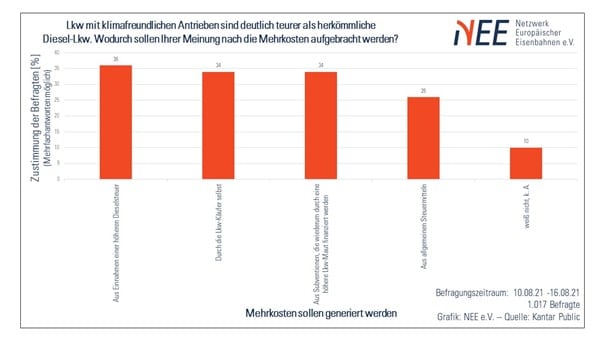
A survey of the population regarding costs for alternative truck drives shows a clear trend, as the graphic illustrates: In a survey commissioned by the NEE from the Kantar Institute, most respondents expressed that the costs for climate-friendly drives should be financed by the industry itself, while the subsidization of retrofitting from general tax revenues received the least support. “Even though the BMVI avoids calculating what their ideas on overhead line trucks would cost us: People have a sense that this will be expensive for us and that financing from the general tax pot would severely burden fairness in intermodal competition.”
Kerkeling concludes: “Politics must now show what it wants to focus on: a proven system that has been in place for several decades, whose actors are ready to quickly bring more goods onto the rail, or expensive experiments that will push our efforts for more climate protection into the future for years.”
Photo: © Loginfo24/Adobe Stock
Graphic: © NEE