



Prologis and GIC establish Joint Venture
Mar 23, 2026 at 2:35 PM
Maersk opens automated distribution center
Mar 23, 2026 at 4:06 PM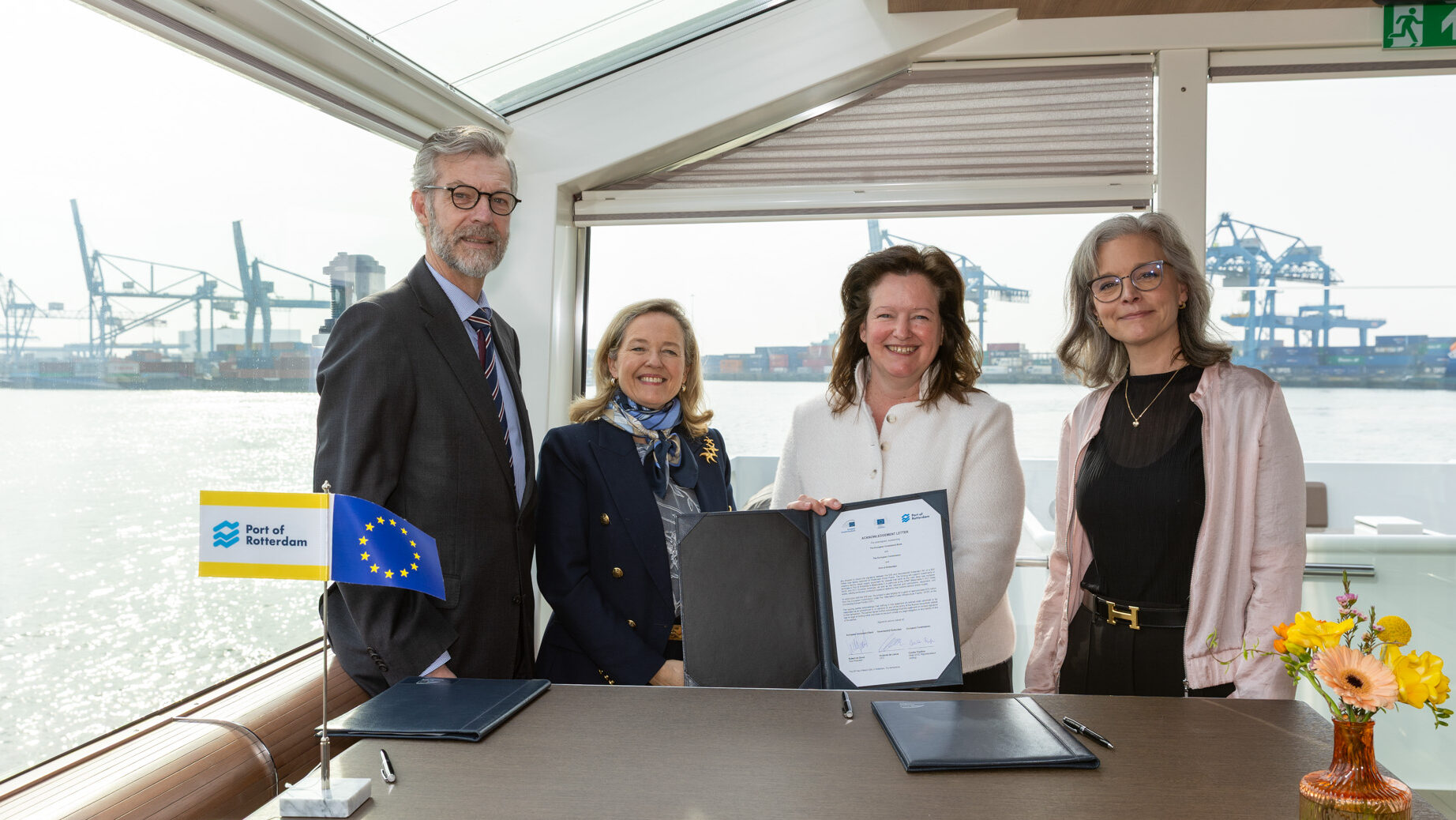
The Port Authority of Rotterdam is receiving a loan of EUR 90 million from the European Investment Bank (EIB) for the installation of shore power facilities at three container terminals in the Port of Rotterdam. This project is supported by a grant from the European Commission under the Connecting Europe Facility (CEF) for alternative fuels in the transport sector. The aim is to connect large container ships to the shore power grid to reduce the use of fossil fuels for onboard electricity generation.
The financing from the EIB will be used for the Rotterdam Shore Power project, a joint initiative of the Port Authority of Rotterdam and the company Eneco. In addition to the installation of shore power supply, Rotterdam Shore Power will also be responsible for providing grid connections, cabling, as well as other construction and earthworks. A total of eight kilometers of quay will be equipped with shore power, with 35 connection points for seagoing vessels being established.
In addition to the EIB loan, the project is eligible for a grant from the European Commission of approximately EUR 70 million under the Alternative Fuels Infrastructure Facility (AFIF) of the Connecting Europe Facility.
EIB Vice President Robert de Groot emphasized the importance of the project for reducing dependence on fossil fuels: “Rotterdam is Europe’s most important port and remains innovative to stay at the forefront. Connecting large container ships to shore power is a crucial step in reducing our reliance on fossil fuels. This benefits not only the environment, air quality, and public health but also our economy, as it will help Europe become less dependent on energy from afar.”
The Port Authority of Rotterdam aims to operate climate-neutral by 2050. Vivienne de Leeuw (2nd from right), CFO of the Port Authority, stated: “Shore power plays a crucial role in the energy transition. Investments like these are essential to achieve our climate goals and strengthen the port’s role as a sustainable, future-proof container hub in Northwest Europe.”
Cecilia Thorfinn (right), acting head of the EU Commission’s representation in the Netherlands, pointed out the need for sustainable transport solutions: “The current geopolitical context forces Europe to make critical decisions to remain competitive and become energy independent. For the Port of Rotterdam, as the largest port in Europe, sustainable transport is crucial for maintaining connections.”
The financing from the EIB, represented by President Nadia Calviño (2nd from left), and the EU grant directly support the ambitions to equip the European transport network with infrastructure for electric mobility. Currently, large container ships still rely on engines or fossil fuel generators to power onboard electrical systems, which not only produces CO₂ emissions but also causes noise pollution and particulate emissions. The commissioning of the shore power facilities is planned for the second half of 2028.