


TGW Logistics Concludes Fiscal Year with Record Values
Oct 25, 2025 at 4:21 PM
Defying Customs Chaos with Variable Supply Chains
Oct 25, 2025 at 6:00 PM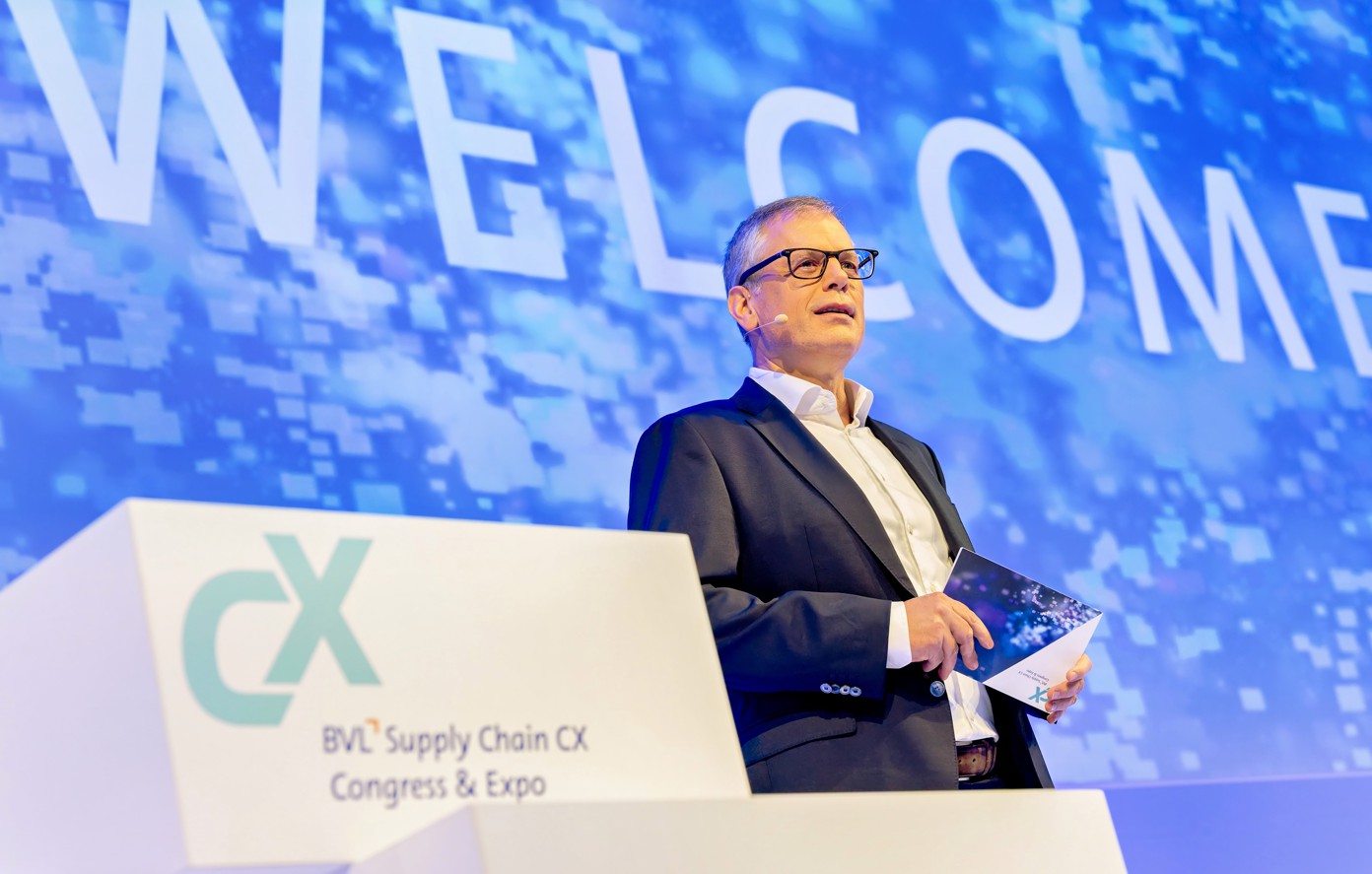
The BVL Supply Chain CX 2025 concluded on Friday in Berlin with a strong program, high-profile speakers, and intense discussions. Around 2,300 participants gathered at the Estrel Congress Center for the leading event in logistics and supply chain management to discuss the future of the industry, technological developments, and economic perspectives. Over 220 speakers and 120 exhibitors offered a wide range of topics, from artificial intelligence to sustainability and geopolitical challenges.
(Bremen/Berlin) The Supply Chain CX has concluded its second edition in a new format. The event combined a professional congress, expo, and networking into a unique format. At the Estrel Congress Center in Berlin, leading representatives from business, science, and politics provided new perspectives on shaping global supply chains.
Among the top speakers were Petra Scharner-Wolff, Chairwoman of the Otto Group, Jens H. Lund, Group CEO of DSV, Major General Jochen Deuer (Bundeswehr), Arthur Valdez (formerly Amazon, Starbucks, and Target), Ilse Henne (ThyssenKrupp AG), Achim Puchert (Mercedes-Benz Trucks), Nadine Despineux (Jungheinrich), Sebastian Peters (Airbus Operations), Prof. Dr.-Ing. Alice Kirchheim (Fraunhofer IML), and Ashwin Bhat, CEO of Lufthansa Cargo.
In addition to expert contributions, exchange and cooperation were the focus. The CX networking concept offered numerous opportunities: moderated connect tables, meetings for young professionals, and the format Ladies in Logistics. The BVL Events app facilitated targeted networking through matchmaking functions, a service that was heavily utilized by participants.
A special highlight was the ceremonial awarding of the German Logistics Prize on Wednesday evening, followed by the popular Networking Night. The grand CX party in the expo area marked the emotional and inspiring conclusion of an event that once again showcased the innovative strength and diversity of the industry.
“Logistics Next Level” by Strauss Work Wins the German Logistics Prize
The German Logistics Prize 2025 was awarded to the workwear brand Strauss for its project “Logistics Next Level”. At its headquarters in Biebergemünd, the aging logistics center was comprehensively revitalized during ongoing operations – with remarkable results: 26,000 tons of CO₂ savings compared to a new building, halved throughput times, 80% fewer errors, and 98% customer satisfaction.
COO Matthias Fischer explains: “We wanted to not just renew our logistics but revolutionize it.” The renovation was fully financed from internal funds (55 million euros) and allows for a doubling of shipping capacity while reducing unit costs. Social aspects also convinced the jury: the workforce was closely involved, and the weekly working hours could be reduced to 37.5 hours with full wage compensation.
The combination of a brownfield approach, modern automation, ecological responsibility, and active employee participation is considered exemplary. The project provides a robust blueprint for companies looking to develop future-proof logistics structures under cost pressure and space constraints.
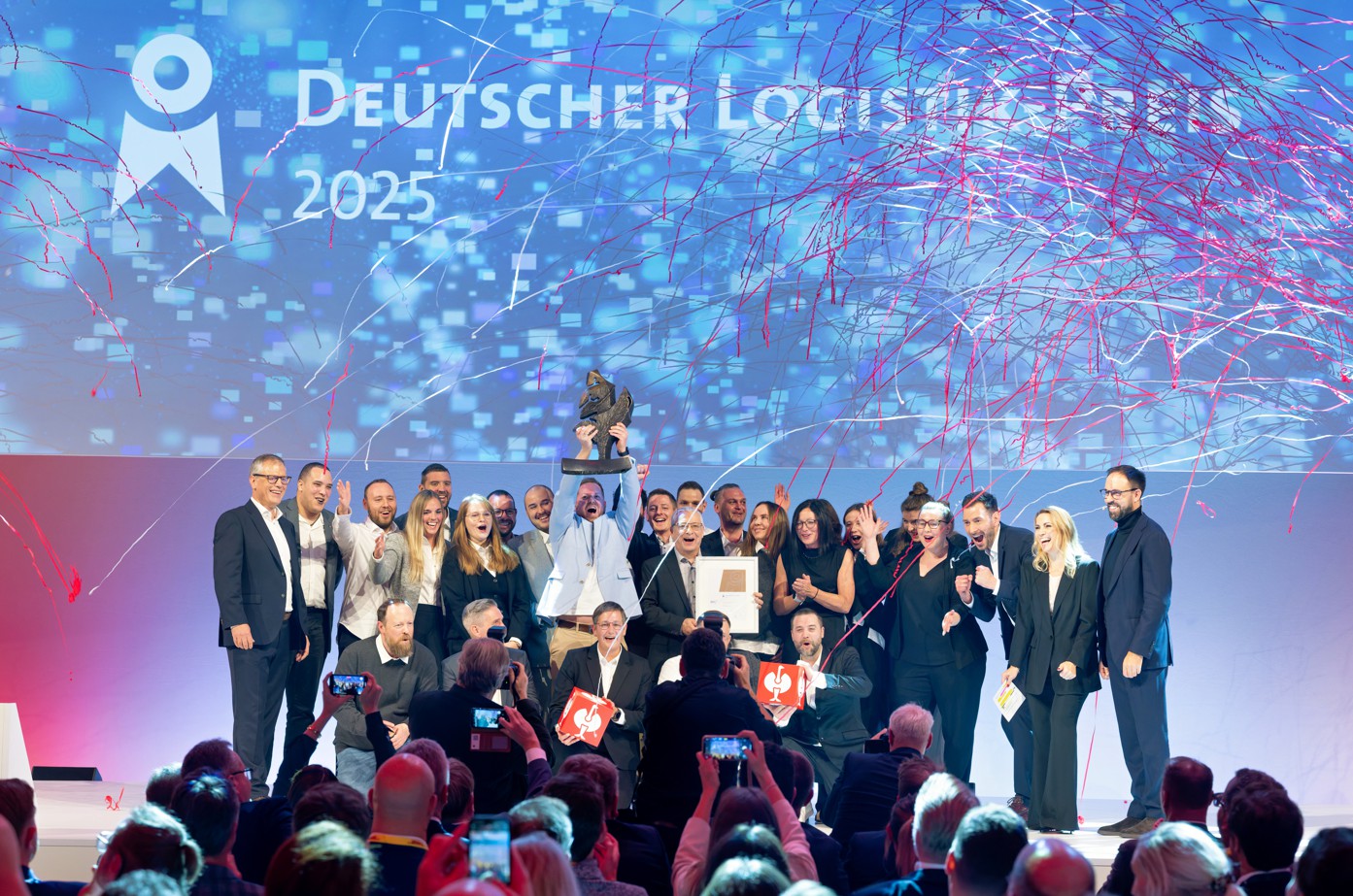
The employees of Strauss celebrate winning the German Logistics Prize. COO Matthias Fischer (center) holds the victory certificate
Finalists Siemens and Tchibo
In addition to Strauss, Siemens and Tchibo impressed with innovative concepts. Siemens created a smart, scalable, and sustainable solution based on artificial intelligence at the Logistics Center Erlangen. Four AI-based systems – from automatic box size determination to autonomous robot picking – enabled seamless automation. The new pick-and-pack line increased productivity by 124%, and the shipping line even by 300%. “Today, the entire process from material handling to shipping preparation is automated,” said Dr. Ekine Aristizabal, Head of Logistics Center Erlangen. The jury and auditors recognized the consistent integration of modern technologies into ongoing operations as an outstanding example of digital transformation.
Tchibo, on the other hand, made a strong statement for circular logistics with “The Power within Returns”. At the Cheb (Czech Republic) location, an automated system was developed that processes around 850,000 returns per week. 27% of the items flow directly back into new orders, and 55% are available in the webshop again within 30 minutes – a total of 96% of returns can be reused. “For us, returns are not an end but the beginning of a new product cycle,” said Laura Andersch, Head of SCM Reverse Logistics at Tchibo.
Logistics Remains the Third Largest Economic Sector
The event also drew clear economic lines. Kai Althoff, Chairman of the BVL and CEO of 4flow, presented current figures: With an economic output of 335 billion euros, logistics remains the third-largest economic sector in Germany after trade and the automotive industry. It represents around 8% of the total economic output and about a quarter of the European logistics market.
The new Top100 study from Heilbronn University, led by Prof. Martin Schwemmer, which will be published in November, shows a nominal increase of 2.6% for 2024 compared to the previous year. At the same time, the number of employees fell by about 60,000 to 3.35 million, representing a decline of 1.8%.
The so-called “Logistics Experts” led by Prof. Christian Kille (TH Würzburg-Schweinfurt) predict stagnation in economic output between 337.7 and 338.7 billion euros for 2025. They expect only a slight recovery to up to 349.5 billion euros in 2026. This results in a real decline of up to 0.8% for 2025 before a slight growth could begin in 2026. Althoff commented: “The middle scenario seems most likely – a sideways movement in 2025, followed by moderate growth in 2026. A real turnaround is not expected until then.” The BVL logistics indicator, created in collaboration with the ifo Institute, signals a slight recovery but not yet a sustainable upswing.
Industry Demands Stronger Political Support
The BVL officials found clear words for politics. In the new study “Trends and Strategies in Logistics and Supply Chain Management”, only 6% of companies state that their interests are adequately represented politically. 60% explicitly disagree, and 34% are undecided – a clear wake-up call to decision-makers. Althoff: “How Germany develops economically depends not only on geopolitical factors but also on German and European politics. Logistics is a central indicator for the overall economy – yet it is often overlooked politically.”
According to the study, the most urgent areas for action include infrastructure, reducing bureaucracy, digitization, energy transition, skilled labor shortages, and global trade. Many of these topics are anchored in the coalition agreement but have only been partially implemented so far.
“We see positive approaches – such as the special fund for infrastructure, which opens urgently needed investment opportunities,” Althoff continued. “But decisive steps are still lacking in electricity prices and skilled labor migration. The framework is there; now it needs implementation – quickly, consistently, and with foresight.”
Industry is Resilient
The BVL Supply Chain CX 2025 demonstrated how diverse and resilient the industry is – from technological excellence to sustainable innovations to societal dialogue. Berlin once again became a showcase for logistics – and a place where it became clear that future viability is not just a buzzword but the result of collaboration, courage, and strategic foresight.
BVL Supply Chain CX 2026 will take place from October 21 to 23 at Estrel Berlin
Photos: © BVL / Caption for the cover image: Kai Althoff, Chairman of the BVL, welcomes guests to the BVL Supply Chain CX