



Job and Career are Topics at the Transport Logistic
Apr 15, 2025 at 3:41 PM
Craiss Opens Locations in Augsburg and Munich
Apr 22, 2025 at 7:11 PM
The topic of 3D printing has a lot of potential in connection with logistics. The issue of supply chain blockades has eased somewhat after Corona, but has flared up again due to the blockade by Houthi rebels at the Gulf of Aden, the entrance to the Suez Canal. Wars and now also trade wars keep the topic current. Therefore, the Logismedia Group, which includes Loginfo24, is hosting a specialist forum at transport logistic in Munich titled: “3D Printing and its Impact on Global Transport”
By: Andreas Müller
(Basel) The industrial revolution through 3D printing technologies is gaining momentum. What was once primarily used in the field of prototype development has long since found its way into series production. In industries such as aerospace, medical technology, or mechanical engineering, additive manufacturing is already an integral part of modern production processes. This development does not come without consequences for international logistics – because if products can be manufactured directly where they are needed, the question arises: What role does transport across continents still play?
The basic idea of 3D printing is simple yet revolutionary: Instead of transporting physical goods around the globe, digital blueprints can be sent, which are then transformed on-site, for example, in a regional printing center, into the desired product. This decentralization of manufacturing means that many transports, as they are still common today – for spare parts, small components, or individual components – could potentially be eliminated. Especially in air and sea freight, this could lead to a decline in the quantities transported in the medium term.
But is 3D printing a threat to the logistics industry? Not necessarily. Rather, new and interesting business fields are opening up for logistics service providers. Some large companies have already recognized the potential and begun operating their own 3D printing centers. There, for example, spare parts are produced on demand and delivered directly to the end customer. This connection of production and logistics in one place not only creates efficiency but also entirely new services – such as in spare parts logistics, where time plays a crucial role.
Customized Production
Exciting perspectives are also emerging in e-commerce. Products that are individually tailored – whether in design, size, or function – can be customized before shipping. However, the interplay between online ordering, digital production orders, and fast delivery requires a sophisticated infrastructure. Logistics service providers that not only transport but also take over parts of the value creation could play a central role here.
However, a deep understanding of the technology and its possibilities is a prerequisite. Those logistics companies that want to become active in the field of additive manufacturing need expertise in materials science, printing processes, and data management. Additionally, the IT infrastructure is crucial: The secure transmission and management of digital print files, compliance with licensing rights, and integration into existing ERP and tracking systems pose high demands.
New Concepts for Warehousing and Transport Planning
The logistics landscape is also changing spatially. While central warehouses with connected distribution used to form the backbone of supply chains, increasingly decentralized hubs – so-called micro-hubs – are now emerging, where production and shipping take place. These locations require new concepts for warehousing, quality assurance, and transport planning.
Interestingly, this also shifts the focus within logistics. While cross-border transport may decrease in certain areas, local and urban delivery – especially on the last mile – continues to gain importance. The ability to deliver quickly and efficiently in the shortest time becomes a competitive advantage. Particularly in combination with local 3D printing, this can lead to a real differentiation.
Integral Partners of a New Production Logistics
Ultimately, the logistics industry is not facing a loss of significance but rather a transformation of its tasks. Companies that recognize and actively shape this change early on have the chance to position themselves not just as pure transport service providers but as integral partners of a new production logic. The key to success lies in the willingness to embrace new technologies, forge strategic partnerships, and further develop their service portfolio.
Another chapter is the procurement of raw materials. With paper, as with previous printers, it doesn’t work; it requires so-called filaments. Wikipedia describes this as: “3D printing filament, or filament for short, is a wire-like material that serves as the raw material for Fused Deposition Modeling in 3D printers. The filament typically consists of a thermoplastic plastic that is wound into a continuous strand on a spool.” Of course, the raw material must also be produced and delivered to the manufacturer or service provider.
Specialist Forum at transport logistic
The topic is complex, and many questions remain unanswered. Therefore, the Logismedia Group AG, which includes Loginfo24, is hosting a specialist forum on the occasion of the transport logistic fair, which takes place from June 2nd to 5th in Munich. Here are the details:
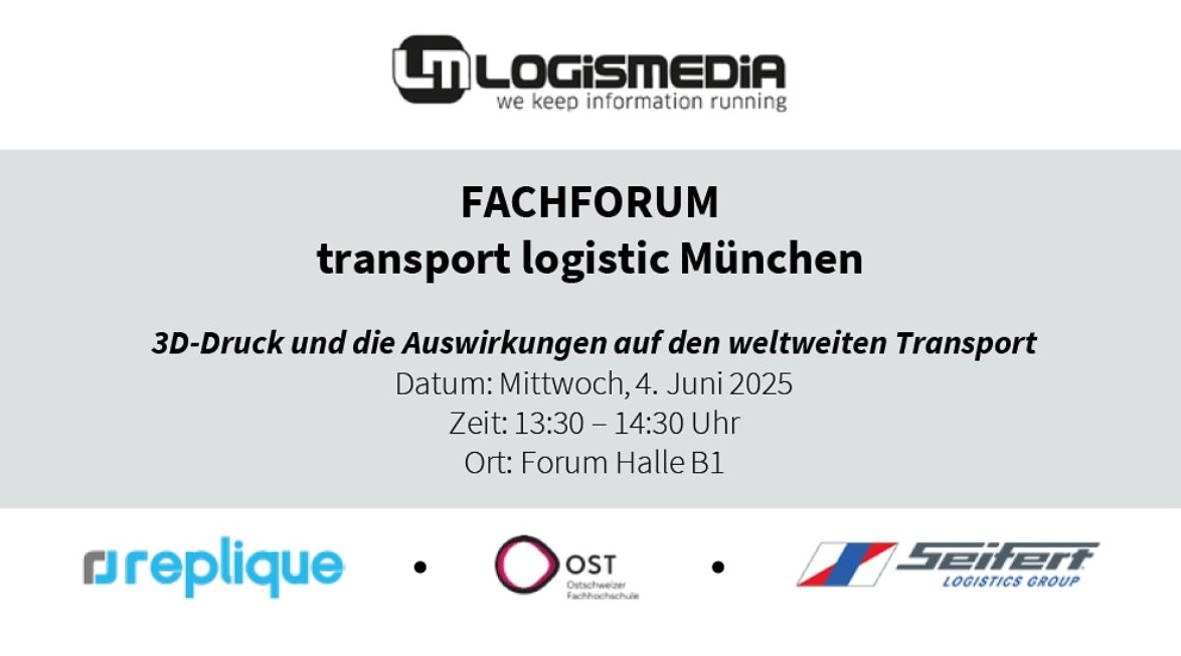 Speakers are:
- Dr. Max Siebert, Replique
- Dr. Fabian Frommer, Seifert Logistics
- Dr. Katrin Oettmeier, OST Ostschweizer Fachhochschule
For visitors to the fair, this forum is freely accessible.
Further Information:
On LinkedIn
On the Loginfo24 website (including presentation for download)
In the conference program of transport logistic
Photo: © Loginfo24