


Fiege Celebrates Topping-Out Ceremony for Multi-User Logistics Center in Borna
Mar 27, 2025 at 7:38 PM
DB Cargo Remains the Problem Child of DB After Schenker Sale
Mar 27, 2025 at 8:27 PM
How many hall roofs in Germany are already equipped with solar systems? The conclusion of the survey conducted by Fraunhofer IIS in project partnership with the “Power of Logistics” initiative of the logistics real estate working group of the Federal Association of Logistics e.V. as well as ECO MONDIA Green Technology Europe GmbH and hep global GmbH: There is still plenty of capacity for the energy transition, as around 80 percent of German commercial and logistics property roofs are free of PV.
(Bremen) A total of 120,150 commercial halls[1] were classified using automatic image recognition through a trained neural network and analyzed according to their size category and regional distribution[2]. The result: Over 19 percent of the halls are equipped with PV – for logistics properties, the share is just below 18 percent. Among these more than 23,400 commercial buildings with roof PV systems, differences are evident in size classes as well as regional distribution. However, commercial and logistics properties also show differences.
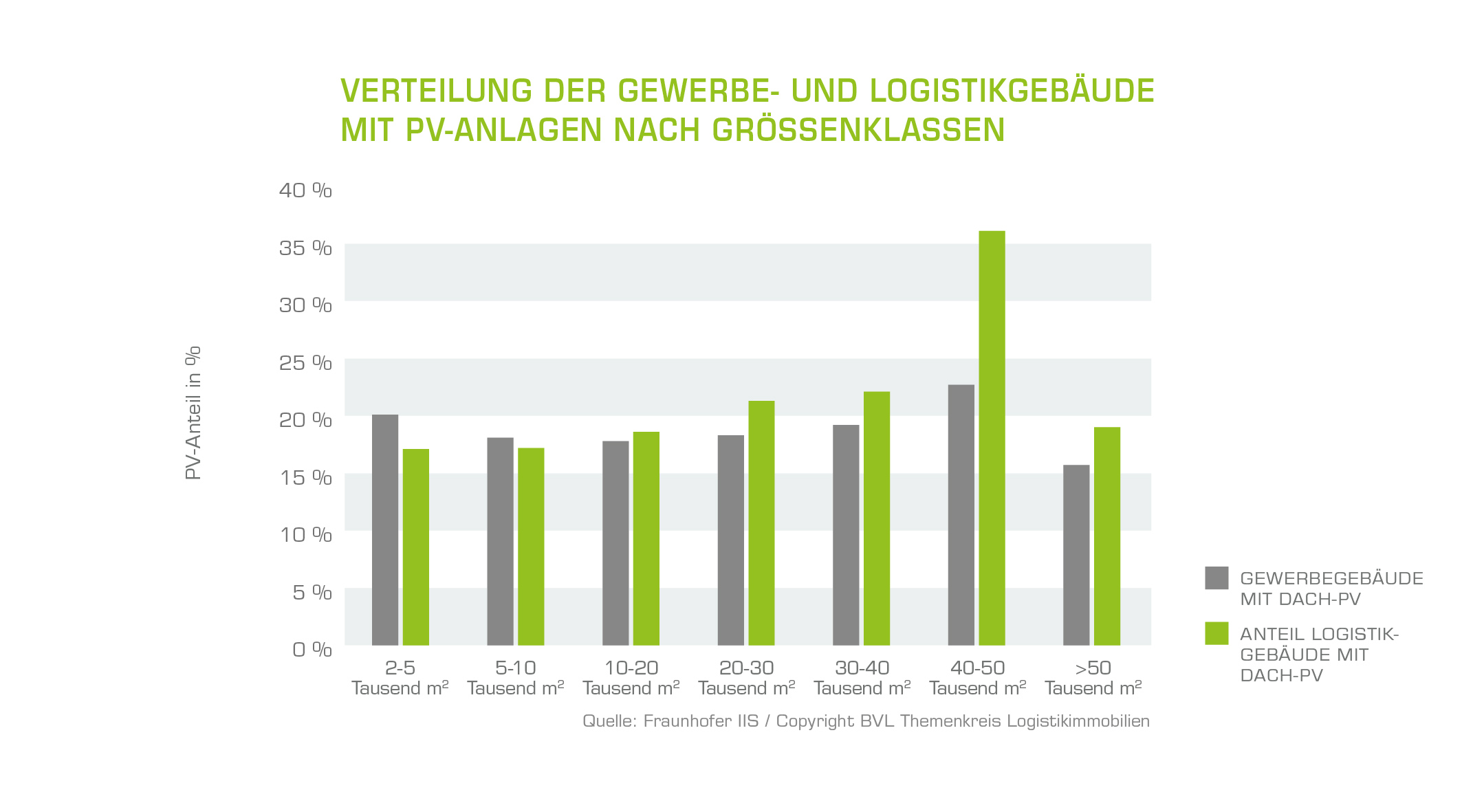
Hall roofs of 40,000 – 50,000 square meters most commonly equipped with PV
Commercial properties in the size range of 40,000 to 50,000 square meters have the highest solar coverage at almost 23 percent. Properties between 2,000 and 5,000 square meters make up the second strongest size class with over 20 percent. It is striking that large commercial properties over 50,000 square meters still hold significant potential, as just over 84 percent of the hall roofs are without PV systems.
For logistics properties, the PV coverage in the size range of 40,000 to 50,000 square meters is already the highest at around 36 percent overall. There is also enormous potential in big box logistics properties over 50,000 square meters, as around 81 percent of the roofs are without solar systems.
“In terms of solar energy, the ESG potentials for logistics and industrial properties are far from being exhausted. Even if a PV installation on an existing property is not always possible or economically sensible for static or energy reasons – with around 80 percent of free roof areas, I wonder why this immense potential remains untapped. Perhaps the complexity of the projects is also discouraging, alongside the lack of grid capacities,” says Kuno Neumeier, spokesperson for the logistics real estate working group of the BVL and CEO of the Logivest Group, who launched the “Power of Logistics” initiative in 2022.
Tilo Nahrath, spokesperson for the initiative and managing director of RE.source Projects, adds: “We have noticed that a lot has happened in the past two years, and the roof PV system has become standard in new logistics properties. For this trend to continue and to tap into the dormant potential of the 80 percent of unoccupied areas, many framework conditions need to be improved. This includes the new government maintaining the already established course and particularly expanding grid capacities and reducing bureaucratic hurdles.”
 Baden-Württemberg and Bavaria lead in PV coverage
As expected, there is significantly more photovoltaic on commercial roofs in southern and western Germany than in the north and east of the country. The most solar systems on the roofs of commercial halls can be found in Baden-Württemberg, with a share of over 26 percent, closely followed by Bavaria with almost 24 percent. The last places are occupied by the city-states of Hamburg with just over five percent PV coverage and Berlin with just over eight percent. This is also due to natural location factors, as the sun shines more in the south than in the windy north, but when broken down to the level of cities and districts, it becomes clear that local and infrastructural conditions also play a role. For example, the Bavarian district of Straubing-Bogen has the highest PV coverage on commercial hall roofs in Germany at around 50 percent, closely followed by the district of Landau in Rhineland-Palatinate with almost 48 percent. The frontrunner Baden-Württemberg ranks third in the district ranking with just under 43 percent in Biberach, while the fewest PV installations, with only around three percent, can be found in the district of Görlitz in Saxony.
Since the end of January, the Solar Peak Law has been in effect
“The energy supply of tomorrow is decentralized, digital, and transparent. Since the end of January, the Solar Peak Law has also been in effect, which mandates both the remote control of the systems and the use of intelligent measuring systems. However, in many halls, we still see a need for optimization, as comprehensive consumption data collection is lacking in many places. This data is the basis for efficiently utilizing the green energy generated, applying it for heating/cooling and e-mobility, and feeding the excess energy into the grid and trading it,” says Richard Schneider, spokesperson for the “Power of Logistics” initiative and managing director of fabrikon GmbH.
[1]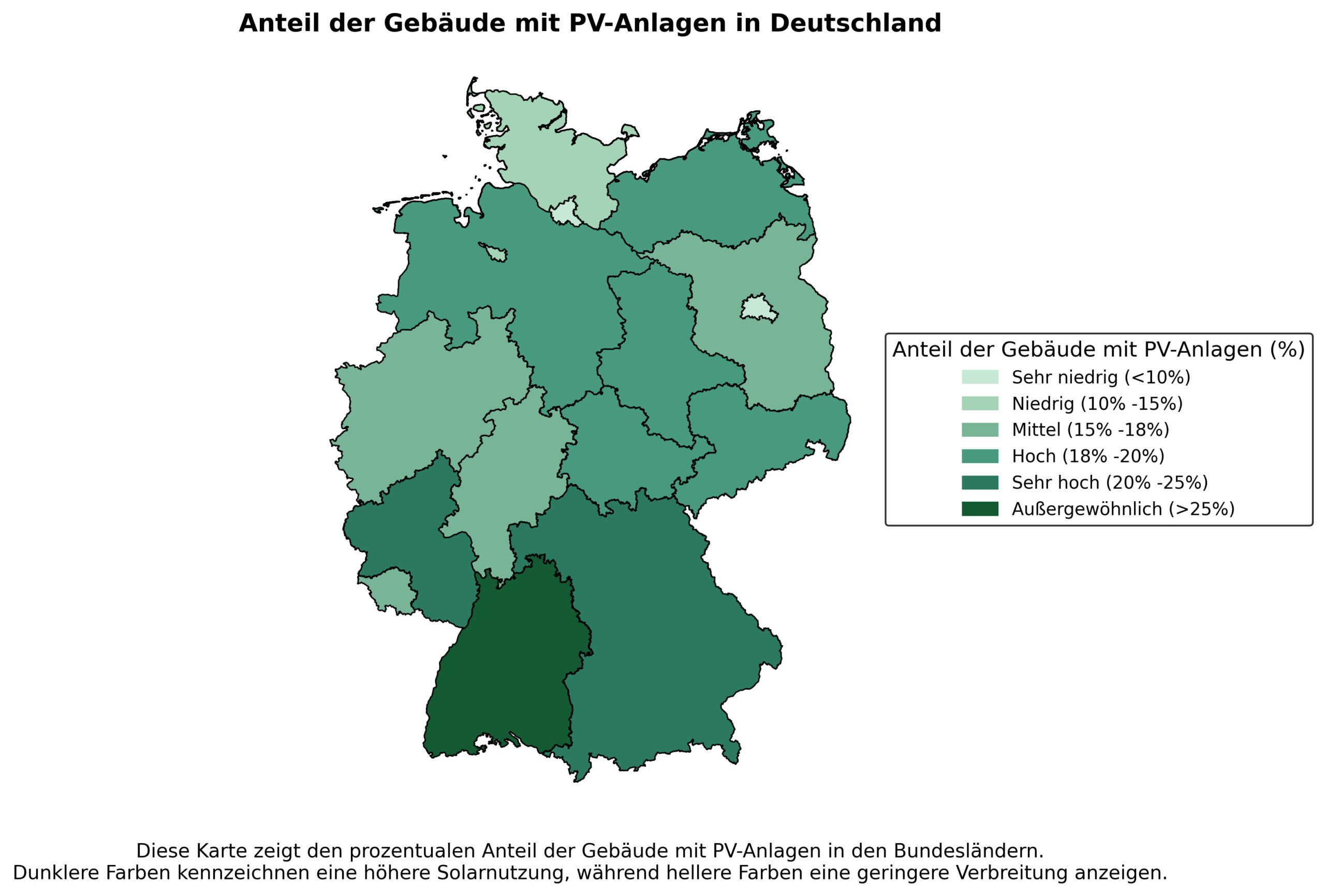 All buildings in commercial land use with a building area of 2,000 square meters and above were examined nationwide.
[2] Date of image analysis: 2024 / Date of image capture: 2021 to 2024
- Source of commercial properties: Official house outlines of the surveying and cadastral administrations of the federal states
- Source of analyzed images: Digital orthophotos of the surveying administrations of the federal states
Photo: © Logivest
Graphics: © BVL