




Webfleet Introduces New Driver Terminal PRO X
Mar 13, 2025 at 6:41 PM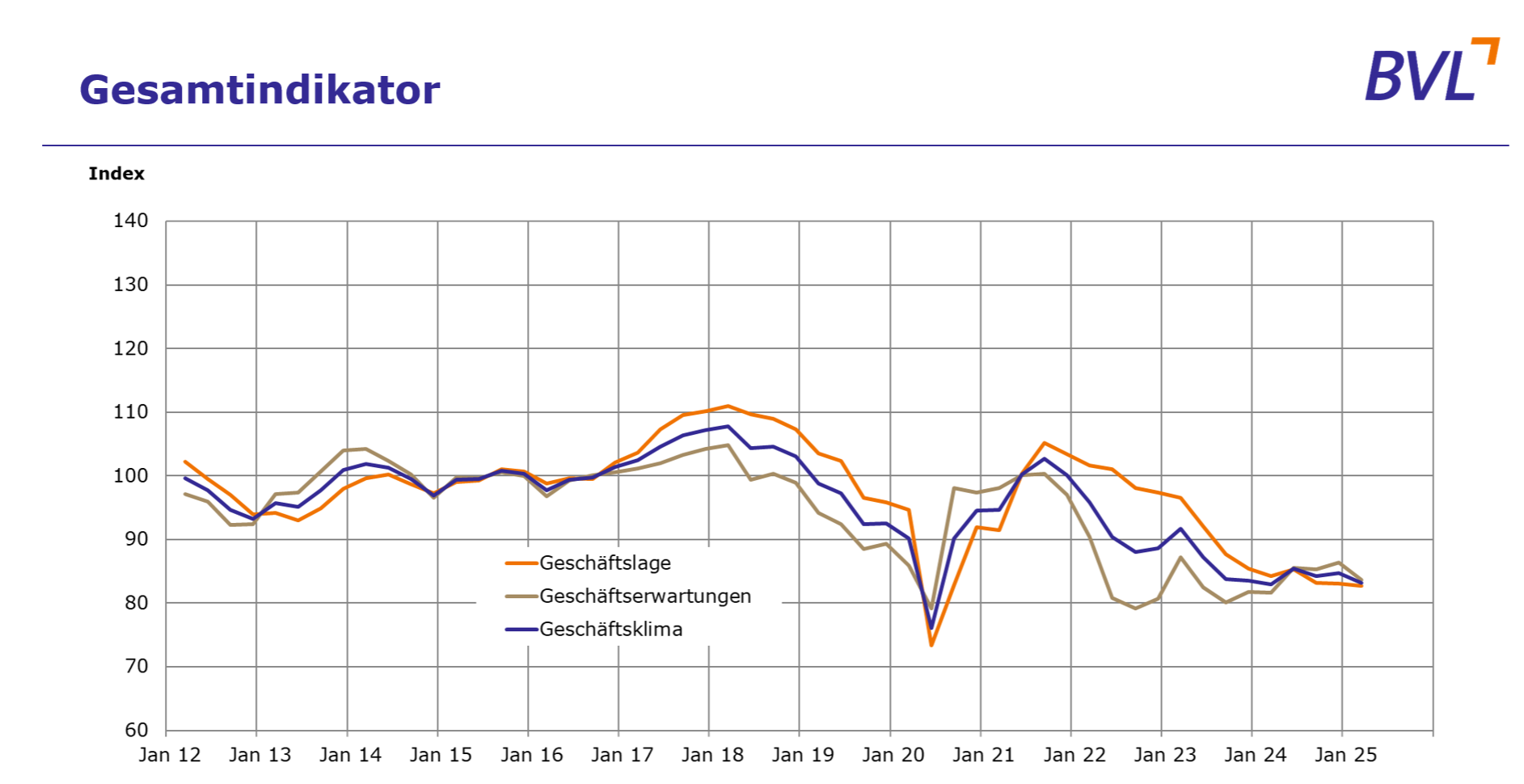
The Logistics Indicator for Q1/25 Does Not Exude Optimism
Mar 13, 2025 at 7:26 PM
DHL and the Stern School of Business at New York University have today released the DHL Trade Atlas 2025, a comprehensive analysis of the key trends in global trade. In times of geopolitical tensions and looming tariff increases, the report provides data-driven insights and covers nearly 200 countries and territories.
(Bonn) Since the re-election of Donald Trump as US President last year, uncertainty has prevailed regarding future trade relations. However, the DHL Trade Atlas 2025 shows that the growth of global trade has proven remarkably resilient despite various crises around the world. This pattern is expected to continue even if the US raises tariffs.
Trade Grows Faster Than in the Previous Decade
According to current forecasts, merchandise trade is expected to grow at an average annual rate of 3.1 percent from 2024 to 2029. This is roughly in line with the growth of global GDP. Compared to the past ten years, this would represent a slight acceleration in trade growth. Even if the new US government implements all announced tariff increases and other countries take retaliatory measures, global trade is expected to continue growing over the next five years—albeit at a significantly slower pace.
New Leaders in Trade Growth: India, Vietnam, Indonesia, and the Philippines
Four countries are expected to rank among the top 30 in both the pace and absolute volume of trade growth from 2024 to 2029: India, Vietnam, Indonesia, and the Philippines. India is also projected to have the third-highest trade growth rate (6 percent), behind China (12 percent) and the USA (10 percent). The countries expected to see the largest absolute trade growth are located in Asia, Europe, and North America. Among the countries with the fastest projected trade growth are several from Africa and Latin America.
In terms of major world regions, trade volume is expected to grow the fastest in South and Central Asia, Sub-Saharan Africa, and the ASEAN states—at average annual rates between 5 and 6 percent. For all other regions, growth rates of 2 to 4 percent are anticipated.
New Record in Long-Distance Trade
Despite widespread interest in nearshoring and producing goods closer to customers, the DHL Trade Atlas 2025 highlights that global trade has not become more regionalized overall. The actual trade flows even suggest the opposite. In the first nine months of 2024, the average distance traveled by all traded goods reached a new record of 5,000 kilometers. The share of trade within major world regions simultaneously fell to a new low of 51 percent.
Reasons for Optimism Despite Changing US Trade Policy
The DHL Trade Atlas 2025 explains why there are reasons for optimism about the future of global trade despite a more restrictive US trade policy. Most countries still view trade as an important driver of economic progress, and new US trade barriers could strengthen relationships between other countries. Furthermore, many of the tariffs threatened by Trump may turn out differently than originally announced to prevent a rise in domestic inflation. The report also notes that the US share of global imports currently stands at 13 percent and 9 percent of exports. Thus, while US trade policy has significant impacts on other countries, it does not solely determine the future of global trade.
Products from China Find New Routes to the USA
The DHL Trade Atlas 2025 also provides new insights into geopolitically induced changes in global trade patterns. Trade between the blocks of close US allies and China declined in 2022 and 2023 compared to trade within these blocks. However, the declines were minor and did not continue into 2024.
The USA and China have reduced their bilateral trade—but not so much that one could speak of a “decoupling.” In 2016, direct trade between the USA and China accounted for 3.5 percent of global trade. In the first nine months of 2024, this share fell to 2.6 percent. However, the USA still sources a similarly high share of its imports from China as the rest of the world. Additionally, there are indications that US imports from China are underreported. Data that also consider Chinese components in goods that the USA imports from other countries show that US dependence on goods manufactured in China is not significantly decreasing.
The DHL Trade Atlas 2025
provides a wealth of data-driven insights and analyses on the state and prospects of global trade. It serves as a current information source for decision-makers in politics and business, educators, students, the media, and the interested public. Compact country profiles summarize the trade structures of nearly 200 countries and territories on a single page. The countries covered by the DHL Trade Atlas account for over 99 percent of global trade, global GDP, and the world population.
With the new edition, users can find dhl.com/tradeatlas for the first time additional free interactive content on various aspects of the report. This allows for customized analyses and retrieval of trade trends for specific countries, regions, and product groups. The website also offers simple options for downloading data and images.
The DHL Trade Atlas 2025 was commissioned by DHL and created by Steven A. Altman and Caroline R. Bastian from the Stern School of Business at New York University. It includes data and updated forecasts up to January 2025.
Photos: © DHL