


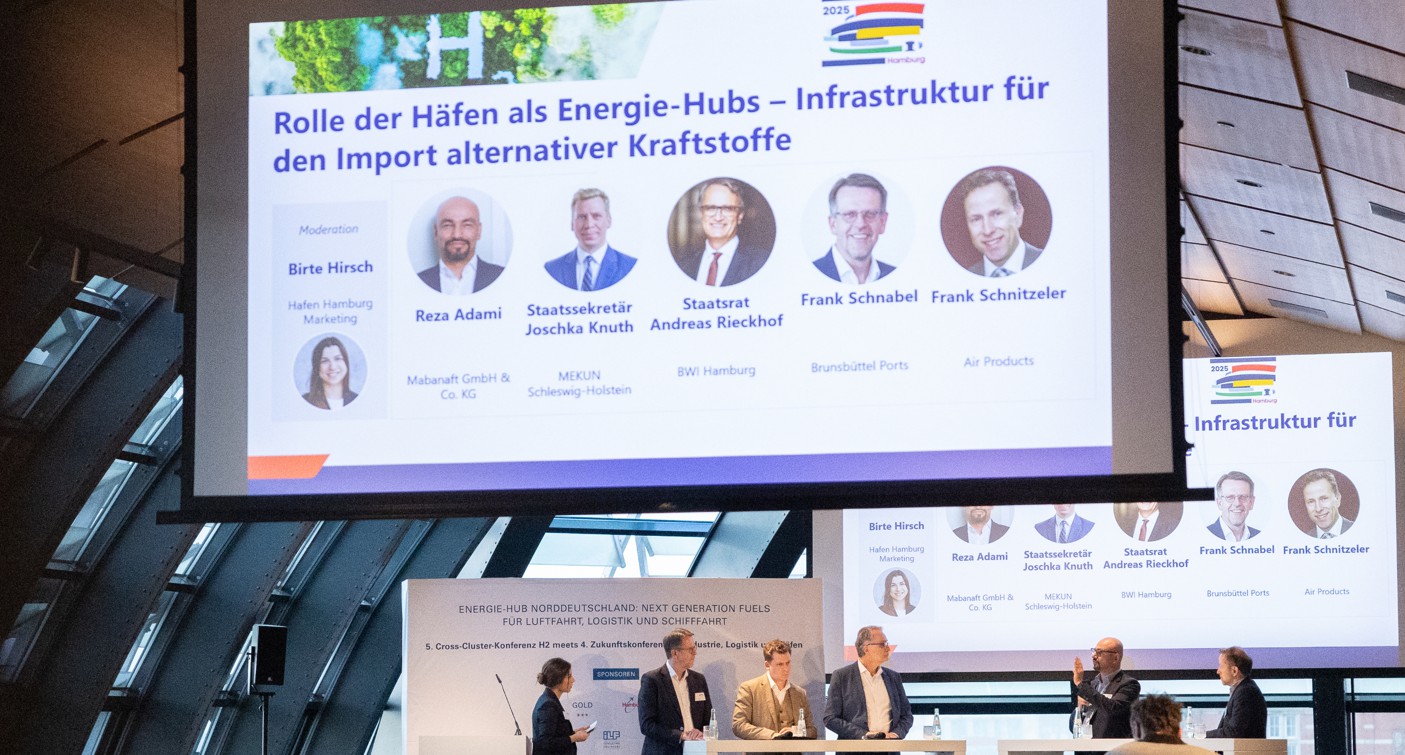
Hamburg Port on the Way to Becoming an Energy Hub
Feb 6, 2025 at 9:39 PM
Truck Parking Solutions Provider Aparkado Celebrates 5 Years
Feb 8, 2025 at 6:35 PM
The LBS – Bavarian Freight Forwarders Association e.V. is waiting to resume wage negotiations with ver.di after a weeks-long pause in discussions. Just before the negotiations were halted, the LBS had improved its offer. The association now expects the union ver.di to lower its maximum demands and resume negotiations.
(Munich) “We are curious to see what proposals the union will bring to the table to resume the dialogue,” said LBS Managing Director Sabine Lehmann. “After we, as employers, improved our offer during the last conversation before the negotiations were halted in December – and went to the limits of what is still economically justifiable – we now expect the employees’ side to move away from their maximum demands and meet us halfway in the negotiations. ‘Negotiating’ does not mean, in our understanding of the word, that one side stands still while the others are expected to move,” Lehmann stated. “Although this seems to be the new strategy currently.”
It is ver.di that has demonstrably ended the talks – without showing any willingness to compromise and insisting on maximum demands; while employers had already made significant concessions. Lehmann points out that the increases of 90.00 euros effective from February 1, 2024, and another 80.00 euros from July 1, 2024, benefited all employees in the tariff-bound companies last year. This significant increase in the just-concluded year, which represents a considerable burden for companies in economically difficult times, is completely disregarded by ver.di.
The Bavarian industry association emphasizes that the current negotiations are based on the understanding that freight forwarding and logistics, as cross-sectional service providers, are directly dependent on the overall economic development. “The development of key industries in Germany is already showing a downward trend for the foreseeable future, and the geopolitical scenarios – including the announced high tariff policy of the USA – do not allow for any relaxation in the long term,” explains Lehmann. “Thus, the period during which the new collective agreement is to apply is marked by negative signs. From this perspective, we understand our offer, in contrast to the union, as fair because we want to enable our employees across all trades and areas of responsibility to receive a reasonable wage increase.”
LBS Rejects Demands
The accusations that the LBS opposes a fair solution and wants to “devalue” the work of industry employees are firmly rejected by the association. The method of accusing the negotiating partner of “blockade” or a “dictate of conditions” without being able to substantiate this concretely, “may be an accepted style in election campaigns. However, it is not suitable as a basis for negotiations,” comments Lehmann. “The success of each individual company depends directly on good cooperation within the companies and the recognition of individual performance. Every one of our member companies is aware of this. At the same time, a sustainably oriented business policy also requires careful economic action – from personnel costs to investments in climate protection to securing competitiveness.” Employers also see themselves responsible for the future viability of both the companies and the jobs, even in economically challenging times: “This is inseparably linked for us.”
Since the union has repeatedly propagated the goal of a “modern” collective agreement, the LBS notes, for example: Defining the attractiveness of training professions solely through increased pay contradicts exactly this modernity. How else can it be that even among the best-paid training professions such as air traffic controller, ship mechanic, police officer, administrative specialist, or social insurance specialist, not all offered positions could be filled in 2024? “A collective agreement in the training sector that is solely reduced to euros and cents is anything but modern, as it does not take into account the flexibility and individuality of training concepts that provide the next generation with secure long-term perspectives,” says Lehmann. Incidentally, the LBS points out that the collective training allowances in Bavaria are the highest nationwide.
Working Towards a Joint, Constructive Result
In the interest of a holistic and future-oriented wage policy, the LBS therefore invites the union side to work together to achieve a joint, constructive result, taking a realistic view of the economic environment and the perspectives of employees. The LBS understands ver.di’s announcement of strikes for February 18 as window dressing that lacks any justification.