
Logistics Market Study Switzerland 02 by GS1 is Published
Jul 12, 2024 at 6:43 PM
Terberg Special Vehicles are the Silent Helpers of Logistics
Jul 12, 2024 at 7:34 PM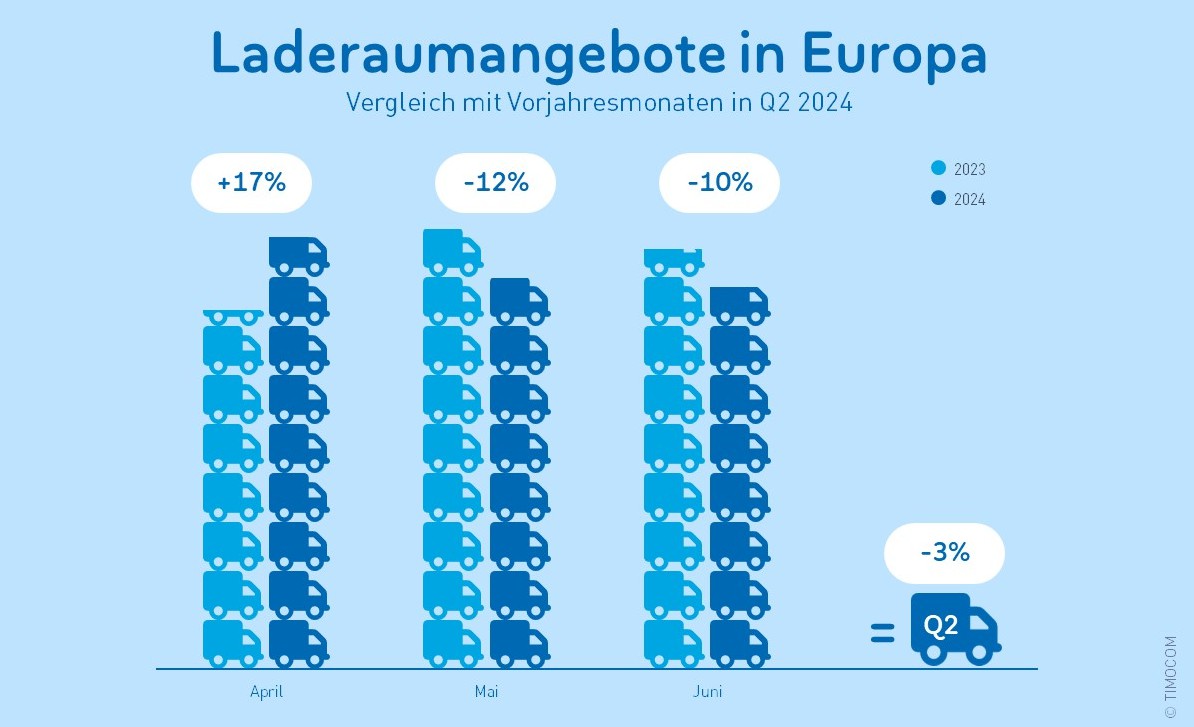
A total of twice as many freight offers were generated across Europe compared to the same period in 2023 (+101%) and 53% more than in Q1 2024. As in the previous year, May showed peak values in freight volume (+112% compared to 2023) and reached a new annual high with an average freight share of 81%. The number of freight offers in the German domestic market was 66% higher in the second quarter than in the same quarter of the previous year. Compared to the first quarter, the number of domestic offers also increased by two-thirds.
(Erkrath) In the holiday-heavy month of May, there is always a particularly high demand for transport. To manage such peaks, the additional required capacities are primarily sought on freight exchanges. Even shippers and freight forwarders, who usually rely on fixed transport partners, increasingly place transport orders in this situation. “The offer prices on freight exchanges are usually more lucrative than the fixed terms agreed upon,” explains Gunnar Gburek, Head of Business Affairs at TIMOCOM. “Freight carriers are often unwilling to provide their clients with additional capacities at the comparatively low freight prices. Therefore, many clients are turning to offering open transport orders on freight exchanges.”
The driver shortage and the increase in insolvencies contribute to capacity bottlenecks in the transport market. In the TIMOCOM marketplace, after a year-on-year decrease of 28% in loading space offers in Q1 2024, there were again 3% fewer truck capacities listed in the second quarter of 2024 compared to the previous year. “Higher demand and rising prices actually encourage freight carriers to build new capacities. However, poor infrastructure and the unpredictable availability of new drive technologies cause many to hesitate,” says Gunnar Gburek. “This could lead to a potentially recovering economy stalling due to a lack of available capacities.”
TIMOCOM recommends shippers to establish closed freight exchanges where the additionally required routes can be offered. There, the connected fixed transport partners then have the opportunity to request market-appropriate prices for these routes through price proposals. “The offers in freight exchanges are currently usually more lucrative than the conditions agreed upon at the beginning of the year,” says Gunnar Gburek, Head of Business Affairs at TIMOCOM.
Offer prices and price proposals fluctuate
Within Germany, the offer prices of listed freight offers in Q2 2024 ranged on average between €1.61/km and €1.83/km depending on current demand. The average price in the second quarter was 13.9% higher than the offer price of the same quarter last year. In contrast, the price proposals from carriers in the 2nd quarter showed average values of up to €1.93/km. In weeks with high demand, the requested price for domestic routes increased significantly. This is an increase of 17.4% compared to 2023. Thus, the offer and demand prices are significantly apart. “In the end, both parties will likely have reached a compromise in the middle,” comments Gunnar Gburek.
Looking at all European routes, the offer price averaged €1.60/km. The price proposals for international transports, on the other hand, averaged up to €1.58/km, which is almost at the offer price level. Here, the difference was not as pronounced, as longer cross-border routes generally allow for a cheaper km price, and the costs for diesel and tolls vary significantly by region.
The highest offer prices were found on routes to Great Britain: The peak values for transport offers, especially from Switzerland, Italy, and France to the United Kingdom, ranged on average between €2.34/km and €2.75/km. The additional effort due to complicated customs clearance and lengthy waiting times at the borders, as well as the difficulty in finding suitable return trips, are significant reasons for the comparatively high prices.
Summer slump expected: Decline in freight offers until the end of August
The forecast for the third quarter of 2024 anticipates a declining demand in the transport market. The average ratio of freight to loading space offers is expected to be below 70:30 in the traditionally weaker summer months of July and August. Only from September onwards, with the upcoming Christmas business in mind, seasonal increases in freight offers are likely to be observed again. The freight share in the TIMOCOM Transport Barometer could then again exceed 75% and approach the values of TI2022.
Here is the full report
Graphic: © TIMOCOM