


Combined Transport Reports a Decline in Freight Volume in 2023
Jun 20, 2024 at 7:40 PM
DB Schenker Receives Award from Texas Instruments
Jun 20, 2024 at 8:08 PM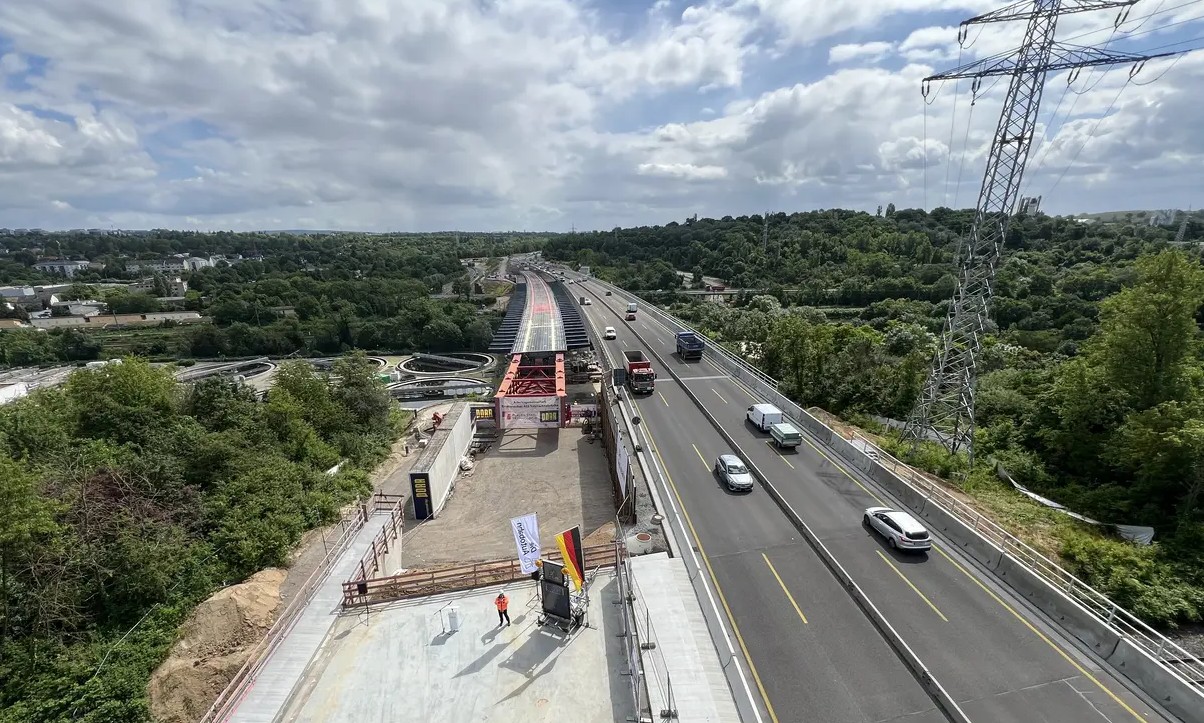
Over 4,000 bridges in the area of highways in Germany are currently in urgent need of renovation or must be rebuilt. Against this background, Federal Minister of Transport Dr. Volker Wissing (FDP) announced at the first Bridge Summit two years ago that the federal government would carry out 400 bridge construction projects per year by 2026 at the latest, in order to address the backlog of renovations within ten years.
(Berlin) Because this promise is unlikely to be fulfilled, several top associations are now addressing the federal government in a joint emergency call. The Federal Association of Medium-Sized Construction Companies (BVMB), the Main Association of the German Construction Industry (HDB), the Central Association of the German Construction Industry (ZDB), the Association of Consulting Engineers (VBI), Pro Mobility – Initiative for Transport Infrastructure, the DVLV – German Association for Noise Protection on Traffic Routes, the Quality Association for Steel Guardrails, and the German Asphalt Association (DAV) criticize: “We are far from the 400 bridges annually. In addition, in recent weeks, more and more tenders have been canceled due to lack of funds, and the construction program of the Autobahn GmbH is being stretched overall. Furthermore, it has become known that the budget of the Autobahn GmbH is to be cut by 20 percent from 6.2 billion euros to 4.9 billion euros. This negligent investment policy will lead to further bridge closures and the continued deterioration of the road network.”
The top associations therefore urgently warn against cutting funds for highway construction. Instead, additional investment funds of one billion euros per year must be provided to get the bridge modernization program off the ground and to secure the modernization of federal highways. The General German Automobile Club (ADAC), the Federal Association of Goods Transport, Logistics and Disposal (BGL), the DSLV Federal Association of Freight Forwarders and Logistics, and the BWVL Federal Association for In-House Logistics & Shippers also join the appeal, as the failure of a single highway bridge already has serious consequences for traffic, residents, and the economy along the detour routes. The closures of the Rahmede Valley Bridge (A 45) and the Salzbachtal Bridge between Frankfurt and Wiesbaden have clearly demonstrated this. If the federal government does not allocate sufficient financial resources for federal highway construction in the current transport budget and the medium-term financial planning, it would have fatal consequences – a traffic collapse is to be feared.
Road is the Number 1 Transport Carrier
“A functioning and reliable highway network is an essential foundation for the mobility of people and a functioning economy. After all, the road is the number 1 transport carrier. As a European transit country, Germany also has a responsibility for mobility across Europe,” emphasize BVMB, HDB, ZDB, VBI, Pro Mobility, DVLV, Quality Association for Steel Guardrails, DAV, ADAC, BGL, DSLV, and BWVL. According to the current overview of the BMDV, more than 1,000 highway bridge structures are in a “not sufficient structural condition” and 80 structures are in an “inadequate structural condition.” The load-bearing capacity and thus the functionality of many bridges are severely impaired. If the bridge construction program is not implemented as announced by the federal government, the associations predict further bridge failures that would paralyze traffic for years. The detour traffic around dilapidated or closed highway bridges causes traffic chaos in the municipalities along the detour routes, burdens residents and businesses in the regions, and excessively strains the traffic routes in the municipalities.
Important for the Construction Industry as Well
The bridge construction program is also important for the construction industry. “The companies have increased their capacities because they relied on the fact that the orders announced by the federal government would also come.” Now, instead, construction companies are sitting in a waiting loop, which has significant financial consequences. Short-time work, even in bridge construction, can no longer be ruled out.
Photo: © The Autobahn GmbH des Bundes / Image Caption: The Salzbachtal Bridge (A66) near Wiesbaden is expected to be completed in 2025. However, this does not change the fact that another 4,000 highway bridges in Germany are waiting for their renovation.