


SGKV with Statistical Report on Combined Transport 2023
Jun 8, 2024 at 7:12 PM
ZetesMedea Optimizes Warehouse Operations at GUD in South Africa
Jun 11, 2024 at 6:04 PM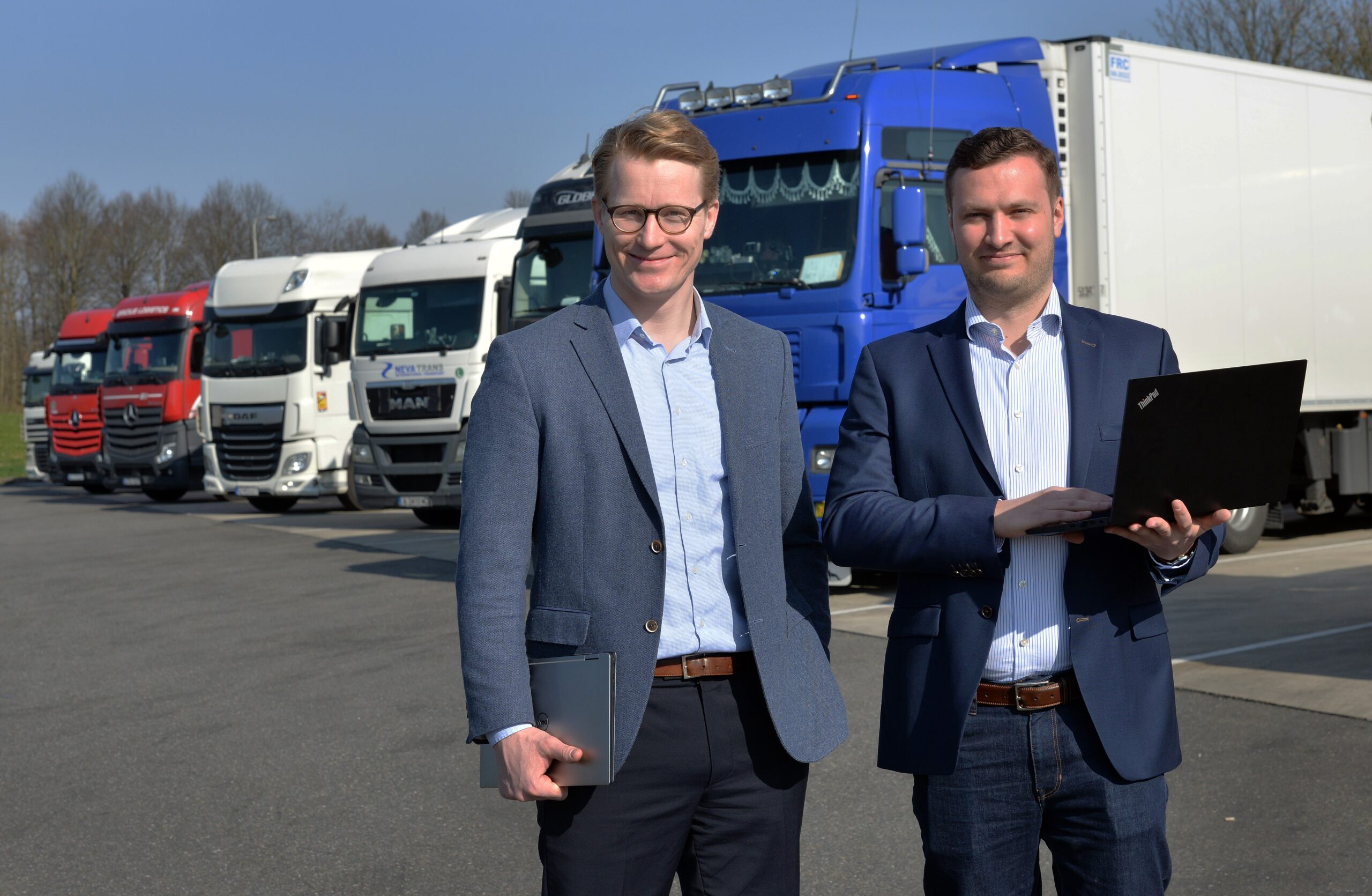
It cannot be done without: With a 72 percent share of transport performance, trucks are indispensable for freight transport. Yet, the mode of transport lacks future viability. There is a shortage of drivers, and CO2 emissions are too high. But what if part of long-distance transport were converted into regional traffic? The start-up MANSIO has taken on the optimization of meeting traffic.
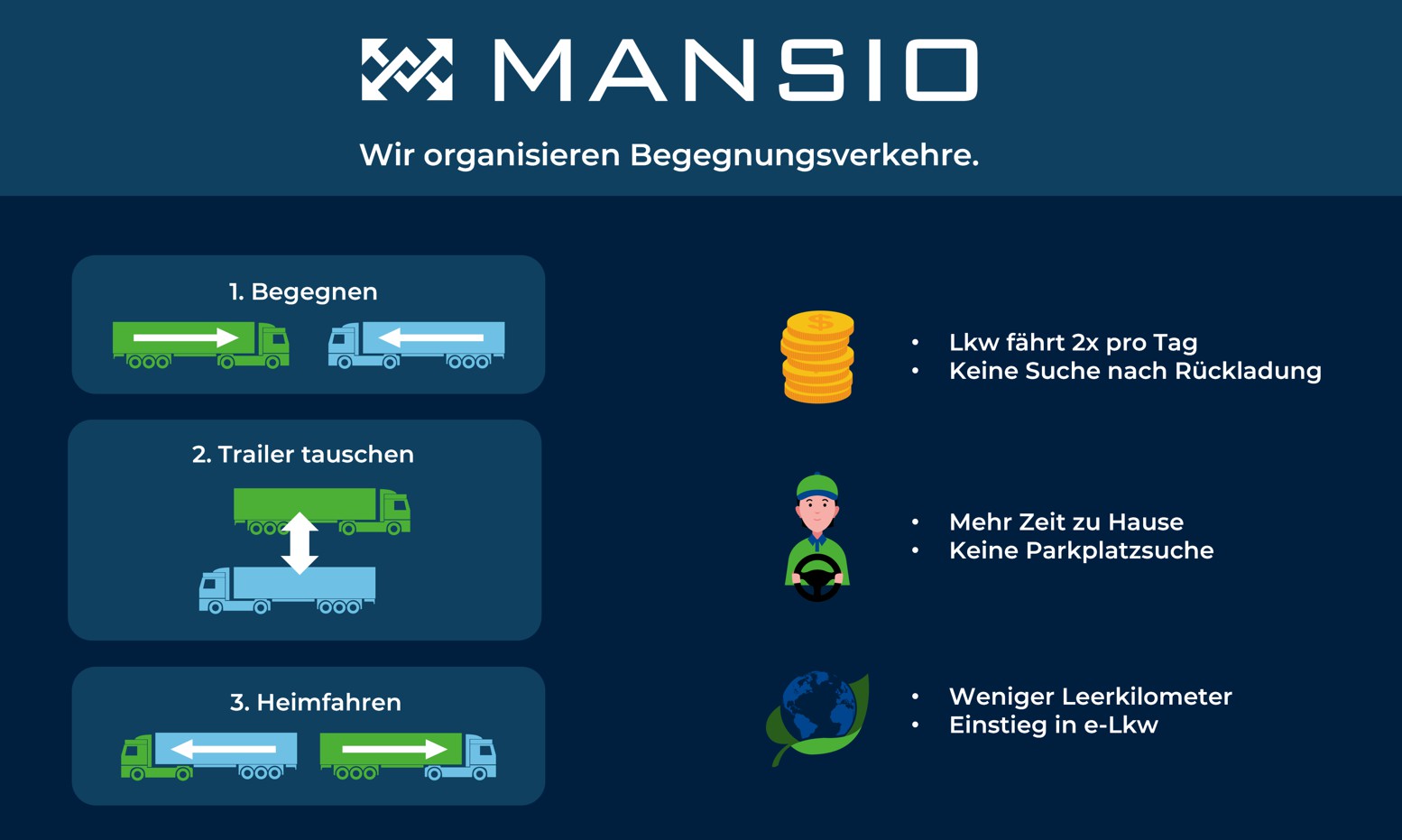
(Aachen) This approach is pursued by the start-up MANSIO with its IT solution for intelligent meeting traffic. Its managing founder, Maik Schürmeyer, outlines the concept: “In meeting traffic, two drivers exchange their truck trailers after about 4.5 hours of driving time at a defined waypoint. Both return to their home location after the trailer exchange. Thus, the trailer continues its journey in long-distance transport while the driver can stay in the region.”
To ensure the matching of transport orders for paired traffic that then takes place in meeting traffic, MANSIO has developed a digital transport system based on a complex optimization algorithm and AI. This incorporates data on the vehicle, locations, and transport orders, among other things. Additionally, the maximum driving distance and driving time, loading windows, technical compatibility of vehicles, and driver qualifications are included. Based on these parameters, the IT solution checks which transport orders can be combined for meeting and relay traffic.
Back Home After Shift Ends
“By requiring movement within a radius of 4.5 hours around the starting location, advantages arise for both drivers and dispatchers. Schürmeyer lists these: “The trucker is back home after the shift ends, and the carrier can use the vehicle in a two-shift operation.” Overall, the job profile for the driver becomes significantly more attractive and family-friendly due to the changed concept. He is at his home location at the end of the day instead of spending his free time as “rest time” in the truck. The latter is not very appealing and is also dangerous. Truck parking spaces on highways are scarce. As a result, according to ADAC, trucks park in a high-risk manner at 46 percent of rest areas. Additionally, there is the risk of cargo theft. Drivers are often attacked during their rest time due to the lack of secure parking spaces.
In contrast, drivers would be operating in their territory with the MANSIO concept – that is, the region they know well, which is another comfort factor. “If these arguments resonate with some job seekers, meeting traffic can help attract more personnel. There is significant potential among female drivers. Currently, only about two percent of drivers are female,” informs Schürmeyer, highlighting the current skilled labor shortage in the industry, “Germany currently lacks about 60,000 to 80,000 truck drivers.”
Better Conditions for the Use of E-Trucks in Long-Distance Transport
In addition to the tense labor market situation, the desired reduction of CO2 emissions in the transport sector also requires new impulses. Because here, too, one faces a nearly insurmountable task. To achieve the Paris climate goals, the transport sector requires at least an 80 percent reduction in greenhouse gas emissions by 2050 (compared to 1990). “To reduce emissions, various technologies, fuels, and innovative concepts are needed,” says Schürmeyer. The MANSIO concept could, for example, support the use of battery-electric trucks on partial routes in long-distance transport.
Currently, e-trucks are almost exclusively used in local transport. Schürmeyer cites the low battery range, the patchy charging infrastructure, and the high investment costs of about €400,000 per vehicle – about four times that of a conventional truck – as reasons. “Through meeting traffic, e-trucks are already becoming suitable for long-distance transport,” Schürmeyer is convinced, “we create a regional transport system where only the trailer is moved in long-distance transport.” The entrepreneur can use the vehicle in a two-shift operation, allowing for quicker amortization of the purchase and charging the truck on his own premises. Schürmeyer reports from practice: “Our users see in meeting traffic with MANSIO exactly the application case to invest in e-trucks in the future.”
But he looks not only as an entrepreneur but also as a scientist at the development. This is part of his position as a professor of logistics at Niederrhein University of Applied Sciences. For him, long-distance transport is one of the major contributors to CO2 emissions, which requires swift action in this segment. The 39-year-old can also substantiate this: “About 56 percent of truck tours in Europe are longer than 300 km.”
 Fewer Empty Kilometers and Improved Parking Situation
However, it is not enough to look at the distances traveled in isolation; one must also look inside the trucks, finds Schürmeyer. After all, about 20 percent of the kilometers driven by trucks are so-called empty trips. This share can be minimized with MANSIO’s IT solution. The algorithm is trained so that each vehicle drives loaded from its home region to the transfer point. “We expect that the empty kilometers for obtaining backloads can be reduced by up to 50 percent through the use of our digital tool,” explains Schürmeyer.
For the trailer exchange, the MANSIO team plans about 20 minutes. This not only frees drivers, who must observe an 11-hour rest period in long-distance transport, from the forced break on the highway but also improves the parking situation. According to Schürmeyer’s estimates, over 30,000 truck parking spaces are missing on Germany’s highways. “If meeting traffic were to take place nationwide in Germany, no additional truck parking spaces would need to be built,” Schürmeyer’s calculations show.
Enabling Operation of Conventional and Autonomous Trucks
While the concept for optimizing long-distance transport is being rolled out, MANSIO has already set its next goal. The IT service provider for logistics solutions wants to be the first to enable a hybrid operation of conventional and autonomous trucks. MANSIO aims to provide the IT for managing a Europe-wide network in which trailers are handed over between manual and autonomous trucks.
Photos/Graphics: © MANSIO / Cover Image (l. to r.): They lead MANSIO: Dr. Maik Schürmeyer (Founder and CEO) and Julian Blasig (COO)