
SBB 2023 Overall Profit – Cargo with Reduced Losses
Mar 12, 2024 at 7:41 PM
TOPREGAL has been selling shelves online for 15 years
Mar 15, 2024 at 7:38 AM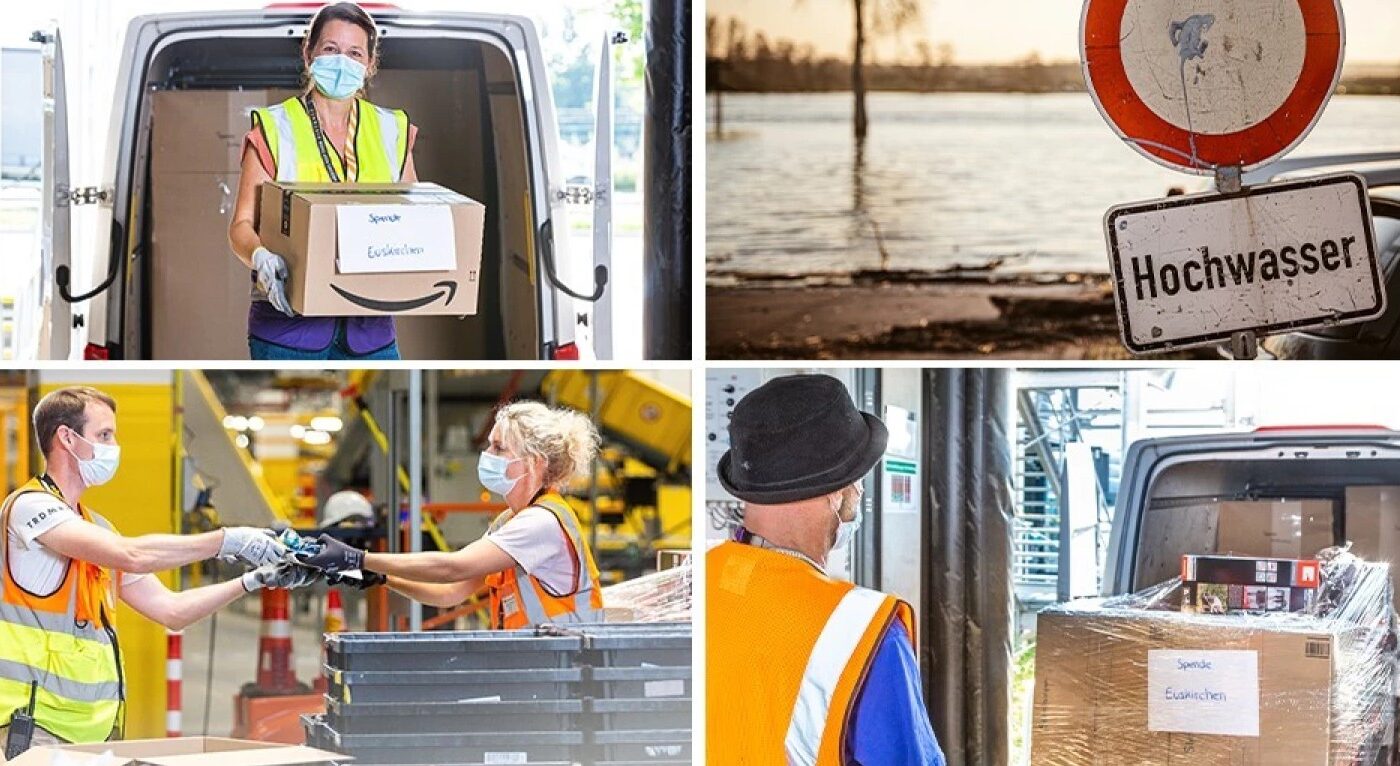
Amazon today opened its first European disaster relief hub in Rheinberg near Düsseldorf. In this special center, the company stores relief supplies and utilizes its global logistics network to quickly send these products to local non-profit organizations in the event of natural disasters.
(Munich/Rheinberg) The disaster relief hub is a dedicated area within an Amazon logistics center where items can be stored and quickly packaged that are most urgently needed during natural disasters such as floods, earthquakes, or wildfires. The logistics center in Rheinberg is conveniently located near international airports and is connected to a dense transportation network.
The storage area of 2,000 square meters accommodates 1,000 pallets of relief supplies. This is equivalent to the loading capacity of 20 Boeing 737 aircraft. The hub is prepared to respond to the most common natural disasters in Europe, such as floods and wildfires. The stocked items include relief supplies that are typically in high demand, such as tents, blankets, cots, mats, and sleeping bags for emergency shelters. Hygiene kits containing soap, toothbrushes, and toothpaste are also stored, and work gloves and cleaning supplies are available for emergency responders.
Data analysis of products requested during natural disasters since 2017 shows that more than 80% of the requested items are identical after each major natural disaster. Based on its own data and forecasts from aid organizations, Amazon keeps millions of relief supplies ready to be packaged and sent to affected communities as needed. The most frequently requested products include diapers, tarps, cots, blankets, heaters, tents, and cleaning supplies. Thanks to the hub, where these items are ready for shipment, the company can provide assistance in less than 72 hours – much faster than if teams had to package the products and consolidate them in various facilities across the continent.
In his greeting in Rheinberg, State Secretary Matthias Heidmeier from the Ministry of Labor, Health, and Social Affairs of North Rhine-Westphalia emphasized the importance of crisis preparedness: “As a representative of the state government, I am very pleased with the trust in the location of North Rhine-Westphalia. In particular, because I see here an important contribution to managing crises and disasters that can be made from North Rhine-Westphalia.
I am convinced that well-thought-out preparation for possible crisis scenarios is an essential component of strengthening resilience, both individually and collectively. Because for me, crisis resilience begins with individual preparedness in terms of emergency supplies, a well-equipped home pharmacy, and basic first aid knowledge, and continues chronologically into topics such as planning and organizing disaster protection, disaster relief, and humanitarian aid. It is certain that we as a society must prepare even better for crisis and disaster scenarios in the future, and every expertise is needed here. Therefore, the commitment of private actors like Amazon, who are willing to complement the tasks of state actors through their work in the field of disaster relief, is to be welcomed.”
“Natural disasters are occurring more frequently and are becoming increasingly severe. We mobilize our global inventory, our logistics, and our technology to support communities affected by these emergencies. We want to use our size and our passion for good,” said Bettina Stix, who has built Amazon’s disaster relief team. The department already operates disaster relief hubs in the USA, Asia, and Australia. “To this end, we work with local and international aid organizations to understand their needs, and we have analyzed our data to identify the most requested products after natural disasters. With the opening of this new hub in Germany, we can respond even faster and more efficiently to disasters in Europe, the Middle East, and North Africa.”
Partnerships with Aid Organizations are Essential
Amazon collaborates with national and international aid organizations such as the Red Cross, Save the Children, and the International Organization for Migration (IOM) of the United Nations to understand their needs and procure the products they request in advance. Thanks to this collaboration, Amazon has been able to assist in over 145 natural disasters worldwide since 2017 and donate more than 24 million relief supplies.
Amazon’s partnership with the IOM has already helped tens of thousands of refugees and families affected by disasters. The company donated essential items worth nearly 6.5 million euros for refugees across Europe and products worth 1.5 million euros for areas affected by earthquakes in Turkey and Syria. Amazon has provided logistical support through trucks and planes to ensure smooth delivery of relief supplies. Amazon employees also help. In volunteer actions, they packed tens of thousands of hygiene kits that can be distributed to refugees across Europe.
Jeanette Camarillo, Deputy Director of the IOM’s Department of Humanitarian Assistance and Reconstruction, said: “The establishment of this hub is a significant milestone in our collaboration. I am very pleased that the IOM will be a strategic partner in this important project. Our joint work in disaster relief and emergency response over the past years has been very fruitful and has laid a strong foundation for our future joint efforts.”
In addition to donating products and logistics services, Amazon has also made it easy for its customers to donate products through the company’s online shops. When the Russian invasion of Ukraine began, customers from across Europe sent thousands of products via Amazon to aid organizations that donated them to displaced families from Ukraine.
Amazon operates disaster relief hubs in the USA, Asia, and Australia. Since 2017, the company has utilized its inventory, logistics, and technologies to assist in over 145 natural disasters and humanitarian crises, donating more than 24 million relief supplies worldwide. In the last 18 months alone, Amazon has responded to natural disasters around the world, including wildfires in Chile, Colombia, Australia, and Hawaii, earthquakes in Japan, Turkey, Syria, and Morocco, as well as hurricanes and cyclones in Puerto Rico, Florida, and India.
State-of-the-Art Technology in Action: Disaster Relief through Cloud Computing
Amazon’s support during natural disasters goes beyond logistics for the rapid delivery of goods to affected areas. Amazon Web Services (AWS) helps organizations optimize their disaster relief efforts through cloud computing. For example, AWS collaborates with the American Red Cross to better assist on-site through cloud applications. This also includes the use of Alexa-enabled devices to receive hurricane alerts and schedule blood donations.
AWS has a dedicated disaster relief team that helps readiness partners – including aid organizations, authorities, and non-profit organizations – prepare for and respond to disasters worldwide using the cloud. This includes testing proof-of-concepts and fine-tuning existing solutions under simulated disaster conditions, such as deploying AWS disaster relief vehicles to provide networks when internet and telecommunications infrastructure has been severely damaged. These vehicles are equipped with powerful and mobile cloud computing devices designed for stable operation under challenging conditions.
AWS supports partners with cloud applications to map heavily affected areas and assess damage, restore internet connections, and ramp up capacities in call centers to handle more inquiries after a disaster. The team provides AWS computing power to on-site response organizations to process local information directly, enabling faster decisions on where to focus relief efforts.
Combating Wildfires in Chile, Colombia, and Maui
Recently, AWS provided cloud applications and expertise to assist in combating wildfires in Chile, Colombia, and Maui. Through state-of-the-art technologies, responders were able to assess the extent of the damage caused by the fires, identify new hotspots, and track the progression of the fire. The teams used aerial imagery to create maps for decision-making and preventive measures.
More Information on Amazon’s Disaster Relief Efforts
Photo: © Amazon