




Spedination Expands Presence in Germany with New Office in Aschaffenburg
Nov 9, 2023 at 7:19 PM
Development of Short Sea Shipping 2022 in Germany
Nov 11, 2023 at 12:21 PM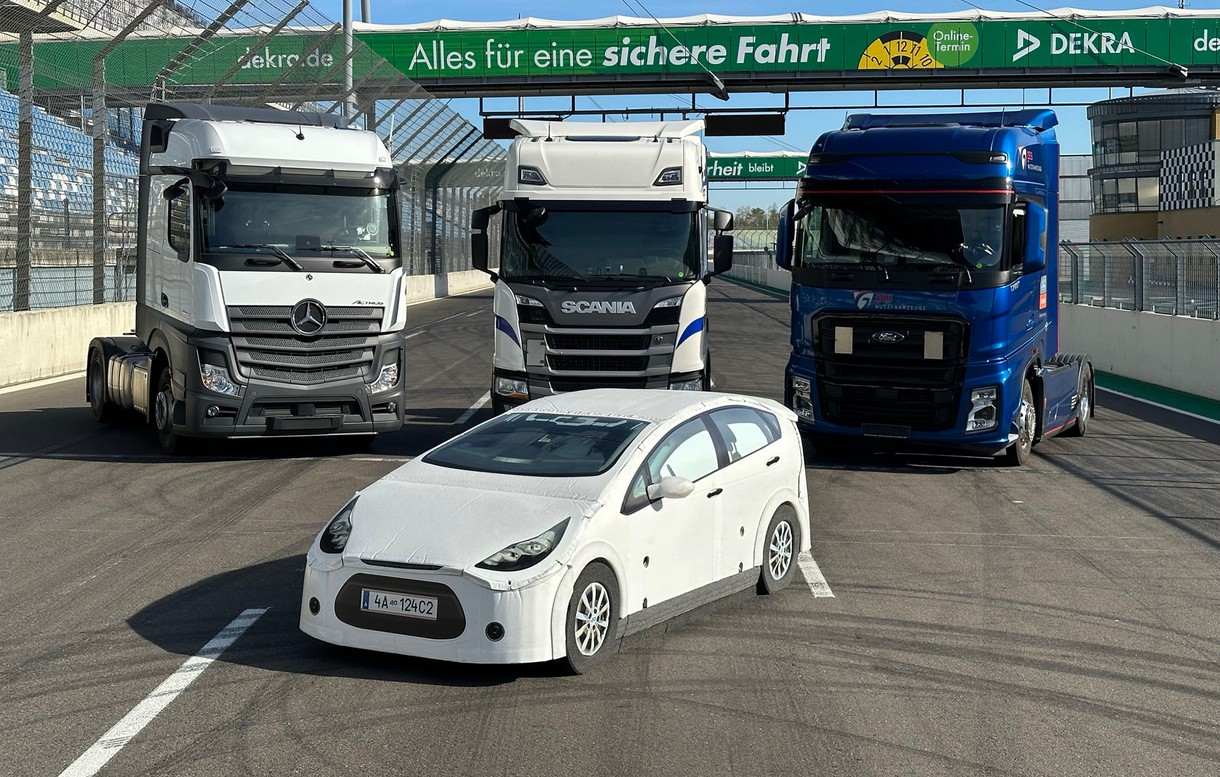
Since 2018, the emergency braking assistant for trucks has been legally required in the EU. However, despite being mandatory equipment, serious accidents at the end of traffic jams continue to occur. What are the technical backgrounds for this? Can the behavior of the driver unintentionally impair the effectiveness of the assistants? DEKRA has investigated these questions for the 2023 Road Safety Report “Technology and Human”.
(Stuttgart/Lausitzring) Driving tests with three trucks from different manufacturers were conducted at the DEKRA Technology Center at Lausitzring in Brandenburg. “It became clear that while the tested emergency braking assistants are compliant with the law, there is still significant potential for optimization, particularly in system design,” summarizes Uwe Burckhardt, Head of Testing and Events at DEKRA Lausitzring.
When it comes to improving road safety, driver assistance systems also play an important role in trucks. A significant accident scenario is rear-end collisions at the end of traffic jams. Especially involving heavy trucks, this often results in serious injuries and fatalities among occupants. While optimizations in the compatibility of vehicle structures can alleviate the situation to some extent, the physical limits are quickly reached with increasing speed differences. Given the large masses of heavy commercial vehicles, the potential of passive safety to mitigate accident consequences is limited.
Driving tests with tractor units from various manufacturers
Effective improvements can therefore primarily be achieved through active safety systems. Driver assistance systems like the truck emergency braking assistant can prevent accidents or reduce their severity. However, not all emergency braking assistants perform as well as technically possible and desirable. This is the result of driving tests at DEKRA Lausitzring with three tractor units from different manufacturers. The trucks, equipped with measuring technology as well as steering and pedal actuators, approached a stationary car dummy at a speed of 50 km/h in a straight line – with 100% overlap, meaning directly in the center of the target’s rear.
The tests were initially conducted as a test of the respective system without driver intervention, followed by various driver interventions with differing brake pedal pressure and steering input simulated. “For reproducibility, the driver interventions were triggered by robotics as soon as it recognized in the collision warning phase that the emergency braking assistant had already reduced the truck’s speed by 2 km/h,” explains DEKRA expert Uwe Burckhardt regarding the test setup.
Manual additional braking can improve effectiveness
During the tests without driver intervention, it became apparent that the assistance systems are designed very differently depending on the truck manufacturer in terms of warning and braking behavior. The trucks from manufacturers 1 and 3 came to a stop before the obstacle, but the distance to the dummy was only five centimeters for manufacturer 1, while for manufacturer 3 it was 2.6 meters. The system installed in the truck from manufacturer 2 did slow down the vehicle, but could not prevent a collision with the dummy. At least the collision speed was reduced to 27 km/h.
In further simulation cases, the truck from manufacturer 1 reliably warned and braked to a standstill and was not “disturbed” by driver interventions. The truck from manufacturer 2 showed at least some improvement due to driver intervention: a strong braking input reduced the impact speed to 15 km/h, and a strong steering input, given the speed reduction by the emergency braking assistant, at least allowed it to pass by the car dummy. However, a moderate steering input would not have been sufficient for this. Thus, while the system meets legal minimum standards, it cannot reliably prevent rear-end collisions. The system of the truck from manufacturer 3 mostly warned and braked reliably. However, even a moderate braking input from the driver caused the emergency braking assistant to deactivate, thus nullifying its safety-related function. “This unexpected system behavior for the driver shows that the legally required override capability can, depending on the design, prevent successful accident avoidance,” warns Uwe Burckhardt.
Legal requirements must be increased
In conclusion: The various tested truck emergency braking assistants are undoubtedly compliant with the law. However, the comparison of the system designs from different manufacturers and the partial effectiveness of a manual additional braking show that the technical potential is not fully utilized by the existing regulations. The systems also showed significant safety-relevant interactions depending on driver behavior. It would therefore be desirable to discuss a standardization of the system designs. Furthermore, DEKRA’s tests showed that deviations from the “standard” significantly reduce the performance of the systems. Therefore, manufacturers should make their necessary tests for functional development more variable and test the systems in even more diverse scenarios.
“For the future, it is also important to increase the legal requirements so that the systems function even more reliably in real traffic situations,” demands Jann Fehlauer, Managing Director of DEKRA Automobil GmbH. According to the minimum requirement in the current regulation, the systems must reduce speed by 20 km/h before a stationary obstacle. “So if the truck is traveling at 80 km/h, it would still collide at 60 km/h, which still means devastating accident consequences,” says Jann Fehlauer.
At the UN level, new, stricter minimum requirements for the future have already been formulated and adopted: the maximum collision speed may be 42 km/h – this means a stronger minimum braking intervention than previously required. The ability to deactivate will be significantly restricted, and the systems must automatically reactivate themselves. Additionally, the systems must also function in urban environments and recognize pedestrians. These regulations are set to apply to newly developed vehicle types from September 2025 and to all newly registered trucks from September 2028. According to the DEKRA Managing Director, these regulations could be even more ambitious from a road safety perspective. “However, they are clearly a step in the right direction and must now be quickly implemented into applicable EU law.”
Road Safety Report available for download
Further background on the topic as well as on the tension between technology and humans in general can be found in the DEKRA Road Safety Report 2023. It is available at www.dekra-roadsafety.com .
Photo: © DEKRA