


BGL Protests to the EU Against Tyrolean Blockade Traffic Policy
Oct 12, 2023 at 7:24 PM
Scannell rents to tire wholesaler Tyremotive in Kitzingen
Oct 13, 2023 at 6:48 PM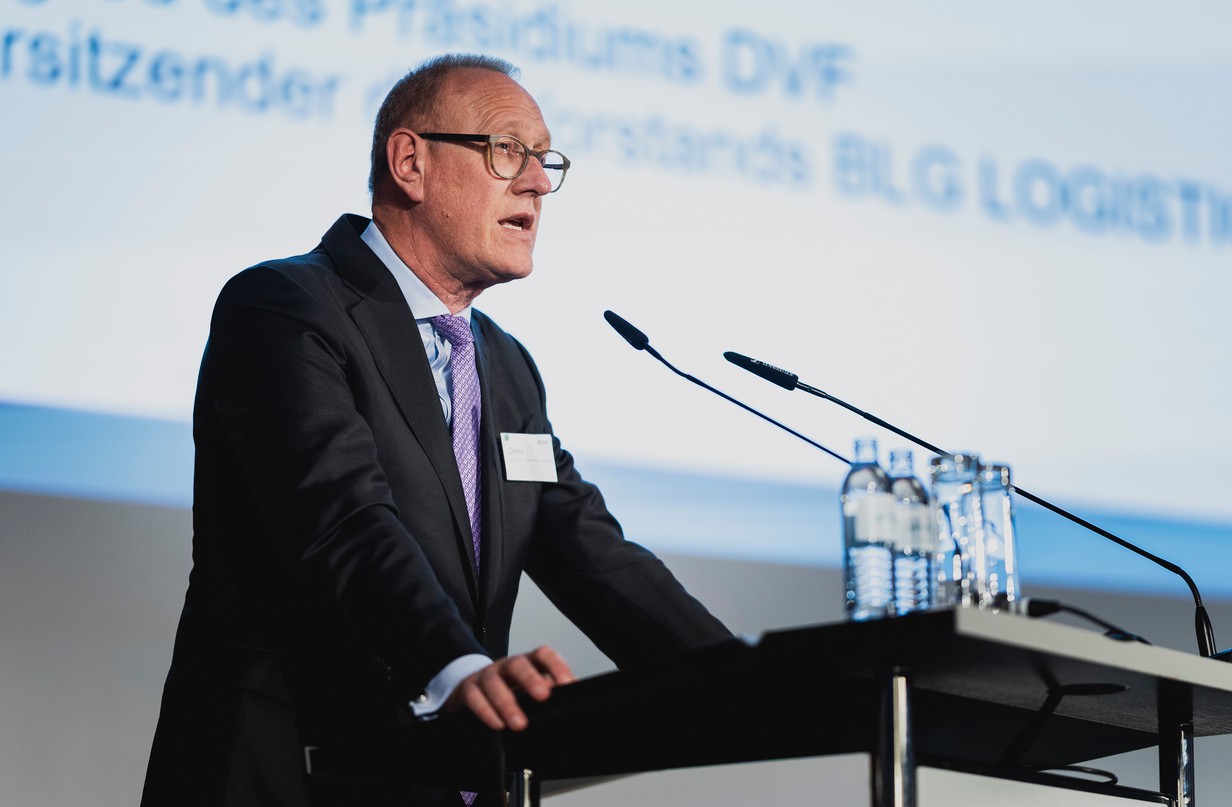
Frank Dreeke, member of the DVF Presidium and Chairman of the Board of BLG LOGISTICS GROUP AG & Co. KG, emphasized at the DVF event the need for consistent investments in the competitiveness of Germany’s port and shipping location: “Ports are becoming hubs of global transport chains for green energy.
(Berlin) For this to work, strategic investments must be consistently maintained over a long period – from shipping, terminal operators, ports, and also from the federal government. Therefore, the increase in the port compensation scheme is absolutely necessary. Moreover, competition in the handling business, the competition between ports and transport chains remains one hundred percent relevant. Development of handling, infrastructure, seaward access, and performance of hinterland connections – these are core points by which we will measure the success of the National Port Strategy.”
Dr. Arnt Vespermann, CEO of Offen Group and member of the Presidium of the German Shipowners’ Association (VDR), assessed the engagement of global logistics companies and container lines in German ports as fundamentally positive: “These investments demonstrate the competitiveness and relevance of the local location in international competition.” Vespermann emphasized the importance of the availability of alternative fuels for achieving the net-zero carbon target: “A combination of promoting research and development, financial incentives, and internationally coordinated regulations is essential in this regard.”
Comprehensive Investment Package in the Maritime Sector Required
Dieter Janecek MdB, Coordinator of the Federal Government for Maritime Economy and Tourism, stated regarding faster production and provision of alternative fuels that quotas, as in the new EU regulation FuelEU Maritime, are an important instrument: “In addition, the development of infrastructure for the import and transport, especially of hydrogen and hydrogen derivatives in ports and on land, must be advanced. With the port strategy and the hydrogen import strategy, we will create the basis for this.” He highlighted the current focus areas for the transition of Germany’s energy base: expansion of facilities and networks for renewable energy, development of infrastructure for hydrogen, and construction of LNG terminals. In light of the debate on the port compensation scheme, Janecek announced a study commissioned by BMWK and BMDV to examine the needs of ports regarding the energy transition.
The Chairman of the CDU/CSU Parliamentary Group’s Coastal Working Group, Oliver Grundmann MdB, criticized these steps as insufficient: “From all areas of the maritime economy, we are hearing alarm signals that the federal government has not responded to adequately so far. We need a comprehensive investment package for port infrastructure and waterways, billions in investments to make the north a hub for a successful energy transition for all of Germany. We demand a massive infrastructure acceleration package, the swift implementation of the Federal Transport Infrastructure Plan, and the acceleration of port infrastructure projects. And we urgently need guarantees, qualitative tendering criteria, and value creation clauses to ensure that investments remain in the country.”
Waterways Underfunded – WSV Undermanned
The inadequate financial resources and the sluggish renovation of waterways were also addressed as a massive problem. Heiner Dettmer, CEO of Dettmer Group KG, strongly called for higher investments to increase the attractiveness of the waterway system for shippers. A failure of this transport route would have catastrophic consequences for the supply of the population and especially for industry: “Rail or road cannot cover the volume additionally. This is obviously not recognized or is being suppressed by the responsible politicians, as inland shipping does not mobilize voter support. Investments in infrastructure should amount to at least two billion euros annually to secure the future of the waterway.”
Bernd Reuther MdB, transport policy spokesman for the FDP parliamentary group, stated that the waterway will need renovation measures in the coming years, particularly for weirs, locks, and bridges. “Given the strained budget situation, prioritization is crucial so that at least the optimization of unloading for the Middle and Lower Rhine and the renovation of the West German canal network can be advanced. Negotiations on the approval acceleration law are still ongoing. For future-proof mobility, we need an acceleration turbo for all modes of transport, which applies to roads and rail as well as to waterways.”
“The political will to strengthen the rail transport mode is clearly visible. In contrast, the importance of the ‘waterway system’ is losing political priority. This is negligent, especially for the industrial Rhine corridor with a high share of the modal split,” judged Jan Sönke Eckel, Managing Director of RheinCargo GmbH & Co. KG. Eckel also emphasized that inland shipping is largely trimodal. While the funding landscape is good regarding combined transport, funding for other facilities of port infrastructure is also necessary.
More Transparency in Decision-Making
The coordinator of the Parliamentary Group for Inland Navigation, Mathias Stein MdB, SPD faction, called for more transparency and speed in decision-making within the Federal Waterways and Shipping Administration (WSV), which is currently too opaque and slow: “This causes frustration among businesses and industry, but also among employees. The personnel situation at the WSV also worries me. That nearly 10 percent of positions within the WSV are vacant cannot be a state of affairs!” Furthermore, the federal government must set regulatory and financial framework conditions in the National Port Strategy. “This gives it the opportunity to demonstrate itself as a reliable partner of inland navigation and to ensure adequate financial, structural, and personnel capacities in the area of waterways.”
Photo: © DVF / Caption: Frank Dreeke, member of the DVF Presidium; Chairman of the Board of BLG LOGISTICS GROUP AG & Co. KG