


35 Years of Refurbishment Center at Intralogistics Specialist STILL
Oct 1, 2023 at 6:07 PM
TGW Logistics Presents Study on the Refrigeration Systems of the Future
Oct 3, 2023 at 2:29 PM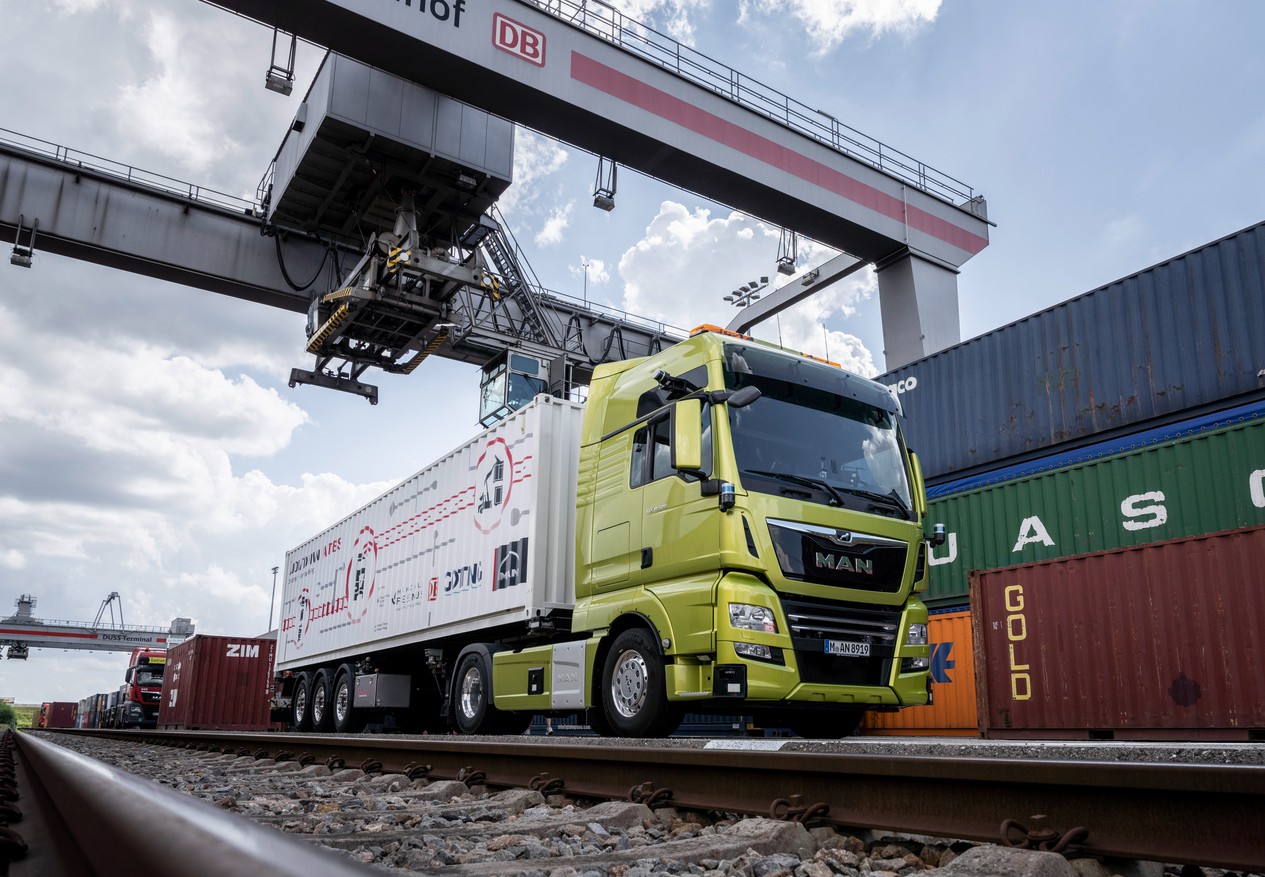
MAN Truck & Bus, Deutsche Bahn, Hochschule Fresenius, and Götting KG have jointly achieved groundbreaking research results in the use of an autonomous truck in container logistics. As part of the research project “Autonomous Innovation in Terminal Operations” (ANITA), they successfully demonstrated how self-driving trucks, with the appropriate integration into the infrastructure, can make combined freight transport on road and rail more efficient, predictable, and flexible in the future.
(Ulm) The project partners have developed an autonomously driving truck that can independently handle container transshipments from road to rail using digital mission planning. The research project, funded by the Federal Ministry for Economic Affairs and Climate Action, lasted a total of three years, with experts testing the vehicle in practical operations at the DB Intermodal Services container depot and DUSS container terminal in Ulm for about six months.
“In the development of autonomous driving systems, concrete logistics applications and customer benefits have been our focus from the very beginning. Therefore, in ANITA, we not only worked on the development of automated driving in a container terminal but also advanced the digital integration of the technology into the logistics process together with our partners. Only in this way can we meaningfully utilize the advantages of autonomous trucks in the future: the safety gains, the increased flexibility – especially in light of the growing driver shortage – the good combinability with other modes of transport, and of course, the optimal energy efficiency in operation, which becomes particularly important in connection with electromobility. ANITA is an important foundation for MAN to bring autonomous trucks to the roads as series solutions in the traffic between logistics hubs like Ulm starting in 2030,” said Dr. Frederik Zohm, Board Member for Research & Development at MAN Truck & Bus.
Intensive Test Drives Provide Comprehensive Insights
The intensive test drives with safety drivers and development engineers not only provided comprehensive insights for the continuous refinement of the autonomous driving function and its interaction with mission planning but also for the necessary preparation of terminals for the integration of the new technology.
“Combined transport will continue to grow in the coming years and play an important role in shifting traffic to environmentally friendly rail. To achieve this, the complex processes in the terminals must be made more efficient and accelerated. This can only be done if we further automate and digitize logistics processes. The project conclusion of ANITA has impressively shown what the future in the terminals can look like. The autonomous truck works in real terminal operations and can thus make a decisive contribution to the future viability of combined transport,” said Dr. Martina Niemann, Board Member of DB Cargo AG for Finance, Controlling, and Offer Management.
Communication with Depots and Terminals
For the autonomous truck of the ANITA project to fulfill its transport task in container transshipment, it must be able to communicate with the infrastructure of the DB IS depot and DUSS terminal. For this purpose, the scientists from Hochschule Fresenius analyzed the existing processes, workflows, and behaviors of people and machines on-site in the first project phase and transferred them into a digital set of rules. The Contract Specification Language (CSL) from Deon Digital serves as a common language for the clear and complete communication of all involved systems. This has resulted in a complete mission planning that connects both the vehicle and the IT systems of the DB IS depot and DUSS terminal.
Like a universal interpreter, the solution speaks the languages of all heterogeneous systems and guides the automated truck through the process of container transshipment, as Prof. Dr. Christian T. Haas, Director of the Institute for Complex Systems Research at Hochschule Fresenius, explains: “We have here a communication-intensive multi-agent system, meaning various actors such as truck drivers, crane operators, and forklift drivers use different forms of communication like speech, gestures, etc., and convey the information they deem relevant. Since in autonomous transshipments, it is not the driver who communicates with the dispatcher, but the truck that ‘talks’ to databases or other machines, a digital – that is, machine-understandable – communication system had to be developed to ensure the mission works. This was a high development effort, which has now also led to success and corresponding productivity gains.”
Expertise in Object Detection
Götting KG contributed its expertise in object detection and environmental sensing to the project in addition to MAN to enable future transferability to other logistics hubs and scalability for additional application scenarios. “To make driverless vehicles even more attractive, we are continuing to work on safe obstacle detection for greater ranges and speeds,” said Hans-Heinrich Götting, Managing Director of Götting KG, at the conclusion of the ANITA project.
More about the ANITA project: https://www.anita.digital
Photo: © MAN