leogistics has been on the path to success for 15 years
Sep 21, 2023 at 6:18 PM
LHG receives “Award for Reflective Governance Practice”
Sep 21, 2023 at 7:05 PM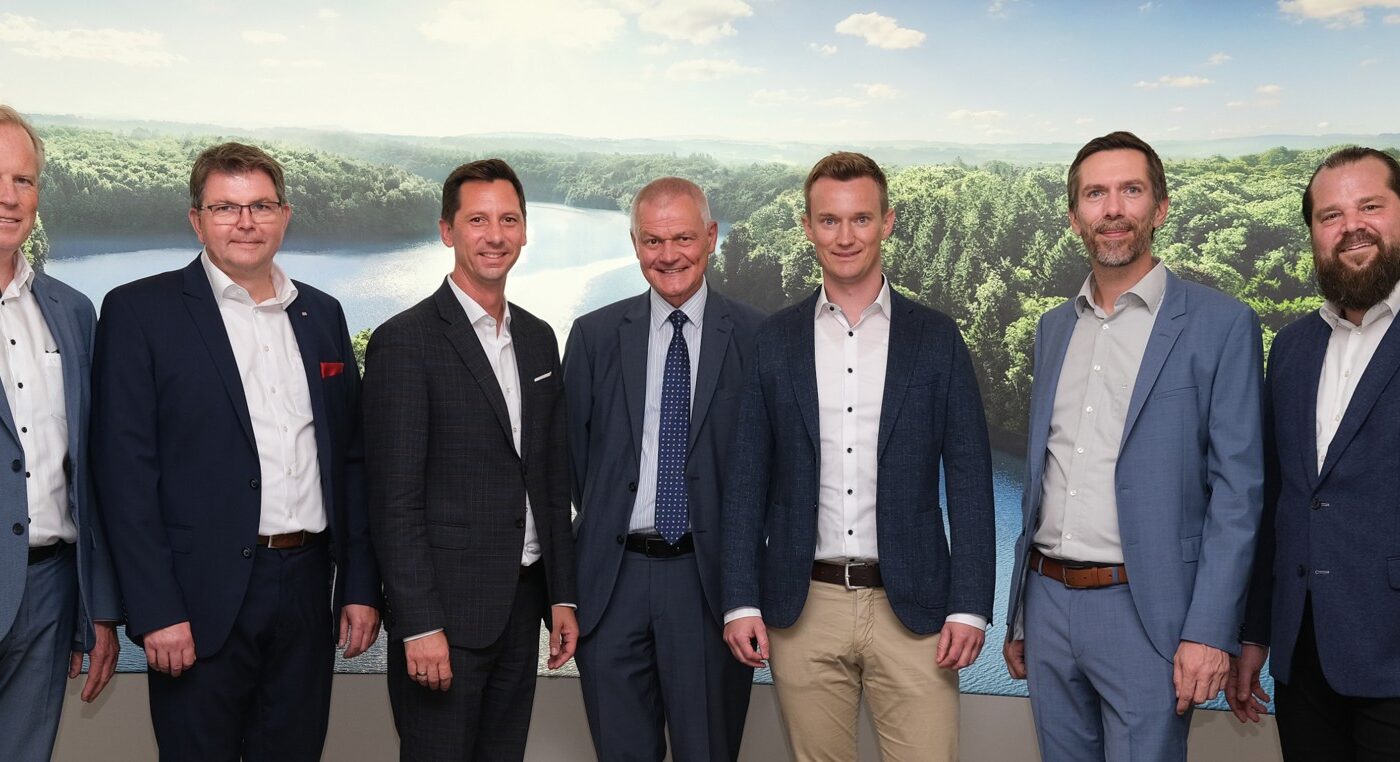
Shifting more freight to environmentally friendly rail is increasingly becoming a beacon of hope for industry and logistics. Especially in the southwestern Westphalia region, shippers are looking for reliable transport modes to deliver goods and products to customers. With the years-long closure of the A 45 motorway due to the construction of the Rahmedetal Bridge and overloaded alternative and heavy-duty routes, companies in the region urgently need alternatives for their logistics chains.
(Hamburg/Siegen) Intermodal transport is considered one of the most promising solutions. To successfully link different transport modes, the rail infrastructure must also be further improved. Here, both the state and federal governments want to invest even more.
Udo Sieverding, head of the Department of Environment, Nature Conservation, and Transport of North Rhine-Westphalia, emphasized: “The state government wants to bring more traffic onto the rail. Our infrastructure funding for non-federal railways (NE railways) demonstrates this. This year, it amounts to 12 million euros. The Siegen-Wittgenstein district railway has today received two additional funding notices totaling over 350,000 euros. The shift of freight flows to rail is necessary from a climate policy perspective and makes economic sense.”
This was one of the outcomes of the event Dialog.Schiene.Südwestfalen at the Krombacher Brewery Experience Center, which was attended by around 180 visitors. The joint event was organized by KSW Kreisbahn Siegen-Wittgenstein GmbH, Hafen Hamburg Marketing e.V., DB Cargo AG, Federal Association of Logistics e.V. Regional Group South Westphalia, and the IHK Siegen at the Krombacher Brewery in Kreuztal.
Good Example: Project LOG4NRW
Another solution is exemplified by the LOG4NRW project. DeltaPort, duisport, the Port of Dortmund, and the Siegen-Wittgenstein district railway aim to establish a rail and inland waterway system that shifts a significant portion of truck traffic in North Rhine-Westphalia to rail and waterways. If everything goes according to plan, the first trains, which could replace up to 27,000 truck trips per year, could start rolling by the end of 2023. The project connects the terminals in Voerde-Emmelsum, Duisburg, Dortmund, and Kreuztal. “We are very much looking forward to realizing a competitive seaport hinterland transport connection to the North and West ports for Germany’s third strongest economic region, South Westphalia, together with our partners in the foreseeable future,” says Christian Betchen, Managing Director of KSW Kreisbahn Siegen-Wittgenstein GmbH and Südwestfalen Container-Terminal GmbH.
The Krombacher Brewery has also implemented initial rail transports. “Together with KSW and DB Cargo, we have realized the possibility of 45-foot container transports in single wagon traffic for the destinations Berlin, Hamburg, and Bremen shortly after the bridge closure, a project with challenges. However, we remain persistent and will continue to work intensively to utilize and strengthen rail as a transport mode in the region,” says Michael Kröhl, Head of Logistics at Krombacher.
Sebastian Schilling, Head of Service Design at DB Cargo, emphasizes this development: “We have been sensing a comprehensive and significantly higher demand for climate-friendly transport solutions for some time now. Climate neutrality in logistics chains is already a strategic goal for many companies today and an important factor for sustainable business success. This also means engaging more with the possibilities and strengths of rail in logistics – with a further development of logistics systems towards greater rail affinity.
There Are Also Critical Voices
Despite many positive approaches, there were also critical voices pointing out the currently limited possibilities of rail. Many projects are planned long-term and cannot help right now. For example, Sebastian Scheffler, Head of Project Logistics Hilchenbach, SMS group GmbH, pointed out: “Especially in the area of heavy transport, rail transport is particularly interesting for our company. However, for some of our products that could technically be transported by rail, the availability of wagons is very limited, and the dilapidated infrastructure combined with the significant backlog of investments is an additional problem. Moreover, freight rates compared to road freight transport are only conditionally competitive. Nevertheless, we see great potential for increased collaboration.”
With the expansion of the Ruhr-Sieg and Sieg lines, not only would relief for the Rhine line be possible. It could also represent a new opportunity for companies in the region. At least, an expansion is already included in the urgent needs of the Federal Transport Infrastructure Plan. Between Hagen and Siegen alone, ten tunnels need to be widened, bridges adjusted, new overtaking opportunities created, and signal and interlocking technology updated. However, to relieve the companies in the region as soon as possible, accelerated planning by the federal government is required, so the demand. A political commitment from the federal government to quickly create more capacities for this regionally significant line is also the order of the day. “The preliminary planning alone is supposed to last until 2026. The timeline thereafter is uncertain. If we continue to afford this German pace in rail expansion, the region will lose economic dynamism,” says Hans-Peter Langer, Managing Director of the Siegen Chamber of Commerce and Industry.
A45 as an Example of Necessary Shift to Rail
All discussion participants agreed that a shift of freight traffic is absolutely necessary. The example of A 45 prompted companies to rethink transport logistics – and to incorporate rail more strongly than before as part of the supply chain. Now it is up to politics to create the infrastructure to turn this into a sustainable and economically sensible product.
Photo: © Hafen Hamburg/Carsten Schmale / Caption: The organizers of the fourth Dialog.Schiene.Südwestfalen. (l. to r.): Udo Sieverding (Head of Department at the NRW Ministry of Transport), Sebastian Schilling (Head of Service Design at DB Cargo), Andreas Müller (District Administrator of Siegen-Wittgenstein), Klaus Gräbener (Managing Director of the IHK Siegen), Julian Mack (BVL Regional Group Leader), Markus Heinen (HHM Representative West), and Christian Betchen (Managing Director, KSW Kreisbahn Siegen-Wittgenstein).