


Rhenus Expands in Dietzenbach and Builds New Facility in Nuremberg
Aug 24, 2023 at 3:50 PM
Schuon Continues Consistent Modernization of Its Fleet
Aug 24, 2023 at 4:22 PM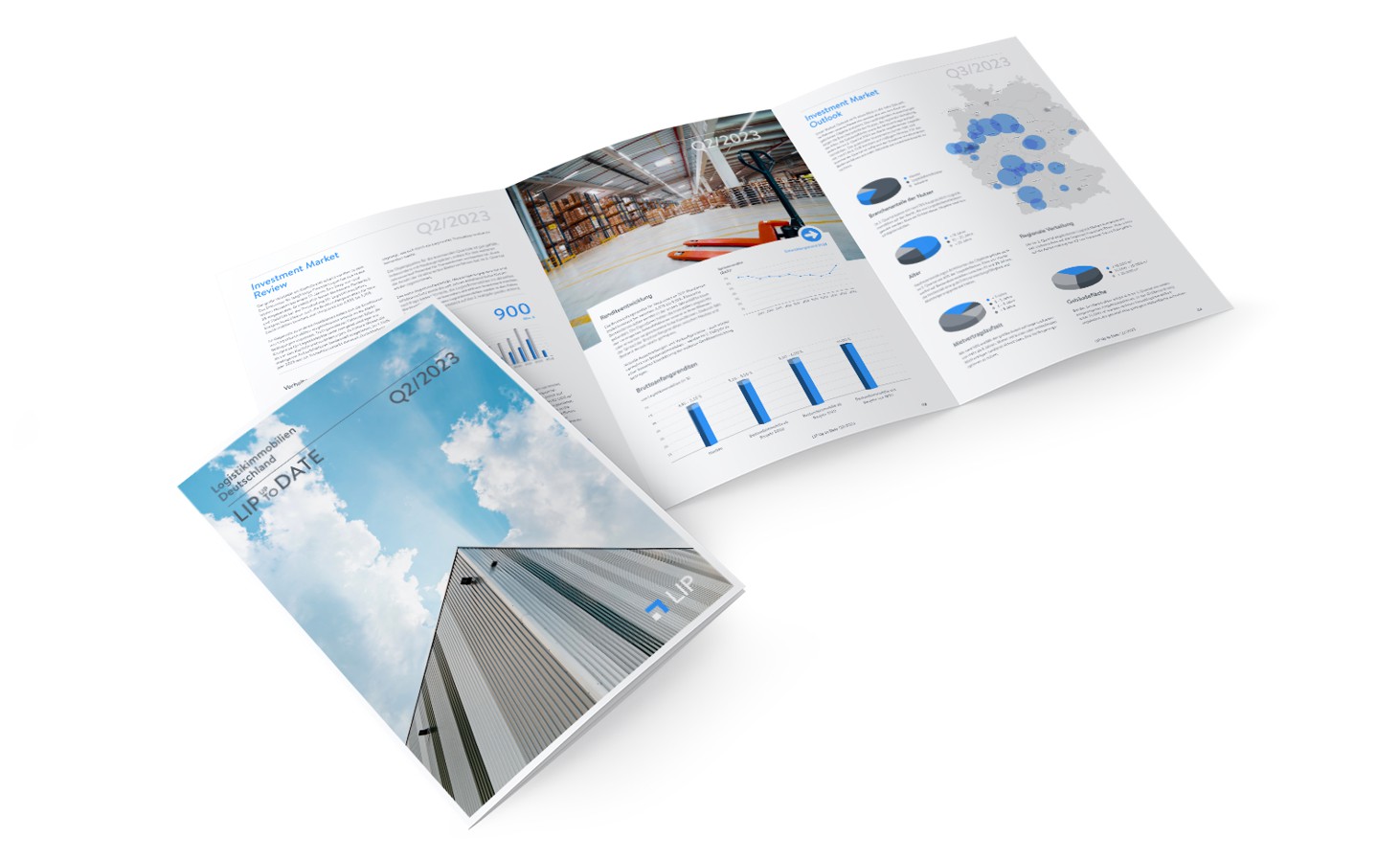
LIP Invest, a leading provider of real estate special funds for institutional investors in the asset class of logistics real estate in Germany, publishes its quarterly market report “LIP UP TO DATE – Logistics Real Estate Germany” detailing current developments in the highly sought-after asset class of logistics real estate.
(Munich) In addition to a review of the second quarter of 2023, the report also provides an outlook on the development of the investment market for the third quarter of 2023. The market report includes figures and information on transaction volume, space turnover and new construction volume, yield development depending on building age, location, property quality, and lease term, as well as interest and market developments.
The significant volatility in the capital market seemed to have passed. The basis for long-term financing had stabilized in recent months around the 10-year swap at about 3 percent. This facilitated easier price discovery for buying and selling logistics properties. Accordingly, the gross initial yields for new properties remained constant compared to the previous quarter at 4.85 to 5.10 percent in the second quarter.
Somewhat surprisingly, the last interest rate hike from July 2023 had an impact on long-term interest rates, leading to an increase of about 0.20 percent. This increase will – albeit only slightly by about 0.10 to 0.15 percent – exert further pressure on logistics yields. Therefore, we expect gross initial yields of 4.95 to 5.20 percent for high-quality modern logistics properties in good locations in the third quarter.
In contrast to other asset classes, the conditions for logistics properties have adapted relatively quickly to market conditions. Despite decreased factors, the purchase prices for logistics properties are not necessarily lower than before the capital market changes, as higher rents tend to offset the lower purchase factors. Nevertheless, there was a noticeable restraint in the transaction market in the first half of 2023, reflected in a limited transaction volume. However, the property pipeline for the coming quarters is well filled, especially with new construction projects, indicating potential for transactions in the remainder of the year. The number of structured bidding processes also increased again in the second quarter.
“Logistics properties are once again at the starting line as one of the first asset classes after the capital market changes of last year: Suitable purchase objects are available; user demand remains; capital market parameters have stabilized, facilitating price discovery – now is the right time for decisive investors to enter,” says Bodo Hollung, partner and managing director of LIP Invest.
Investment Market
In the second quarter, approximately 900 million euros were invested in German logistics properties. As a result, the transaction volume for the first half of the year falls to 1.8 billion euros, the lowest level since 2015. In the first six months, hardly any large-volume portfolio transactions were completed, significantly impacting the half-year results. In contrast, the importance of strong individual transactions is evident. Among the largest deals in the second quarter was the sale of an 81,800 square meter logistics property in Pohlheim near Gießen, which generates an annual net rent of 3.8 million euros.
The gross initial yield for new buildings in prime locations remains constant between 4.85 and 5.10 percent. Classic existing properties were hardly traded in the first half of the year. Owners are currently holding onto properties in light of the reduced purchase factors or are expecting relatively high conditions. As a result, the spread of gross initial yields between new and existing properties is currently relatively low.
Current tenders and sales processes – in the second quarter, existing properties were also increasingly offered – will contribute to a better assessment of future yield developments in the remainder of the year.
LIP continuously analyzes developments in the German logistics real estate market. This includes monitoring the supply situation. In the second quarter of 2023, properties with a volume of around one billion euros were offered for sale. The potential investment volume remains at a moderate level of around one billion euros. Due to the increase in structured bidding processes, more activity in the investment market is expected in the coming quarter. In the second quarter, around 70 percent of the properties that came onto the market were logistics properties used by logistics service providers.
New construction activity increased slightly in the second quarter to about 900,000 square meters compared to the first quarter, but remains moderate. In total, around 1.6 million square meters of new logistics space were built in the first half of the year. The largest construction start of the quarter is the speculative project development by P3 in the Jade Weser Port Wilhelmshaven freight transport center with around 140,000 square meters of logistics space. Compared to previous years, the new construction volume for the entire year is expected to be significantly lower, which is likely to further exacerbate the supply shortage.
Space Turnover
In the second quarter, a total of 1.3 million square meters of logistics space were rented or newly built, resulting in a similar outcome as in the previous quarter. The space turnover for the first half of the year amounts to 2.5 million square meters. Among others, the automobile manufacturer BMW has leased an 82,000 square meter logistics center in Pilsting, Lower Bavaria.
Currently, a slight increase in subleases is observed, as the additional buffer capacities created last year are not always needed. Third-party usable logistics properties can even be subleased at higher conditions in some cases. A slight decrease in demand in some regions is attributed to a recalculation by logistics companies due to the sharply increased rental prices and the elimination of special effects from last year. In many regions, the lack of available space remains the limiting factor.
Will Logistics Properties Soon Come from a 3D Printer?
3D printing processes are already being used in many application fields of the logistics industry, for example in spare parts logistics. The real estate industry has also experimented with 3D technology. For instance, in Beckum, North Rhine-Westphalia, a prototype of a single-family house was created in just under four days, while in Heidelberg, the largest building in Europe made of recyclable concrete is being “printed” layer by layer. The house printing process could significantly contribute to making construction faster, more economical, and environmentally friendly in the future. However, the technology is not yet suitable for mass production, but rather a costly endeavor that only a few companies in Germany offer. It will therefore take some time before logistics properties can be printed in a very short time. Logistics companies that already undertake light production activities could also offer 3D printing in their halls, potentially creating further demand for space.
Download the study here
Photo: © LIP Invest