


Hako inaugurates new logistics center in Bad Oldesloe
May 29, 2023 at 5:00 PM
Eco Performance Award Finalist Bächle Logistics Introduces Itself
May 29, 2023 at 5:52 PM
The second “repair amendment” for the electricity price brake law, which will be introduced by the coalition in the Bundestag today, contains important corrections for freight railways that were excluded from aid due to blind spots in the previous law. Long-term increases in railway electricity prices, combined with the still noticeable war-related price shock, are leading to a shift to road transport and triggering demands for a long-term strategy.
(Berlin) The electricity price brake has limited the crisis-related skyrocketing electricity costs for many railway companies since March. However, companies that have converted a large part of their own vehicles from diesel to a more climate-friendly electric drive in the last two years have hardly benefited from the electricity price brake at all. The reason: Relief payments are tied to data from 2021. This injustice is to be corrected in the repair amendment introduced in the Bundestag today. Special regulations are planned for the affected railway companies to ensure that the reliefs work evenly for all market participants. Additionally, the conditions for all railway companies will be slightly improved. “We see the expected changes as an important encouragement for the industry, especially for companies that have invested during the crisis. As a result, all freight railways will benefit more from the reliefs, while fair competitive conditions on the rail are created,” comments Ludolf Kerkeling, Chairman of the FREIGHT RAILWAYS.
However, even if fair conditions arise within the railway sector, there is a lack of a strategy to establish the same in competition with trucks. The railway electricity price with the electricity price brake is still at least three times higher than in 2021, when it averaged 6.4 cents per kilowatt-hour (or 64 euros per megawatt-hour, further explanations in the INFO below). The diesel price today is hardly higher. Especially in the intermodal, particularly competitive segment of combined transport by rail, there was a significant drop in the first quarter of 2023 – transport volumes fell by almost 14 percent, a similar figure to the Corona times. “It is financially worthwhile for customers to drive the entire distance by truck more often again. Combined transport is the growth path par excellence if we want to shift traffic, including packages and other light goods, to climate-friendly rail,” explains Ludolf Kerkeling.
Fear of a future without the electricity price brake
The industry’s concerns are also directed towards a future without the electricity price brake: it is limited until spring 2024. The question is how to prevent the climate-friendly rail from being priced out of the market if the railway electricity price is long-term above the diesel price development. A solution could be the industrial electricity price law from the Ministry of Economics, which currently only exists as a rough working paper but is supposed to guarantee a fixed, competitive price for “energy-intensive industry.” Kerkeling: “After the positive experiences with the electricity price brake, we firmly expect that rail transport will also be classified as energy-intensive and that the industrial electricity price will advance the achievement of climate protection goals in transport.”
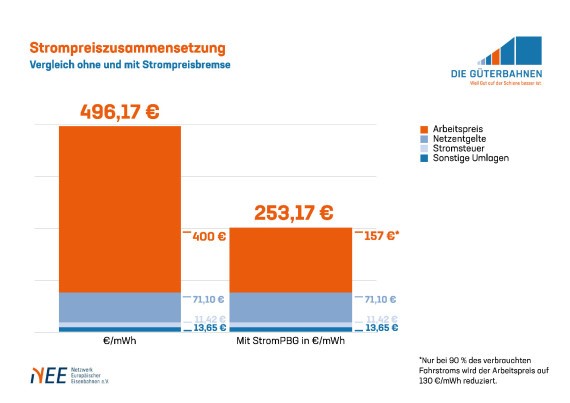
The electricity price brake often leads to misunderstandings in rail freight transport: The striking figure of 130 euros per megawatt-hour (or 13 cents per kilowatt-hour) that traction current allegedly costs according to the electricity price brake law has become established among most customers of railway companies. It is overlooked that only a part of the traction current demand, namely the working price, is affected by the relief. However, the railway electricity price in Germany includes additional components beyond the pure procurement costs that can drive up costs. These components are not covered by the electricity price brake and are therefore not reduced.
Example (for the complete calculation here):
The costs for one megawatt-hour of electricity have thus been significantly reduced, but not to 130 euros, but to 253 euros – nearly double the often assumed costs.
The significant additional costs that have arisen for freight railways since the beginning of the energy crisis have therefore not been eliminated by the electricity price brake: The same megawatt-hour of electricity would have cost around 160 euros in 2021, including network charges, taxes, and levies, only about 63 percent of today’s relieved price.
Photos: © THE FREIGHT RAILWAYS