


A transport logistic of superlatives has come to an end in Munich
May 15, 2023 at 7:40 AM
Swiss Post Reports Significant Decline in First Quarter
May 17, 2023 at 7:06 PMLucerne University of Applied Sciences and Arts Aims to Revolutionize Rail Freight Transport
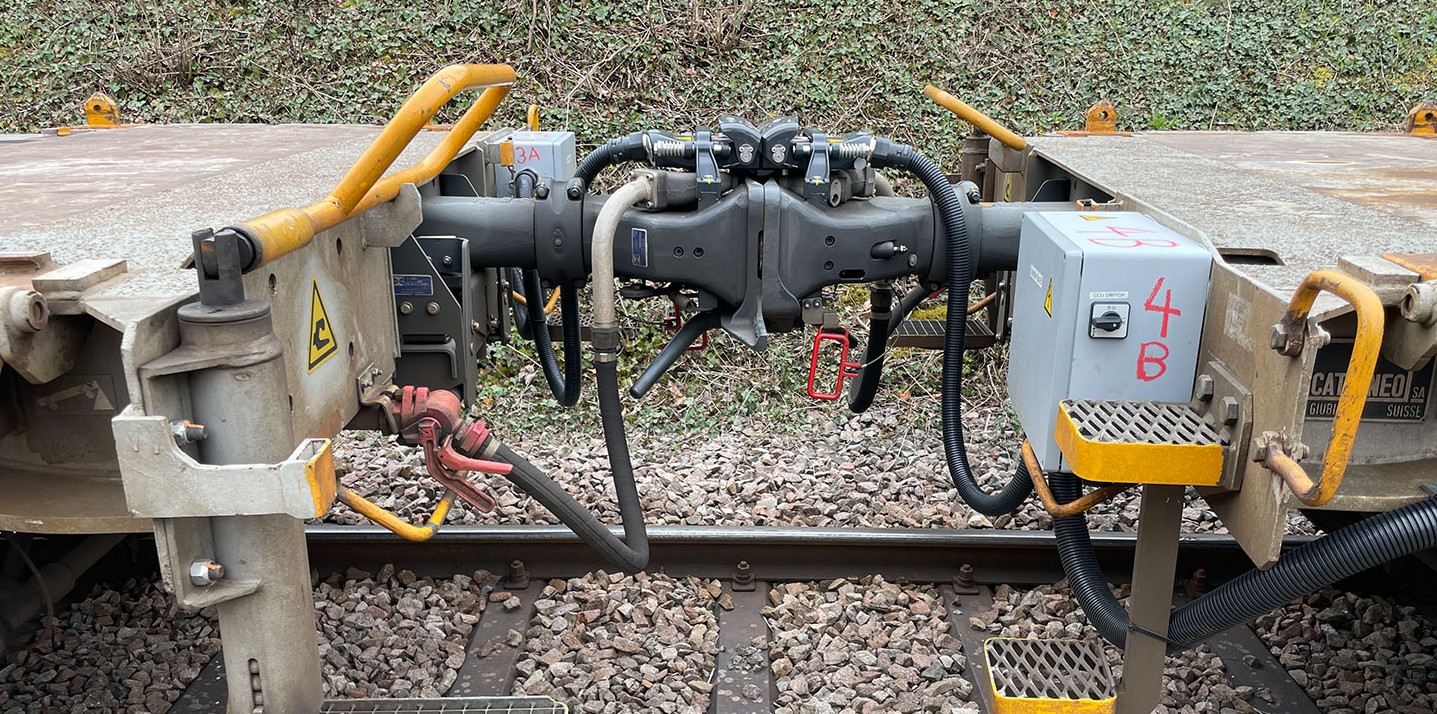
Sending data via power cables: HSLU researchers have made this method usable for coupling freight trains. This is intended to make rail freight transport faster and safer. A pilot trial is currently underway, attracting attention across Europe.
(Lucerne/Wildegg) Monday morning in the canton of Aargau. The guests in the buffet at Wildegg station have no idea that a futuristic train has just passed by outside the window. At first glance, it appears to be an unremarkable freight train. It does not reveal that it is generating interest among experts across Europe. The logo “DAC+” is prominently displayed on the first car. The train composition slowly rolls onto a siding, right next to the impressive industrial area of the building materials manufacturer Jura Cement. Here, an international research team wants to conduct some test maneuvers with the train, as the six cars are equipped with a new coupling system that could revolutionize freight train operations.
Digital coupling instead of ancient technology
Technically, rail freight transport has hardly evolved in the last hundred years. To this day, the work processes are largely manual. Coupling freight cars is a physically demanding job that takes place outdoors in all weather conditions. And that’s not all: before every departure of a freight train, one or two employees must manually check each individual brake, as there is no digital information system. Depending on the length of the train, this involves a long walk. From a business perspective, this costs time and money.
But the lack of an information system is not only detrimental during the preparation for departure. It would also enable useful functions during the journey. For example, it is currently not possible to check from the driver’s cab whether the train is still complete. Therefore, following trains must maintain a large safety distance, which affects the entire train traffic. Efforts are underway across Europe to modernize rail freight transport. SBB Cargo is one of the pioneers with the “DAC+”. The pilot project has been running since February 2023. The acronym stands for Digital Automatic Coupling. This is intended to create a mechanical connection between the cars without manual labor from shunting personnel. At the same time, the DAC+ is also supposed to automatically connect the air line for the compressed air brake system and a power line.
National project with European impact
Simply put, the coupling of the future consists of two basic components: The base is the massive coupling head, which connects and pulls the cars. Additionally, an electronic coupling is installed above it. This can transmit various information about the condition of the cars and brakes to the driver’s cab of the train, and in the future, further applications may be added. The new coupling system is also designed to allow trains to operate across borders and couple cars from different nations.
A first preliminary decision has already been made at the European level: In January 2021, the “European DAC Delivery Programme” (EDDP) selected the type of future coupling head: the so-called Scharfenberg system. SBB Cargo has made a significant contribution to this political decision: The company developed, tested, and put the Scharfenberg coupling head into operation in 2019 as the first railway operator in Europe during a long pilot phase in collaboration with the engineering company Voith.
In the coming months, the focus will be on defining the technology for data transmission at the European level. Experts at the Institute of Electrical Engineering at Lucerne University of Applied Sciences and Arts have made a method usable that does not require a separate cable for communication data, as it is transmitted via power cables. “This means: fewer cables, fewer contact points, and thus less vulnerability to failures or disruptions,” says Gerd Dietrich, a research associate at HSLU. The technology is already being tested in airplanes, and now it aims to revolutionize rail freight transport.
Does data transmission work in curves?
Back to Wildegg in Aargau: The cars of the pilot train DAC+ are already equipped with the new DAC coupling heads. Above them, the prototypes of the electronic coupling are installed. The electronic components of this coupling are not visible at first glance. They are well protected under a black plastic membrane. Gerd Dietrich, a research associate at HSLU, briefly lifts this by hand and explains: “The data transmission via power cables has the additional advantage that it is very robust and functions flawlessly even with short interruptions in contact.” In a freight train, which vibrates slightly during travel and must adapt to the curvature of the tracks, this is a significant advantage.
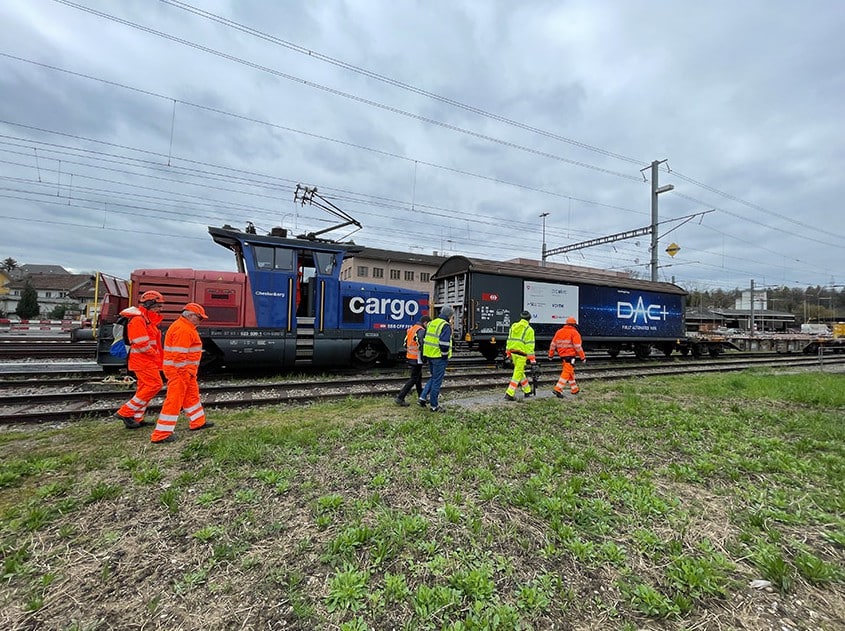
The new coupling is currently being tested at various locations in Switzerland, well labeled.
Currently, two techniques are still in the running across Europe that could serve for data transmission in freight trains. Which one will ultimately prevail is still open. Currently, the power line communication technology from HSLU is in the lead, as there have only been a few provisional field trials with the other system – called Single-Pair Ethernet. The data transmission via power cables will now be thoroughly tested on the pilot train DAC+ for a whole year. In Wildegg, the program includes tight curves, automatic coupling, and automatic brake checks. However, the path from prototype to market launch is still long and poses enormous challenges. An empty freight car weighs 20 tons, and during the coupling process, this weight is accelerated to up to 12 kilometers per hour. This leads to high stress forces under which the contacts must function reliably.
Process optimization and time savings
Nevertheless, the hope placed in the digitization of rail freight transport is great. Currently, railway operators are under pressure due to acute staff shortages. Automated train functions could significantly simplify work processes and contribute to time savings – from remote uncoupling, better monitoring during travel, to more targeted maintenance, as wear can be determined based on data quality.
There is a rumble and a bang. Train driver Alexander Gyger has set the pilot train’s power car in motion using a remote control and has slowly let it roll onto two uncoupled freight cars. A short hissing sound, Gerd Dietrich glances at the coupling. Perfect. The pneumatic brake system has automatically connected, and the electronic data transmission is also functioning. The maneuver is repeated for each of the six cars. Then it is time to depart, as the train still needs to complete test runs on longer curves. The schedule in Switzerland is tight, and the tracks are only available for a short time window.
Meanwhile, the guests in the buffet at the station enjoy their coffee, which may in the future be delivered by freight trains with PLC coupling.
The international consortium that developed this pilot train consists of SBB Cargo and the Competence Center for Intelligent Sensors and Networks at Lucerne University of Applied Sciences and Arts, the companies Voith, PJM, and plc-tec, a spin-off of HSLU. The ambitious project is supported by the Federal Office of Transport (BAV).
Photos: © HSLU