

Klinkhammer Installs Exotec System for Kühne+Nagel
Feb 3, 2023 at 3:43 PM
Short Relaxation with the Country Song “Freight Train”
Feb 3, 2023 at 4:13 PM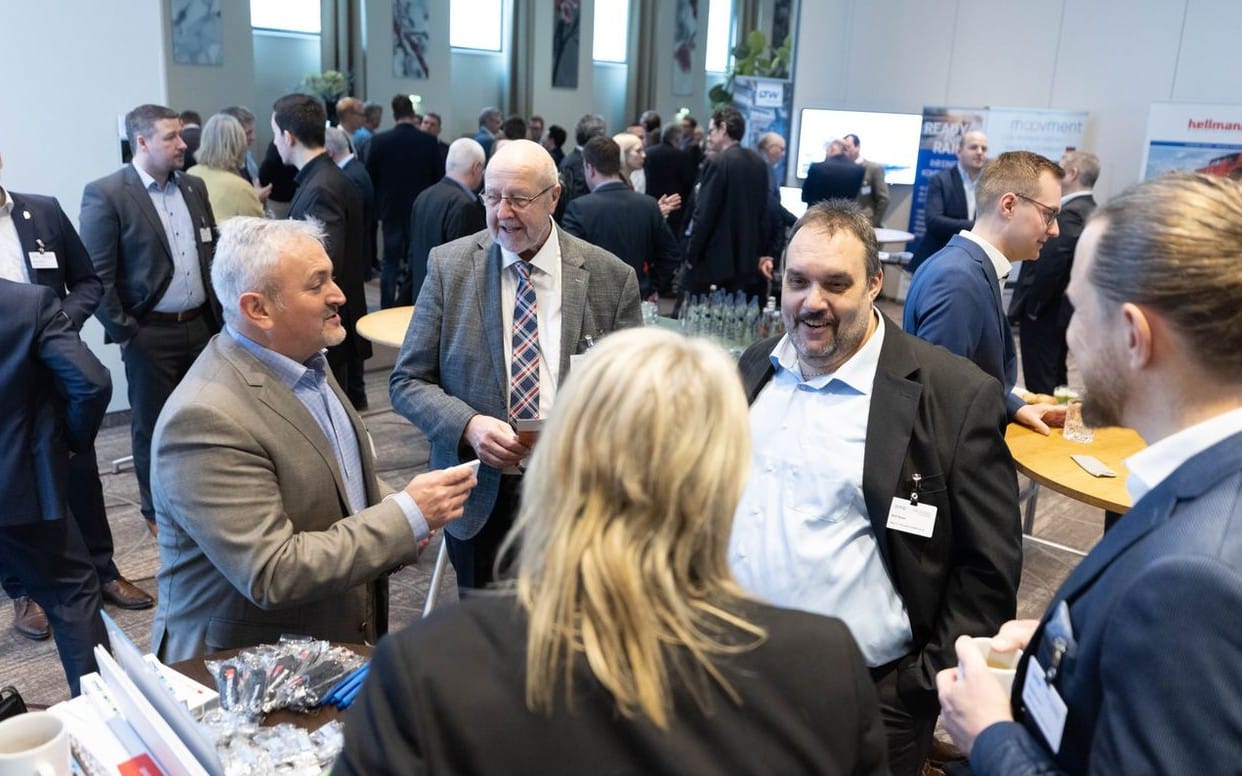
The rail freight transport (SGV) in Germany is in fierce competition with other modes of transport. To achieve the 25 percent market share demanded in the coalition agreement of the federal government by 2030, shippers and service providers must work even more closely with politics.
(Eschborn/Berlin) This is also true with regard to the successful realization of ambitious climate policy goals, concludes the 16th BME/VDV Forum on Rail Freight Transport, which concluded on Thursday (February 2, 2023) in Berlin. The event focused on strengthening the rail transport mode. Other topics of the two-day specialist event with more than 200 participants included intelligent relocation concepts for light and fast goods as well as digital solutions in the field of SGV and KV.
“The rail is the most environmentally friendly land transport mode. In times when climate change occupies large parts of people and companies – not least because of climate goals – this is the greatest asset of SGV,” emphasized Carsten Knauer, Head of the Logistics Section/Advisor to the Specialist Groups of the Federal Association of Materials Management, Purchasing and Logistics e.V. (BME), on Thursday after the conclusion of this year’s BME/VDV Forum in Berlin. However, he believes there is still a need for improvement in terms of digitization, transparency, and collaboration. The existing data must be exchangeable openly and seamlessly. Only in this way can improvements be made in reliability and punctuality. Knauer stated: “The BME-VDV Congress has shown that collaboration among various actors – from shippers to rail transport companies (EVU) to terminal operators and freight forwarders – is very much possible. It is desirable that politics also comes back on board at the next congresses and takes up the sector’s suggestions firsthand.”
Political Support Will Remain Necessary
The Vice President of the Association of German Transport Companies (VDV), Joachim Berends, pointed out that “we still need political support. This applies to improving competitive conditions compared to road transport and to the issue of financing. Accelerating planning and construction remains at the top of the agenda. We had a good process with all parties involved in the rail acceleration program. This has now stalled because the federal government is not in agreement on prioritization in the legislation. This is not good, as we need the acceleration law very soon to upgrade and expand the railway network. There are also several funding measures on the table of the federal government that need to be implemented. First and foremost, the guideline for promoting single wagon traffic.”
The more than 200 participating shippers from all industrial and commercial sectors, as well as service providers from the railway sector, rail transport companies (EVU), and rail freight forwarders, used this year’s forum to exchange ideas on intelligent solutions for the efficient development and expansion of future-proof transport routes using rail.
More than 50 Trains per Week
Dr. Christoph Hempsch, Head of Sustainability Post & Package Germany at Deutsche Post DHL Group, informed in his presentation that “the expansion of fast, light freight transport is an important part of the sustainability strategy” of his company. According to him, the rail is “an environmentally friendly solution for the interregional transport of packages.” More than 50 trains are deployed weekly; in the weeks leading up to Christmas, there were even over 70. According to Hempsch, six percent of all DHL packages are already transported by rail – especially on long transport routes. The rail is “especially on weekends a very good alternative to trucks, allowing for the rest periods of truck drivers.” However, Hempsch also stated that “the shift of time-sensitive transports to rail must offer at least a balanced ratio of opportunities (emission reduction, transport capacity on Sundays, positive customer perception) and risks (reliability, punctuality, flexibility with volume fluctuations).” He finally admitted that “rail transports in our network lead to significantly longer transport durations compared to road transport.”
For Gerhard Oswald, Managing Partner of Gomultimodal GmbH, rail is a strong component in the development and implementation of sustainable transport concepts. To achieve ambitious climate goals, shifting truck transports to environmentally friendly combined transport is an important lever, Oswald emphasized in his presentation. For shippers, combined transport represents the ideal solution for internal CO₂ corporate goals. The success of the Gomultimodal projects “Ready for Rail” and “Moovment” should primarily be measured not in euros, but in avoided tons of CO₂. The big goal is to avoid one million tons annually.
Combined Transport Accounts for Over 30 Percent
Michail Stahlhut, CEO of Hupac, a network operator in intermodal transport in Europe, advocated for combined transport (KV) in his statement. He reminded that more than 30 percent of the rail market in Germany comes from KV. He is convinced that KV will be the growth driver in modal split, even though current deficiencies in infrastructure create disruptive effects in quality and capacity. Stahlhut called for a performance boost from the rail community in this context. “The rail system must achieve more with the same number of trains. Therefore, increasing train lengths to 740 meters is a priority,” Stahlhut stated. KV is “the spearhead of CO2 savings. There needs to be a strong claim to one’s own performance and the reduction of waste at all levels. For this, we must first utilize what we have and then additionally expand the capacity of the terminal landscape.”
Photo: © Peter-Paul Weiler/BMV