HEINLOTH Expands Refrigerated Furniture Logistics
Nov 20, 2022 at 6:10 PM
Gebrüder Weiss Expands Its Logistics Hub in Tbilisi
Nov 20, 2022 at 6:20 PM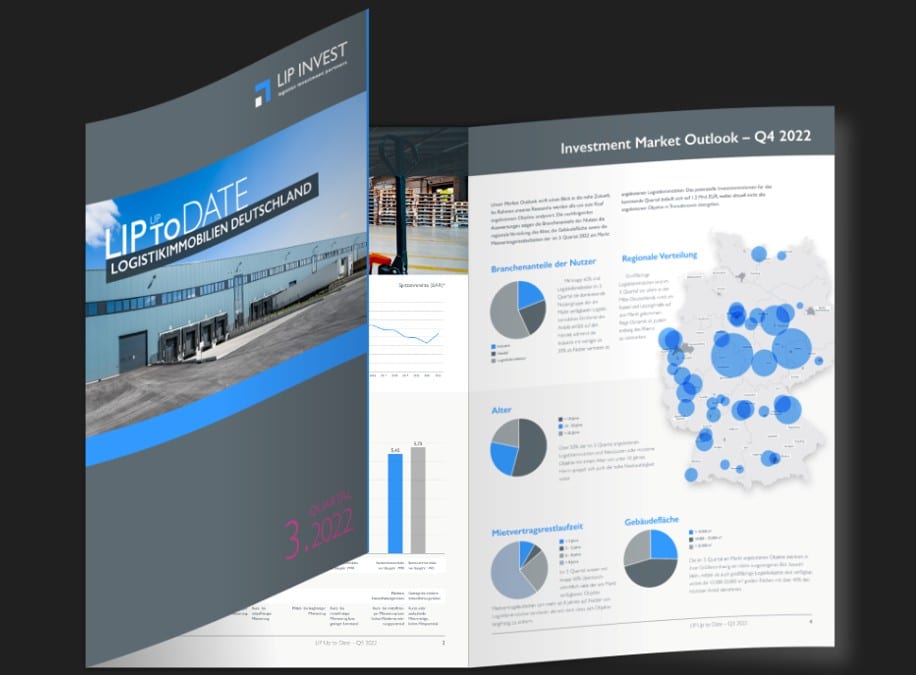
LIP Invest, provider of real estate special funds for institutional investors in the asset class of logistics real estate in Germany, publishes its quarterly market report “LIP UP TO DATE – Logistics Real Estate Germany” detailing current developments in the highly sought-after asset class of logistics real estate.
(Munich) In addition to a review of the third quarter of 2022, the report also provides an outlook on the development of the investment market for the fourth quarter of 2022. The market report includes figures and information on transaction volume, space turnover and new construction volume, yield development depending on building age, location, property quality, and lease term, as well as interest rates and market events.
Market Overview
The investment market for German logistics real estate proved surprisingly stable in the third quarter. Despite significant interest rate increases and high volatility with interest jumps of up to 0.5 percent within a few days, rising inflation, and a challenging price discovery process, the transaction volume in the first nine months exceeds the long-term average. While transaction activity remained high in the third quarter, the results are largely based on deals initiated earlier in the year. Currently, buyers and sellers are finding it increasingly difficult to connect. The situation is reminiscent of the time of the global financial crisis in 2008, when the gap between the price expectations of potential buyers and the value perceptions of property owners widened significantly.
Despite the challenging economic conditions with rising energy prices, supply shortages, and disrupted supply chains, demand for space from users remains very high. Even in light of the increased construction costs, the market for new builds continues to develop dynamically. However, the supply side is increasingly acting as a brake. The lack of available existing spaces and the ever-diminishing availability of suitable plots significantly hinder higher space turnover.
Natalie Weber, authorized signatory and Head of Fund Management at LIP Invest, predicts a significant decline in transaction activity by the end of the year, along with a further increase in yields. “With financing rates of around 4 percent or higher, we will likely soon see yields of over 5 percent for new builds. Properties acquired in recent years at lower yields are expected to maintain their capital values due to rent adjustments.”
Investment Market
Instead of the anticipated decline in transaction activity, the transaction volume in the third quarter remained at 1.9 billion euros, matching the level of the previous quarter. The surprisingly strong result is largely based on previously initiated deals that were finalized in the third quarter. Some large individual deals, such as the purchase of a 60,000 square meter logistics new build in Kerpen for 115 million euros, contributed positively to the quarterly result. Overall, the transaction volume for the first nine months amounts to 8.0 billion euros, primarily due to the strong first quarter.
The changed interest rate conditions have now arrived at the logistics real estate market with some delay. The gross initial yield for modern logistics properties was 4.35 percent in the third quarter. By the end of the year, the peak yield is expected to rise further.
LIP continuously analyzes developments in the German logistics real estate market. This includes monitoring the supply situation. In the third quarter, properties with a volume of 1.2 billion euros were offered for sale. However, not all logistics properties currently available on the market are actually being transacted. With nearly 60 percent, logistics service providers are the dominant user group of the logistics properties available on the market in the third quarter, while the industrial sector is represented to a much lesser extent.
Space Turnover
Due to the limited supply of logistics properties, the rental market slightly stagnated in the third quarter. With 1.8 million square meters, less logistics space was transacted than in previous quarters. Nevertheless, the result of the first nine months, with 6.2 million square meters, exceeds the previous year’s result, primarily due to the strong second quarter. The largest transaction of the third quarter was the rental of 70,000 square meters of logistics space to Moeller Maersk in Bremerhaven.
Overall, user demand remains at a high level, which is also reflected in new construction activity. In the third quarter, 1.4 million square meters of new logistics space were constructed. Thus, the new construction activity for the first nine months amounts to 4.1 million square meters. In September, the project developer Lang & Cie. Industrial announced the start of construction of a 67,000 square meter multi-user center in Koblenz. The rental spaces are already fully leased before completion in 2024.
Outlook
Given the current geopolitical upheavals, uncertain energy supply, and rising prices worldwide, making predictions is challenging. Not only the logistics industry – keywords include availability of labor, driver shortages, availability of space, and infrastructure – but the entire German industry needs stronger support from the political side. Germany is among the best logistics locations in the world. Both the demand for space from users and the interest in logistics real estate will remain high. The asset class has the advantage of inflation protection compared to fixed-rate bonds. Therefore, sellers and buyers will find each other again after a challenging price discovery phase. However, this will not be possible without significantly higher rents.
Trends in Logistics: Strong Demand for Storage Options for Lithium-Ion Batteries
Electromobility is becoming increasingly prominent in the logistics real estate sector. More and more companies – particularly from the automotive industry – are inquiring about space for battery storage. Not every logistics property is suitable for this purpose, especially since there are still no uniform public regulations for proper storage. Therefore, each property must be individually assessed for its suitability.
When storing and handling e-batteries, fire protection is a particularly important consideration. Lithium-ion batteries are highly flammable hazardous materials. They can unintentionally catch fire if mishandled, subjected to extreme temperature influences, or mechanically impacted.
Logistics properties must therefore be equipped with a fire protection system – including an early-triggering fire alarm system – that responds quickly, specifically, and with the correct extinguishing agent. Since extinguishing agents based on powder or foam are less effective, experts recommend sprinkler systems with high water application. In addition to fire protection doors with extinguishing water retention, logistics properties should have a WGK seal to prevent contaminated extinguishing water from entering the groundwater.
Finally, it is essential to document the specifics of battery storage from the outset in the building insurance and to involve the relevant authorities or fire protection experts.
The market report is available for free download at https://www.lip-invest.com/de/research-forschung#forschung.
Photo: © LIP Invest GmbH