


Yusen Logistics Opens New Location in Southern Germany
Sep 18, 2022 at 4:45 PM
KATMA CleanControl Saves Time, Water, Chemicals, and Energy
Sep 18, 2022 at 4:55 PM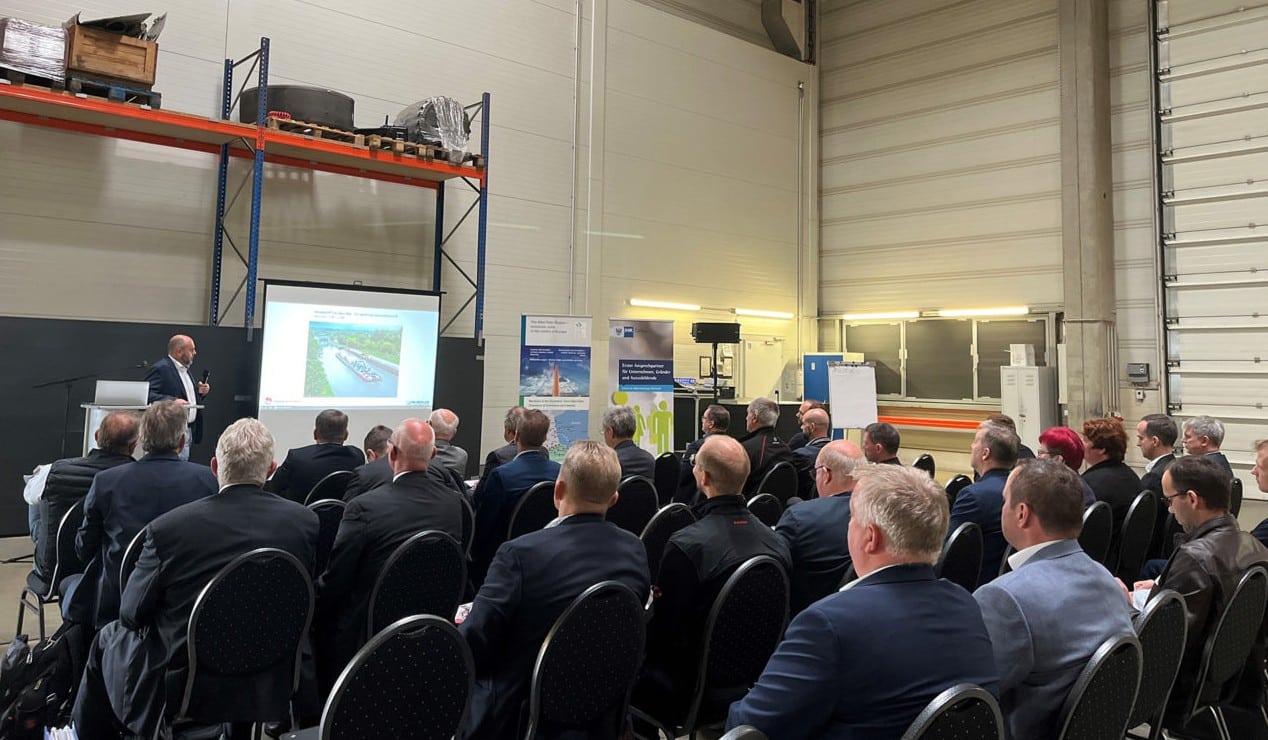
As part of a joint event organized by the Chambers of Commerce and Industry of Cottbus, Dresden, Halle-Dessau, Leipzig, and Magdeburg in cooperation with the Elbe Alliance e. V., the Elbe-Oder Chamber Union, and the Central Germany Logistics Network, numerous companies have demanded the implementation of the “Overall Concept Elbe.” This concept was already adopted in 2017 by the Federal Ministry of Transport and the Federal Ministry for the Environment. The federal states along the Elbe, including Brandenburg, Saxony, and Saxony-Anhalt, were also involved in the decision.
(Riesa) The “Overall Concept Elbe” was developed with the aim of ensuring the navigability of the Elbe while simultaneously preserving environmental and flood protection. However, little has happened in this regard to date. For this reason, business associations and companies invited transporters and shippers to the Riesa port to jointly point out the shortcomings in the expansion of the Elbe inland waterway.
Central Demands to Politics
As a result of the conference, the participants formulated the following positions:
Inland shipping as a resource-saving transport option must not fall out of the focus of politics. Especially for specific transport tasks such as parts of wind turbines, they contribute to relieving the road network.
Inland ports are part of the public transport infrastructure and play an important role as transshipment points not only for waterways. A large part of the truck-to-rail transshipments takes place in inland ports. Thus, they also serve to strengthen rail transport in freight traffic.
Federal politics must stand by its commitments regarding the Overall Concept Elbe and ensure the moderate elimination of known bottlenecks on the transport route Elbe.
The Chambers of Commerce and Industry of Dresden, Leipzig, and Cottbus jointly stated:
“The economy along the Elbe demands the swiftest possible complete restoration of navigability on the Elbe, as decided by the federal government in the Overall Concept Elbe in 2018. Politics and administration regarding the navigability of the Elbe state: first, there needs to be a politically-administrative management that streamlines planning processes, brings the topic of shipping more into focus, and assigns greater financial significance to the economic function of waterways. Furthermore, stronger cross-border cooperation with the Czech Republic has been called for. Finally, with regard to the water balance of the rivers, a stronger water management with appropriate technical solutions for water retention is demanded.”
Urgent Need for Inland Shipping on the Elbe
“The implementation of the Overall Concept, especially in the area of inland shipping, continues to be delayed even five years after its adoption. Inland shipping on the Elbe is urgently needed in our region!” said Andreas Sperl, President of the IHK Dresden, during the conference.
For the transport of heavy or particularly large goods such as bulk materials, scrap, as well as components of wind turbines, transformers, etc., inland shipping represents a resource-saving and efficient alternative to road transport. According to the Federal Environment Agency, inland vessels consume about one-third less energy compared to trucks for the same transport volume, thus saving emissions. Additionally, there are significant difficulties and hurdles that arise when transporting bulky goods and heavy loads on the road.
“Traffic shifting can only actively take place if there are also reliable and competitive alternatives. The measures stipulated and ratified in the Overall Concept must finally be implemented on the Elbe. A deepening of the Elbe in Hamburg alone does not allow the expected container volumes to flow into the hinterland without efficient infrastructure,” added Frank Thiele, Board Member of the Central Germany Logistics Network.
Background Sensitive river landscape and at the same time significant European waterway – this characterizes the German inland Elbe. It runs from the German-Czech border in the Saxon Switzerland to the weir Geesthacht south of Hamburg. To improve the condition of the Elbe concerning the valuable natural space, water management requirements, and shipping in the long term, two federal ministries and nine federal states adopted the Overall Concept Elbe in 2017. It serves as a strategic concept for the development of the German inland Elbe and its floodplains.
Photo: © Netzwerk Mitteldeutschland