



Customs Savings for Switzerland in Billions Thanks to Free Trade
Jun 15, 2022 at 5:30 PM
Trailer Dynamics: As if There Were No Trailer Attached
Jun 15, 2022 at 5:53 PM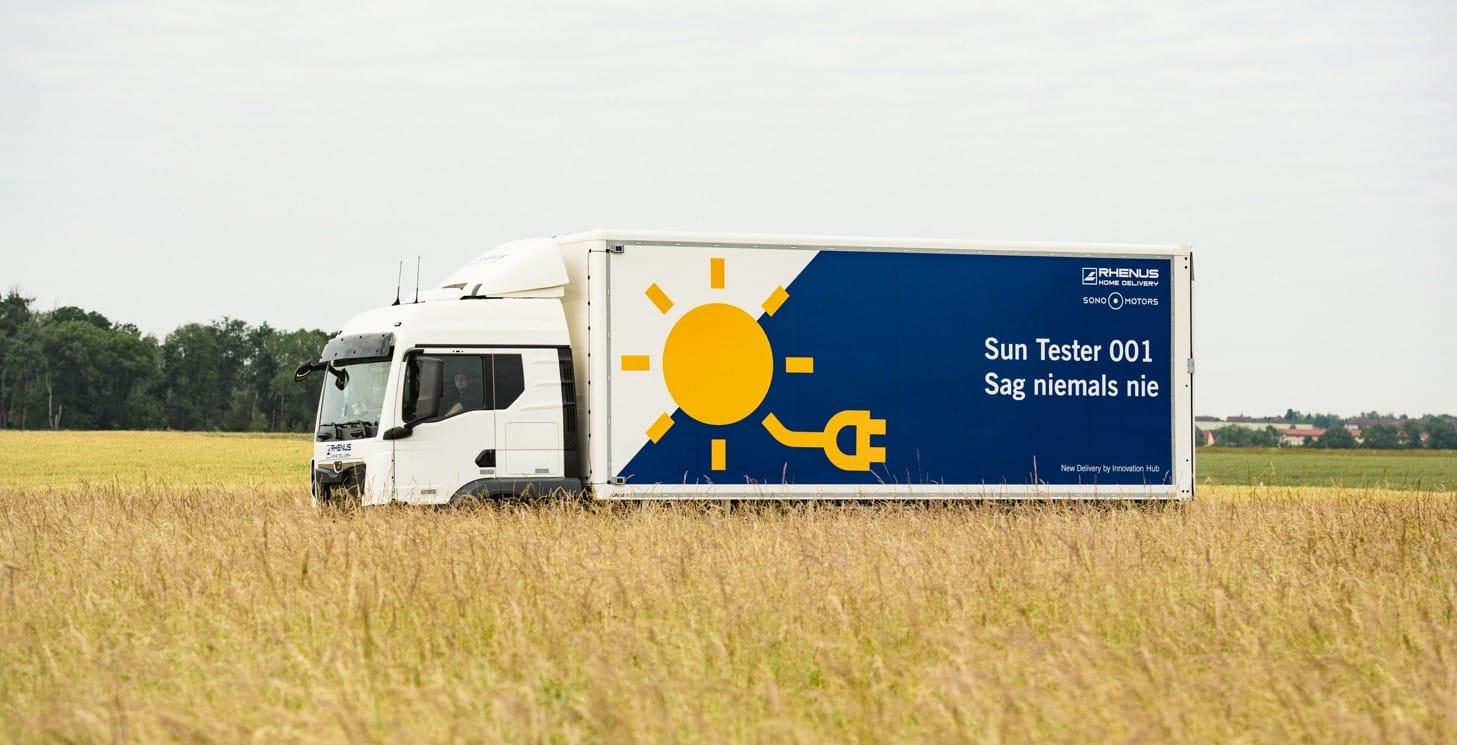
Extending range with solar cells on the transporter: Rhenus Home Delivery is now testing the practical application of this by measuring solar data with a test vehicle. The experiences gained from these measurements can help make the fleet more sustainable in the long term with future-oriented technologies.
(Holzwickede) The Rhenus Group, one of the leading logistics service providers operating worldwide, is continuously striving to make its fleet more sustainable with alternative drive systems. To assess whether solar energy is a viable option, Rhenus Home Delivery is now deploying a test vehicle equipped with solar measurement technology. The specialist in end customer delivery is collaborating with Sono Motors for this purpose. The goal is to determine to what extent solar cells on the vehicle’s surface can extend its range – and what potential the technology offers for widespread use in the future.
Test runs over four seasons
From the blazing sun in midsummer to rainy winter days: To obtain realistic average values, Rhenus has designed the test as a long-term project over four seasons. Light intensity sensors on both sides and on the roof of the still conventionally powered 15-ton truck continuously measure the intensity of solar radiation. A data logger connected via LTE also transmits the exact time of the measurement to Sono Motors, where all measurement data is linked to specific results. Based in Hoppegarten, Brandenburg, near Berlin, the vehicle is currently being tested in Berlin, Brandenburg, and Mecklenburg-Vorpommern. Jonas von Frieling, Head of Innovation Hub for the Rhenus Home Delivery and Rhenus High Tech divisions, explains: “As two companies full of innovative power and drive, Rhenus and Sono Motors are a perfect match for such a forward-looking project.”
Solar cells on vehicles can relieve the power grid
Rhenus Home Delivery is increasingly relying on alternative drives for its fleet. However, the test project holds even more potential: Innovative technologies such as solar-powered electric trucks could contribute significantly to the energy transition in the future, as no additional land needs to be sealed for this type of ecological power generation. “When the transportation sector transitions to electric drives on a large scale, the supply must grow accordingly. Solar cells on vehicles could relieve the power grid. With our test project, we are pioneering in this area,” says Jonas von Frieling.
Photo: © Rhenus Home Delivery