


DHL Improves Offering for Small-Format Goods Shipping
Feb 1, 2022 at 5:32 PM
Logistics Experts See Improvement in Transportation Processes
Feb 1, 2022 at 6:12 PM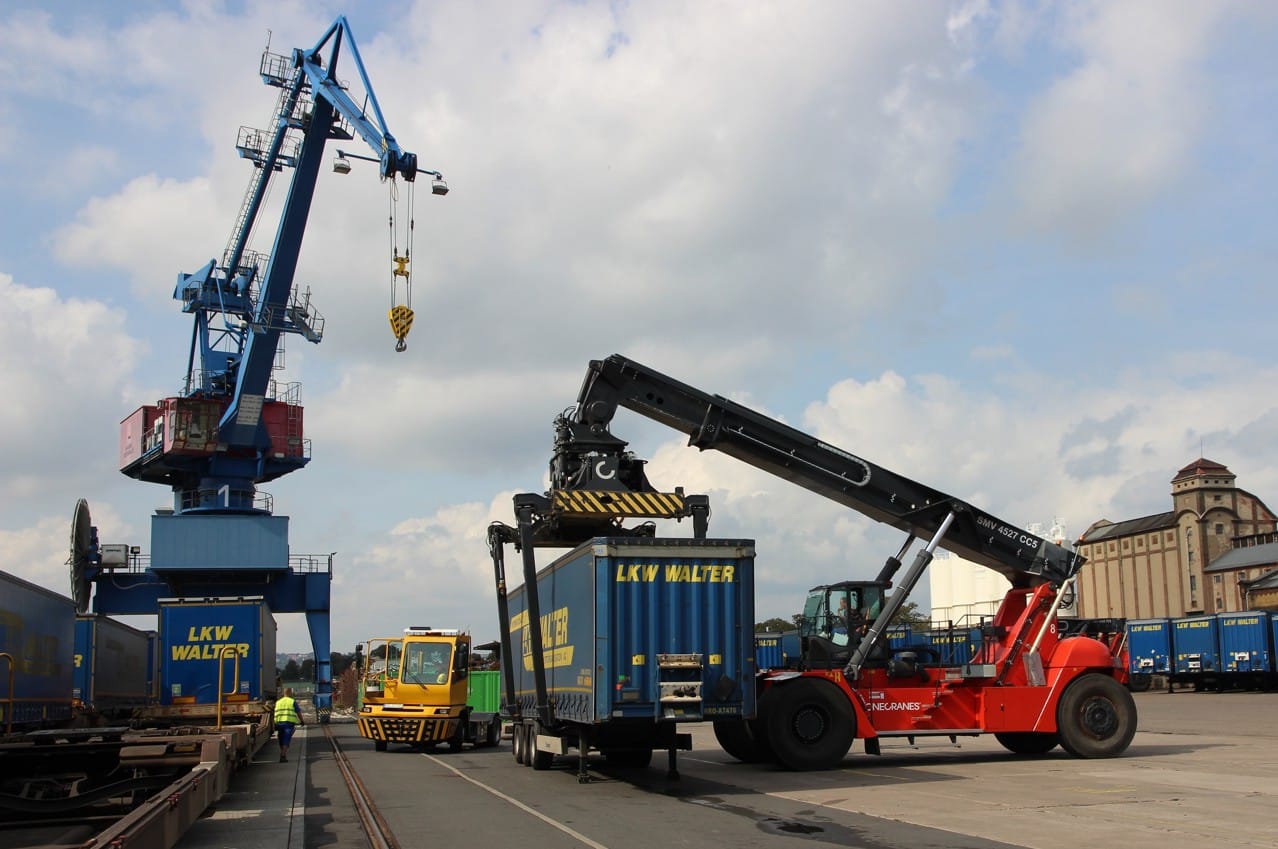
The port association of the Saxon Inland Ports Oberelbe GmbH (SBO) can look back on the best throughput results since 1990, surpassing the previous record year of 2019: A total of 3.16 million tons of goods were handled in the ports – an increase of 19.7% compared to the previous year and 3.1% more than the record throughput of 2019.
(Dresden) Thanks to a variety of trimodal logistics services from a single source, the impacts of the second turbulent year of Corona for the stakeholders and the port operator were limited. This keeps the port association on a successful course. The SBO port association includes the inland ports in Dresden, Riesa, Torgau, Mühlberg, Decin, Lovosice, and Dessau-Roßlau. Economically, it is also shaping up to be one of the best business years for the port association. Here, the port group is experiencing significant growth and will generate a substantial annual surplus.
A new record was achieved in rail freight transport. The port association recorded a significant increase of 65.8% compared to 2020, with a total of 1.26 million tons of goods transported by rail. The TrailerPort in the Alberthafen Dresden significantly contributed to this increased result. In 2021, more than 24,000 trailers (semi-trailers) with a volume of around 500,000 tons were transferred from road to rail. The operator of the trailer trains is the Austrian-based LKW Walter Internationale Transportorganisation AG.
Currently, 12 trains are processed weekly at the TrailerPort Alberthafen Dresden from Monday to Sunday in a 3-shift system, operating on the routes Dresden – Rostock – Dresden and Dresden – Curtici (RO) – Dresden. In 2022, two more routes, one domestic and one international, are expected to be added. To manage the increasing demand for rail transport and traffic shifts, the SBO plans to establish a new TrailerPort on the south side of the Dresden port. This will allow for the handling of up to 50,000 trailers per year in the future. The investment of approximately 3.4 million euros will be financed by the SBO from its own funds.
Shift of Goods to Rail
The three Saxon ports of Dresden, Riesa, and Torgau (SBO) achieved the second-best result since 1990 with 2.28 million tons of goods handled. This corresponds to an increase of 22% compared to the previous year. Here, the rail handling also saw a significant increase of 80.3% compared to 2020. The decline in ship handling due to Corona (-31.8%) was fully compensated by the shift of goods to rail.
The container handling at the port of Riesa also struggled in 2021 with the global impacts of the Corona pandemic. A total of 31,703 TEU (twenty-foot equivalent units) were handled – a decrease of 4,727 TEU (-13%) compared to the previous year. The containers are transported twice weekly by inland vessel and five times weekly via the full train connection AlbatrosExpress between Riesa and Hamburg/Bremerhaven during night shifts. At the port of Riesa, the SBO offers comprehensive logistical solutions for the companies and customers located there. In the temperature-controlled container service hall, numerous “services around the container” are performed. The portfolio ranges from repairs, cleaning, loading/unloading and special construction of containers to the installation of inlets, special and custom fittings, as well as container stuffing and order picking, along with the trading and sale of containers.
2021 Less Low Water
In 2021, the Elbe was almost continuously navigable, allowing for the loading of numerous heavy cargo and project shipments, such as turbines, transformers, engines, and generators, in the ports of Dresden and Lovosice. Nevertheless, the goods handling by inland vessel in the Upper Elbe ports fell by 31.6% to just under 77,000 tons. The main reason for this is the shift in logistics chains due to the Corona pandemic, leading to a significant decline in demand for conventional ship transports (bulk and loose goods). This phenomenon affects not only the Elbe ports but is also noticeable in almost all inland ports in Germany and Europe and will continue until the stabilization of logistics chains, depending on the course of the pandemic.
Czech Ports Also with Good Results
The two Czech ports of Decin and Lovosice (CSP) as well as the industrial port of Roßlau (IHR) in Saxony-Anhalt also developed positively. Here, the goods handling was increased by 18.5% (CSP) and 8.3% (IHR). Particularly, rail freight transport significantly contributed to the increased results. The ports of Decin (+49.7%), Lovosice (+14.9%), and Roßlau (+43%) were able to significantly increase their rail handling. The transported goods included steel products, soybean meal, fertilizers, and grain.
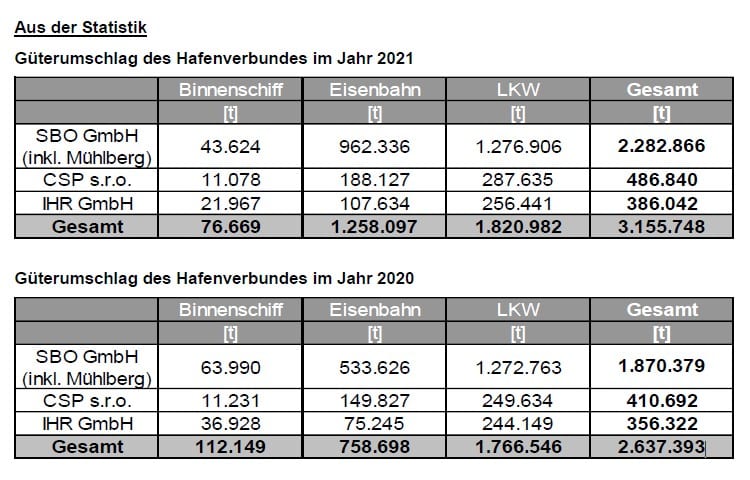
Photo: © Saxon Inland Ports Oberelbe GmbH (SBO) / Caption: Alberthafen Dresden