6 River Systems Sees Great Potential for Logistics Robots
Jan 12, 2022 at 6:28 PM
Federal Office for Goods Transport Becomes PROFI Member
Jan 13, 2022 at 6:54 PM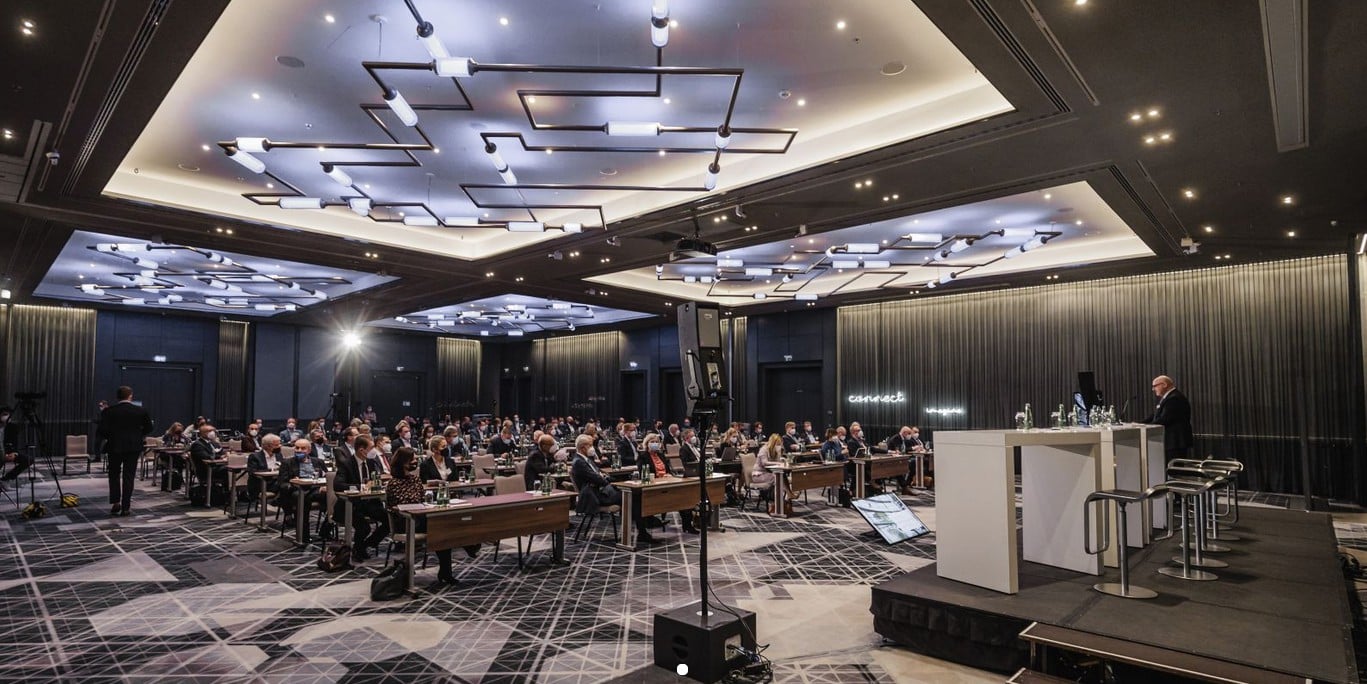
At the annual kickoff event of the German Transport Forum (DVF) titled “Mobility for Germany,” Prof. Dr.-Ing. Raimund Klinkner, Chairman of the Presidium, welcomed both guests on-site at the Berlin Marriott Hotel and those in front of their screens. Transport policy spokespersons and representatives from the transport industry spoke during the event.
(Berlin) DVF Presidium Chairman Prof. Dr.-Ing. Raimund Klinkner emphasized at the annual kickoff event of the mobility association of the German economy that the coalition agreement represents a solid foundation for the transport industry. However, the DVF points out that the speed of implementation is crucial for the competitiveness of the location, the achievement of climate goals, and acceptance among the population.
Klinkner: “Transport and logistics are key industries for achieving climate goals and ensuring that Germany remains livable and an attractive location. The coalition agreement addresses the right issues. Now we need a concerted effort to implement it. This means, above all, more speed through expedited planning and approval processes, sufficient skilled workers in administration, planning offices, and construction, as well as a stronger digitization of processes. We also need solid financing for this transformation over the next decades, for example, through funds modeled after Switzerland.”
New Parliamentary State Secretary at the Federal Minister for Digital and Transport, Daniela Kluckert MdB, also emphasized the need for more speed. She outlined her goals for the first year of government as follows: “The challenges in mobility and digitalization are significant. We need to accelerate infrastructure expansion – therefore, we must modernize, simplify, and digitize approval processes. From decision-making to planning to implementation, we need to become faster. This way, we can address the gaps, ignite the fiber optic turbo, and significantly advance the expansion of fast charging infrastructure.” Additionally, mobility, digitalization, and energy must be more closely integrated, as the DVF President previously demanded. “We, the coalition parties, agree on this. I am convinced that a modern state with streamlined and digitized processes can ensure this integration. The new departmental structure of the BMDV will certainly also be beneficial: the coordination paths will be shorter.”
Detlef Müller MdB, Deputy Chairman of the SPD parliamentary group in the German Bundestag, particularly emphasized the importance of rail and public transport. He saw the acceleration of infrastructure measures as central to the first year to achieve ambitious climate and transport policy goals. “In recent years, the SPD has clearly committed to a strengthened expansion of rail infrastructure and public transport. We will continue on this path and advocate for increased investments in measures to achieve climate policy goals. We will primarily invest more in the new and expansion of rail infrastructure and also significantly strengthen local transport.”
Berthold Huber, Board Member for Passenger Transport at Deutsche Bahn AG, welcomed this commitment: “With the new coalition agreement, climate-friendly rail transport is gaining further momentum. Everyone agrees that we need to significantly accelerate planning and construction in Germany. This is urgently needed, especially with regard to the Germany timetable, because climate change does not wait. Therefore, I am also pleased that the coalition wants to accelerate the introduction of the Digital Automatic Coupler for freight transport and promote intermodal terminals and rail connections. We at DB are more convinced than ever: The trend towards rail, as we experienced before the pandemic, will continue after the Corona pandemic. That is why we are still investing at record levels.”
Sevenfold Speed Needed for Charging Station Construction
Hildegard Müller, DVF Presidium member and President of the German Association of the Automotive Industry (VDA), clearly outlined the demands on the government: “The plans of the coalition for accelerating planning are ambitious – what matters now is the swift implementation. If the federal government wants to achieve its goal of up to 15 million fully electric vehicles and one million charging points by 2030, Germany must become significantly faster in building the e-charging infrastructure, installing around 2000 charging points weekly instead of 300. In plain terms: Sevenfold speed! In parallel, politics must also set suitable incentives for the ramp-up of hydrogen and e-fuels. The proposals of the EU Commission for the Renewable Energy Directive are heading in the right direction but need to be sharpened further. A tax incentive should provide additional incentives. An honest assessment is necessary here: Without e-fuels, which particularly help reduce the CO2 emissions of the vehicle fleet, we will not achieve the climate protection goals in transport.”
Photo: © DVF / Caption: (l. to r.): Frank Dreeke, member of the presidium of the German Transport Forum (DVF), Chairman of the Board, BLG LOGISTICS GROUP AG & Co. KG; Detlef Müller MdB, Deputy Chairman of the SPD parliamentary group in the German Bundestag; Moderator Julia Löhr, Economic Correspondent, Frankfurter Allgemeine Zeitung; Hildegard Müller, member of the presidium of the German Transport Forum (DVF), President of the German Association of the Automotive Industry (VDA); Prof. Dr.-Ing. Raimund Klinkner, Chairman of the Presidium of the German Transport Forum (DVF); Dr. Florian Eck, Managing Director, DVF; Dr. Stefan Schulte, member of the presidium of the German Transport Forum (DVF), Chairman of the Board of Fraport AG; Dr. Heike van Hoorn, Managing Director, DVF; Daniela Kluckert MdB, Parliamentary State Secretary at the Federal Minister for Digital and Transport; Berthold Huber, Board Member for Passenger Transport Deutsche Bahn AG
Competition-Neutral Framework for SAF Quotas
Alternative drives and fuels also play an important role in aviation. All stakeholders in the industry are determined to implement sustainable aviation fuels as quickly as possible and make air traffic CO2-neutral, emphasized Dr. Stefan Schulte, DVF presidium member and CEO of Fraport AG. He welcomed the clear statement in the coalition agreement of the new federal government that a competition-neutral framework is necessary: “The market availability of Sustainable Aviation Fuels (SAF) will be limited in any case and thus represent the central bottleneck. Only from 2030 can we expect production volumes that allow for relevant blending ratios with conventional fuels – but not at competitive costs.” Schulte firmly rejected a kerosene tax proposed by the European Commission: “This would merely lead to a relocation of greenhouse gas emissions, the so-called carbon leakage.” A uniform CO2 pricing is necessary that does not disadvantage the German and European aviation industry compared to its international competitors.
Accelerating Planning and Approval Processes
In the discussion about faster construction, all participants agreed that planning and approval processes must be further accelerated. Bundestag member Müller emphasized that the acceleration of planning and approval processes has earned a very prominent place in the coalition agreement for good reason. “To achieve our climate and transport policy goals for the 2030s, we need more investments that are implemented faster to have the desired impact. This applies to the expansion of transport infrastructure, the expansion of digital networks, and also to the expansion of network capacities and renewable energies.”
“The new federal government should significantly shorten approval processes so that, for example, hinterland connections can be consistently and swiftly expanded,” demanded Frank Dreeke, DVF presidium member and Chairman of the Board of BLG LOGISTICS GROUP AG & Co. KG. “We also need fair competition in Europe; inequalities such as the import sales tax procedure must be eliminated. We need further investments in future topics such as digitalization, automation, and hydrogen, e.g., through research initiatives like IHATEC for innovative port technologies.”
Networking is a Key Issue
Klinkner saw networking as a central feature of the mobility system of tomorrow: “We will need all modes of transport in the future. Roads, railways, waterways, and air traffic must be optimally connected as components of transport chains. Cars, trucks, trains, airplanes, and ships will increasingly be decarbonized on the move, thus changing their climate balance. Cycling and walking will continue to increase. This must also be considered in the planning of transport infrastructure and the associated supply networks. Equally important is the resilience and redundancy of infrastructure, which must withstand climate change.”
VDA President Müller agreed: “For the transformation towards climate-neutral road traffic, we now need a significantly accelerated construction of the required infrastructure: This applies to charging points, power grids, hydrogen filling stations, 5G networks, and the digitalization of road infrastructure.”
State Secretary Kluckert further advocated for better support for technological innovations: “Germany is the world champion in mobility. To ensure that this remains the case in the future, there needs to be an efficient transfer from research to the streets and to the people. To implement theory into practice, we need a new mindset, a proper founding culture. To support this and promote technological innovations, we will create an agency for transfer and innovation (DATI). Furthermore, better access to venture capital is needed. Therefore, we want the KfW to act more as an innovation and investment agency as well as a co-venture capital provider in the field of future technologies.”
Photos: © DVF