


LIS AG presents itself at various trade fairs this autumn
Oct 27, 2021 at 6:00 PM
Alpensped Sees the Future in Combined Transport
Oct 27, 2021 at 6:52 PM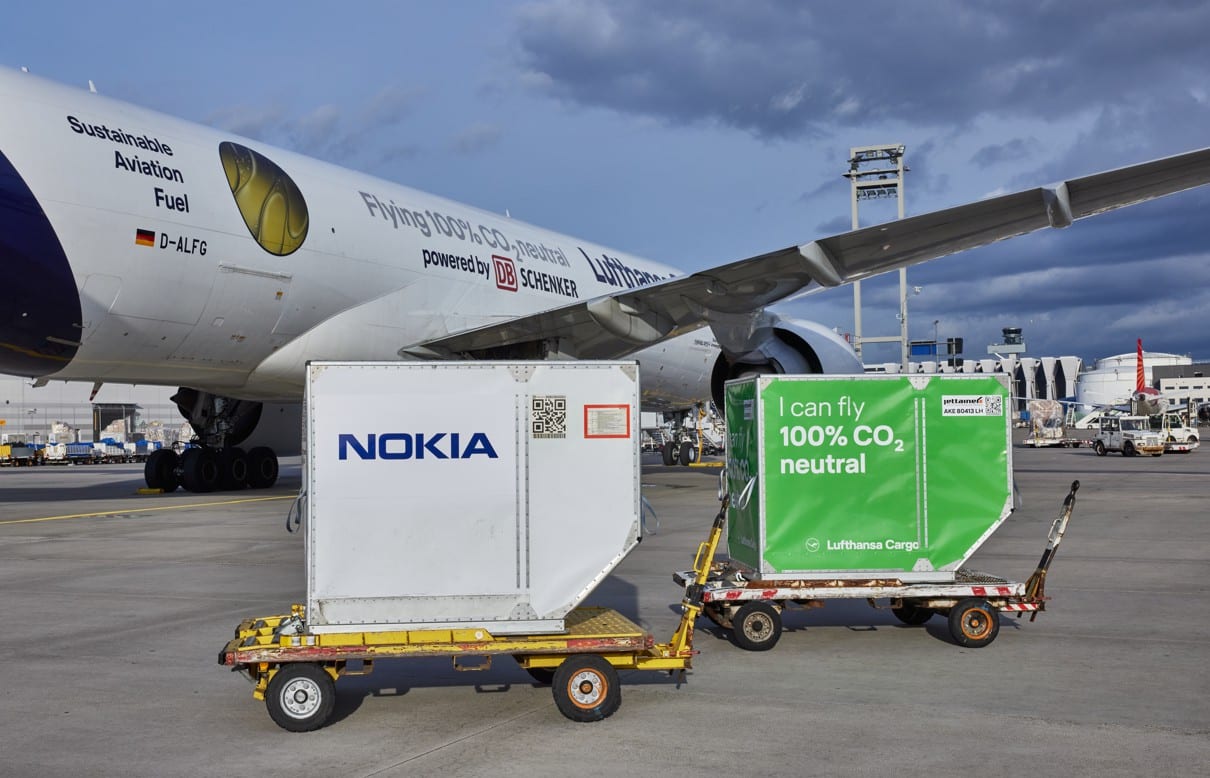
Lufthansa Cargo and DB Schenker announce the expansion of the weekly flight service between Frankfurt and Shanghai. They are flying CO2-free thanks to Sustainable Aviation Fuel, saving 14,175 tons of greenhouse gases in the winter flight schedule. Ahead of the COP26 conference, Nokia joins the ambitious project for more climate-friendly air freight.
DB Schenker and Lufthansa Cargo are expanding their weekly CO2-free cargo flights between Frankfurt and Shanghai. The joint mission will continue throughout the entire winter flight schedule. Nokia has now also joined the initiative. The global telecommunications technology provider will now use the world’s only cargo flight that is 100% powered by Sustainable Aviation Fuel (SAF). Just days before the UN Climate Conference COP26, the companies demonstrate the importance of investing in sustainable aviation fuels and more climate-friendly global supply chains.
The fuel requirement for the flight rotation from Frankfurt (FRA) to Shanghai (PVG) and back is completely covered by SAF, which is produced from renewable biomass waste such as used cooking oils. This saves around 174 tons of conventional kerosene weekly. In the summer flight schedule of 2021, a net reduction of 20,250 tons of greenhouse gases (CO2e) was achieved through the newly launched service in April 2021. From the end of October 2021 to the end of March 2022, an additional 14,175 tons are expected.
Thorsten Meincke, Board Member for Air and Sea Freight at DB Schenker: “The ambitious goal of climate neutrality concerns every company and each of our customers, who are increasingly considering their footprint in their supply chains. Together with Lufthansa Cargo, we are expanding our unique offering of a regular CO2-neutral flight connection. The SAF full charter is a true novelty, as it goes beyond a pay-per-use system. We are pleased to have Nokia on board as a new major customer for our flights to the West. Together, we can avoid greenhouse gases and take another step towards a more sustainable future.”
Investments in Sustainable Solutions are a Priority
Tommi Uitto, President of Mobile Networks at Nokia: “Investments in sustainable solutions are our top priority and a common goal with our partners. We can only achieve our climate goals together. Innovation and cross-industry collaboration are the keys to a green supply chain. We are constantly working to reduce our CO2 footprint in transportation and logistics, and air freight plays a significant role in this. Collaborating on the transport of our 5G equipment with CO2-neutral flights is another important step.”
In the coming five months, Nokia will utilize the CO2-neutral flight service to transport 10 tons of technical equipment weekly for building communication networks. By purchasing SAF, it is possible to avoid 100% of the CO2 emissions from the overall ecological balance without any compensation. The door-to-door agreement between DB Schenker and Nokia also includes the land transport of goods from a production site in Shanghai to the airport, as well as from Frankfurt to Tilburg, Nokia’s European hub in the Netherlands. The land transport will be conducted using the biofuel HVO (hydrotreated vegetable oil).
Ashwin Bhat, Board Member for Product and Sales at Lufthansa Cargo: “The use of SAF is one way to fly CO2-neutral today. We are very proud to be able to expand our partnership with DB Schenker in the coming months. We firmly believe that transitioning our business to CO2-neutral air freight can best be achieved when we pool all our resources.”
SAF is Made Entirely from Waste
The SAF used for this collaboration is made entirely from waste and residues, such as used cooking oils. The CO2 released during combustion in the engine is only the CO2 that was removed from the atmosphere during the photosynthesis of the plant used to produce the oil. Currently, SAF is about three times more expensive than conventional fossil kerosene.
The emissions generated during the production and transport of the fuel are fully offset through certified offsetting projects, ensuring complete greenhouse gas neutrality of the flights. Alternatively, customers can opt for complete insetting. This is what Nokia has chosen for its cargo. It is the most sustainable option currently available on the market.
Other Types of Renewable Fuels as Well
In the future, other types of renewable fuels will also be available. The most well-known production process for this is the Power-to-Liquid concept (PtL) based on renewable electricity, water, and CO2. While the production quantities of PtL are still very limited, SAF based on biomass is already a well-proven fuel today.
The SAF used for the flight connection between DB Schenker and Lufthansa Cargo is produced by Neste, the world’s leading provider of sustainable fuel. The Finnish manufacturer is increasing its production to 1.5 million tons annually by the end of 2023.
Photo: © Lufthansa Cargo