


VTG Relies on Nexxiot Sensors for Pocket Wagons
Jun 3, 2021 at 5:16 PMSGKV Report “Figures and Facts 2020” in Combined Transport
Jun 3, 2021 at 6:17 PMThe DSLV launched an industry discussion ‘Air Freight and Climate Protection’. Air freight remains a strong link in international supply chains for forwarding and logistics companies, especially for high-value and time-sensitive cargo. In addition to price, reliability, and security, climate protection is increasingly becoming part of customer expectations.
(Berlin) Additional technological innovations and process optimizations for flight operations and ground handling of airlines, airports, and logistics companies must be supported by political frameworks that do not further disadvantage German companies in European competition, warns the DSLV Federal Association of Forwarding and Logistics on the occasion of the joint digital industry discussion ‘Air Freight and Climate Protection’ with the Federation of German Industries (BDI) and the Federal Association of the German Aviation Industry (BDL).
Technological Advances and Sustainable Fuels
For CO2-free air freight, timely technological advances – particularly ecologically sustainable fuels for flight operations – are essential. Their market ramp-up must be accelerated by internationally, or at least European-wide binding regulations and incentive programs. “Politics must create a bundle of instruments in cooperation with the stakeholders of air-bound supply chains that can align the increasing demand for goods with a higher climate efficiency of air traffic,” demands DSLV Managing Director Frank Huster.
This could, for example, be contributed by the long-demanded Single European Sky to optimize the routing of air traffic. The upcoming revision of the European Renewable Energy Directive (RED II) will also be crucial by ensuring that the significant additional costs for the blending of ‘Sustainable Aviation Fuels’ (SAF) are evenly distributed across the European air freight industry. Huster: “Harmonization is urgently needed. Today, there are already too many competitive disadvantages for the air freight location Germany due to unevenly implemented European security regulations as well as tax and customs procedures.”
Complete Transparency on Decarbonization Strategies
98 percent of export air freight and 80 percent of goods imported through German airports are handled by forwarding companies that are already contributing to traffic avoidance with targeted strategies for cargo bundling and weight reductions through innovative packaging systems. “Air freight forwarders are also responsible for making air freight as sustainable as possible,” emphasizes Huster. “The selection of such air freight carriers that provide complete transparency about their decarbonization strategies, including offsetting programs, is currently limited to a few European and US airlines. Above all, the willingness of logistics customers from industry and trade to pay for offsetting is a crucial lever.”
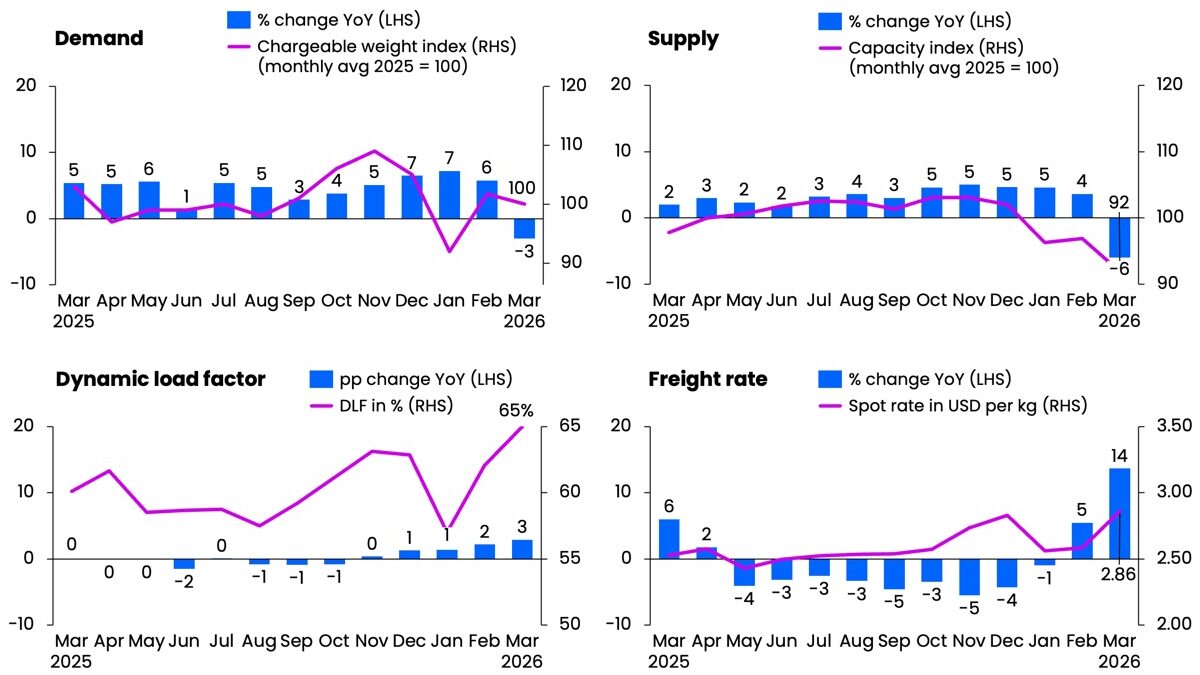
The joint efforts are increasingly overshadowed by a globally growing demand for air freight services. Certain goods such as medical products, perishable items, and spare parts exclude the use of other transport modes, especially on international destinations. In the first quarter of 2021, the freight volume at German airports was already eight percent higher than in the same period of the pre-crisis year 2019, which is also reflected in the resumption of passenger traffic.
Photo: © Loginfo24/Adobe Stock