


Hapag-Lloyd orders 150,000 TEU standard and reefer containers
Apr 15, 2021 at 11:27 AMAppreciation for the Industry’s Achievements on “Logistics Day”
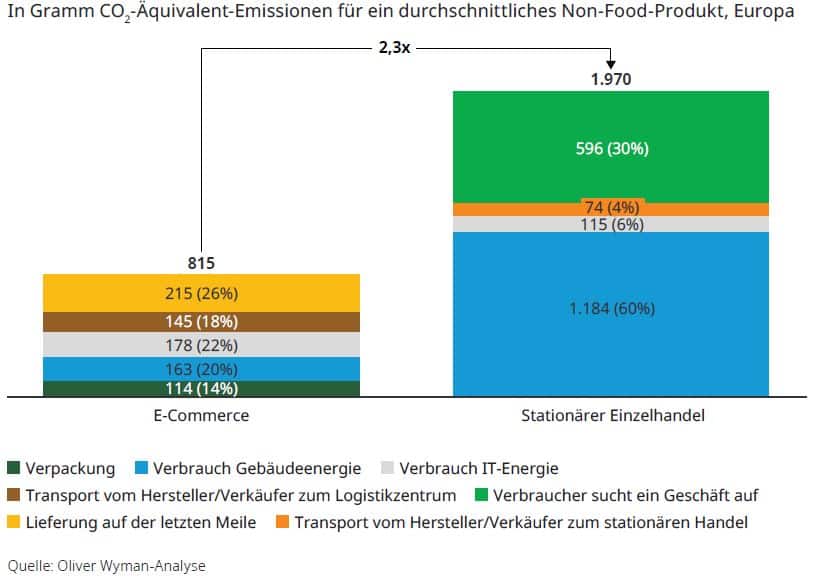
Apr 16, 2021 at 3:25 PME-commerce often has a better climate balance than brick-and-mortar retail. This is the conclusion of a joint study by the strategy consultancy Oliver Wyman and the Logistics Advisory Experts, a spin-off of the University of St. Gallen, conducted in eight European countries, including Germany, France, and the UK. According to the analysis commissioned by the online retailer Amazon, online retail performs on average 1.5 to 2.9 times better in terms of CO2 emissions per sold item across the entire supply chain under the given assumptions in the individual countries. Overall, the retail sector proved to be a growth engine: the industry has recently grown by an average of two percent annually. During this time, e-commerce showed more dynamism and significantly increased its market share, especially during the COVID-19 pandemic.
By: Ludwig Häberle
(St. Gallen) Shopping in physical stores or online instead? In terms of CO2 balance, a joint study by the strategy consultancy Oliver Wyman and the Logistics Advisory Experts, a spin-off of the University of St. Gallen, provides a surprising result. Many people consider e-commerce to be an environmental sinner due to the transportation to their doorstep. However, online retail actually performs 1.5 to 2.9 times better than its brick-and-mortar counterpart per sold unit in eight European countries under the set assumptions. The researchers and strategy consultants were commissioned by the online retailer Amazon. In their independent study, the experts examined the entire supply chain and found that purchasing a product in a physical store releases an average of 2,000 grams of CO2 – whereas an online delivery only releases 800 grams. Shopping trips by bus, train, or bike can reduce the difference, but cannot completely offset it.
City Shopping by Car Makes the Difference
The logistics experts calculated the effect in detail. The physical purchase of a book across all countries generates, on average, 1.6 times the CO2 emissions compared to online shopping, while for fashion products, it is even 2.9 times – returns are included in this calculation. Individual consumption behavior can, however, make a significant difference. For example, someone who walks to the bookstore has the same climate balance as the online buyer. However, since many city shoppers are on the road by car, e-commerce also performs better in terms of traffic burden. The bundling effects of delivery traffic in parcel delivery save 4 to 9 times the amount of individual traffic, relieving city centers. The fact that Germany’s brick-and-mortar retailers leave the largest ecological footprint in Europe is primarily due to the high CO2 emissions of buildings. However, these could be reduced with a higher use of renewable energy, supported by funding instruments for energy-efficient renovations by the public sector.
E-commerce Grows in Double Digits
Besides Germany, France, the UK, Italy, the Netherlands, Poland, Sweden, and Spain were also examined. In all countries combined, the share of e-commerce in total retail sales increased from four to eleven percent between 2010 and 2019 – in Germany, it achieved a growth of 12 percent. “With an annual growth of 15 percent, e-commerce developed much more dynamically than brick-and-mortar retail and contributed about half of the total growth over the last ten years, despite having a significantly smaller market share. Together, brick-and-mortar retail and e-commerce achieved an average annual increase of 2.0 percent.
The study also shows: Brick-and-mortar retail and e-commerce are increasingly merging, as traditional stores venture into the internet. Especially the large retail chains are increasingly pursuing a multichannel approach. They are responsible for 20 percent of the growth in the online segment between 2010 and 2019. At the latest, with the lockdowns during the COVID-19 period, smaller shops are also increasingly striving to go online. The step is worthwhile: In Germany, 51 percent of independent shops increased their sales in the last three years when they also sold online. Without e-commerce activity, only 38 percent achieved this.
The growing retail sector has created new jobs. In the eight countries, around 1.3 million new jobs were created between 2008 and 2018 – one million of them in brick-and-mortar providers. However, purchasing products online generates just as many jobs, contrary to popular belief, as in traditional retail. E-commerce has a greater leverage effect on so-called indirect jobs – such as in logistics centers or last-mile delivery. For every online job, an average of 1.2 additional jobs are created – in brick-and-mortar retail, the factor is 0.2. Thus, the study shows that e-commerce and traditional retail are on par in terms of revenue per employee, with 220,000 euros each.
Wealth Determines the Success of Shopping Streets
The often-suspected displacement of shops in city centers by online competition is not confirmed by the study. The number of employees in brick-and-mortar retail in city locations obviously does not primarily depend on the market penetration of e-commerce, but rather on demographic factors, the wealth of the population, or the attractiveness of cities for tourists. Major cities such as London, Paris, and Hamburg were examined, all of which have a dynamic e-commerce sector. The metropolises generally show stability in brick-and-mortar retail. This also applies to medium-sized and even smaller cities if they have a growing population with above-average wealth. According to the study, the threat to shopping streets in city centers comes less from online retail. An important competitive factor for city retailers are malls and large retail chains that build on greenfield sites in the periphery.
DOWNLOAD THE STUDY
Graphic: © Oliver Wyman
Photo: Adobe Stock
Ludwig Häberle is a project manager at Logistics Advisory Experts GmbH and works as a research associate and doctoral candidate at the Institute for Supply Chain Management at the University of St. Gallen. www.logistics-advisory-experts.ch