


Savino Del Bene Expands Its Sales Team in Germany
Mar 7, 2021 at 10:08 AMRhenus High Tech Joins the Transport Network TENESO
Mar 7, 2021 at 4:18 PMThe Eco Performance Awards 2020 ‘Innovations for Sustainable Road Freight Transport’ will be presented on March 18, 2021, in a digital event. Five companies have been nominated as finalists. The high-profile jury, chaired by Prof. Stölzle from the University of St. Gallen, will select the current award winners from the finalists presented below.
The five finalists:
Park Your Truck aims to solve the truck parking problem
Park Your Truck GmbH identifies new areas that have not been used as truck parking spaces by actively approaching companies and landowners and offering them an alternative usage option. The startup provides these areas to transport companies and truck drivers through a software-based reservation platform (compatible with other systems such as Transporeon). Suitable areas include parking lots at trade fairs, stadiums, or airports, as well as company yards, truck service workshops, and gas stations located geographically close to highways and expressways. Many companies already finance their transport service providers to park in partially secured, reservable truck parking spaces from Park Your Truck.
The reservation platform saves drivers from the lengthy search for parking and actively alleviates traffic congestion. This alone saves up to 16 kilograms of CO2 per truck per day. Extrapolated over a year, this amounts to potential savings of nearly 5 tons of CO2 per truck. Another significant advantage for drivers: the reserved parking spaces have good infrastructure with sanitary facilities and catering options nearby. Park Your Truck currently offers around 10,000 truck parking spaces in Germany and aims to add another 20,000 in 2021.
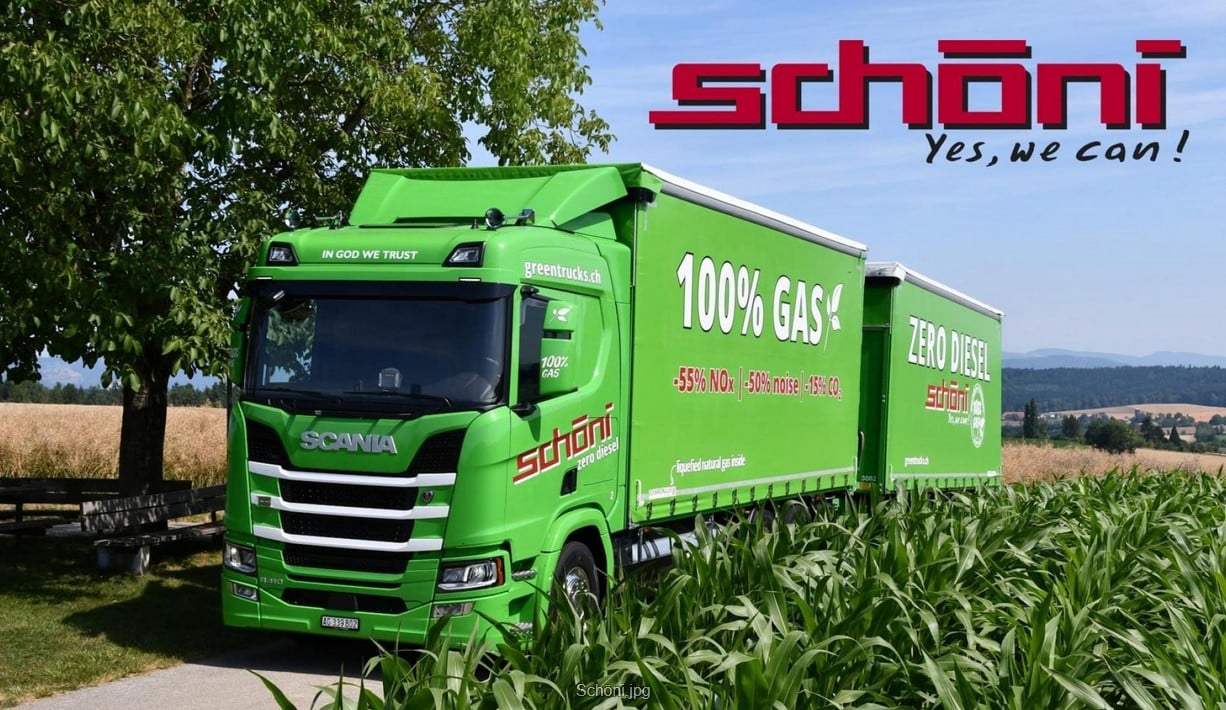
Schöni Transport AG aims to be CO2-neutral by 2023
“We aim to be the first Swiss transport company to operate completely CO2-neutral by the end of 2023, with at least 80% achieved through our own measures,” says Daniel Schöni, head of Schöni Transport AG.
The fleet of the Swiss company consists entirely of low-emission EURO-6 and LNG vehicles, with the first H2 truck joining in April 2021. To achieve the ambitious goals of its CO2 strategy, the company relies not only on testing future technologies like hydrogen but also on so-called transition technologies like biodiesel from slaughter waste. Specific risks are consciously accepted in this process. The advantage: the company is already significantly saving CO2 in road freight transport but must bear any losses, such as engine damage due to the expiration of the manufacturer’s warranty.
In 2021, the first pure biodiesel fleet with 10 trucks will be put into operation. Additionally, the planned deployment of trucks powered by biogas from sustainable energy sources will save around 90 percent of CO2 compared to diesel in the future. Furthermore, the company has relied on unaccompanied combined freight transport for 16 years and has already saved more than 30,000 tons of CO2 during this period. Combined transport will continue to be increasingly promoted by Schöni.
Integre Trans relies on natural gas trucks as part of a modern fleet
The Lithuanian transport and logistics company Integre Trans has a state-of-the-art fleet of more than 500 articulated trucks. All trucks meet the EURO-6 standard and are equipped with the latest navigation and tracking systems.
When acquiring new trucks, the company increasingly opts for natural gas-powered vehicles. This significantly reduces CO2 emissions, and fuel consumption per vehicle decreases by up to 38 percent compared to diesel. Natural gas instead of diesel makes the engines of the articulated trucks significantly quieter, thereby increasing driver comfort.
By 2025, 10 percent of the entire vehicle fleet will be converted to natural gas. The shift of long-distance transport from road to rail is expected to contribute to further emission reductions in the coming years. The use of additional digital technologies is intended to optimize traffic flow and increase road safety over the next four years. Integre Trans also promotes the region and employees in terms of social sustainability and particularly impressed the jury with a holistic and lived sustainable corporate DNA, which is considered outstanding for transport companies from Eastern Europe.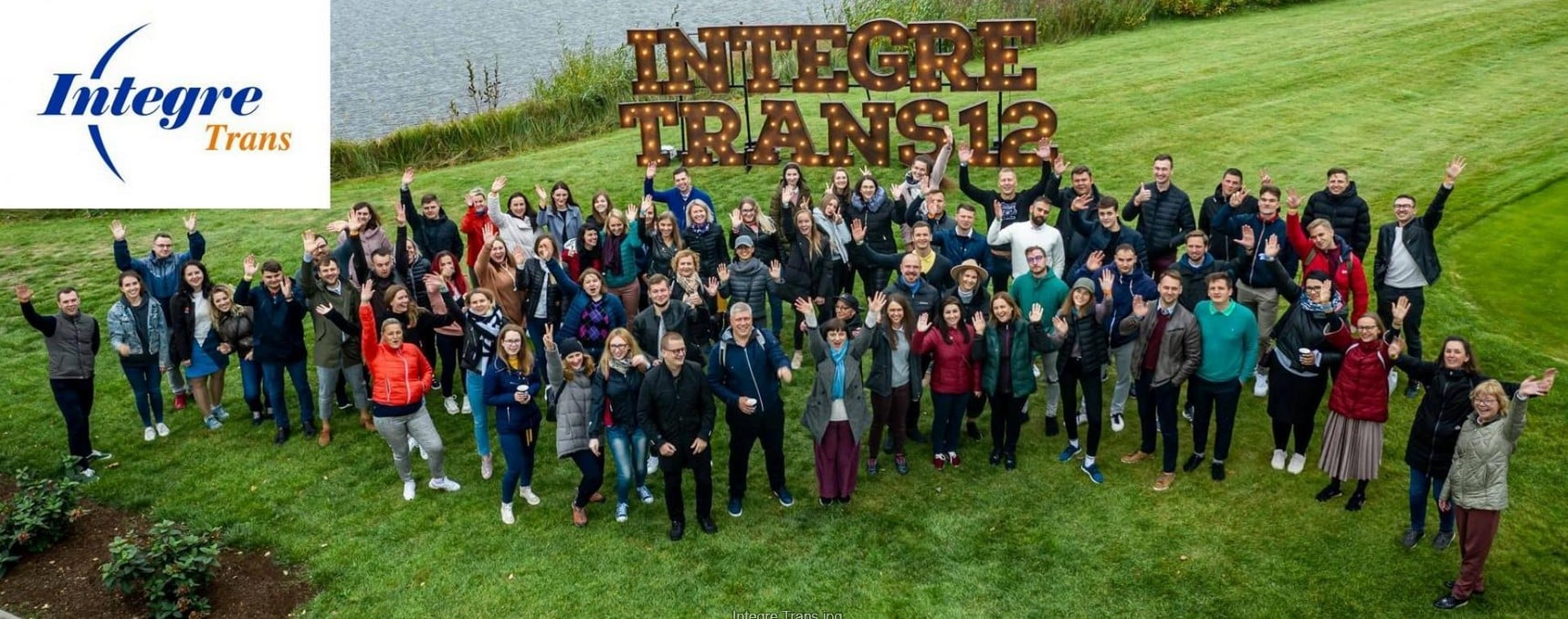
Contargo systematically focuses on CO2 reduction through trimodal transport
Contargo connects container transport between Rotterdam, Antwerp, the German North Sea ports, and the European hinterland in a trimodal transport approach. The company operates its own terminals as hubs and uses its own transport lines via inland shipping, rail, and direct trucks.
By 2050, the company aims to achieve decarbonization, supported by combined transport and the use of electric trucks. A large portion of the transport is to be shifted to rail and waterways. Compared to truck transport, the company is already saving up to 63 percent of CO2 emissions today.
In 2019, the first heavy electric trucks were put into operation. A year later, all German terminal locations switched to green electricity. Modern hybrid reach stackers are used for loading containers.
Four ships have been modified by Contargo to sit 130 instead of 150 cm deep in the water, allowing them to carry 200 to 300 tons more, especially during low water, thus eliminating the need to shift to trucks.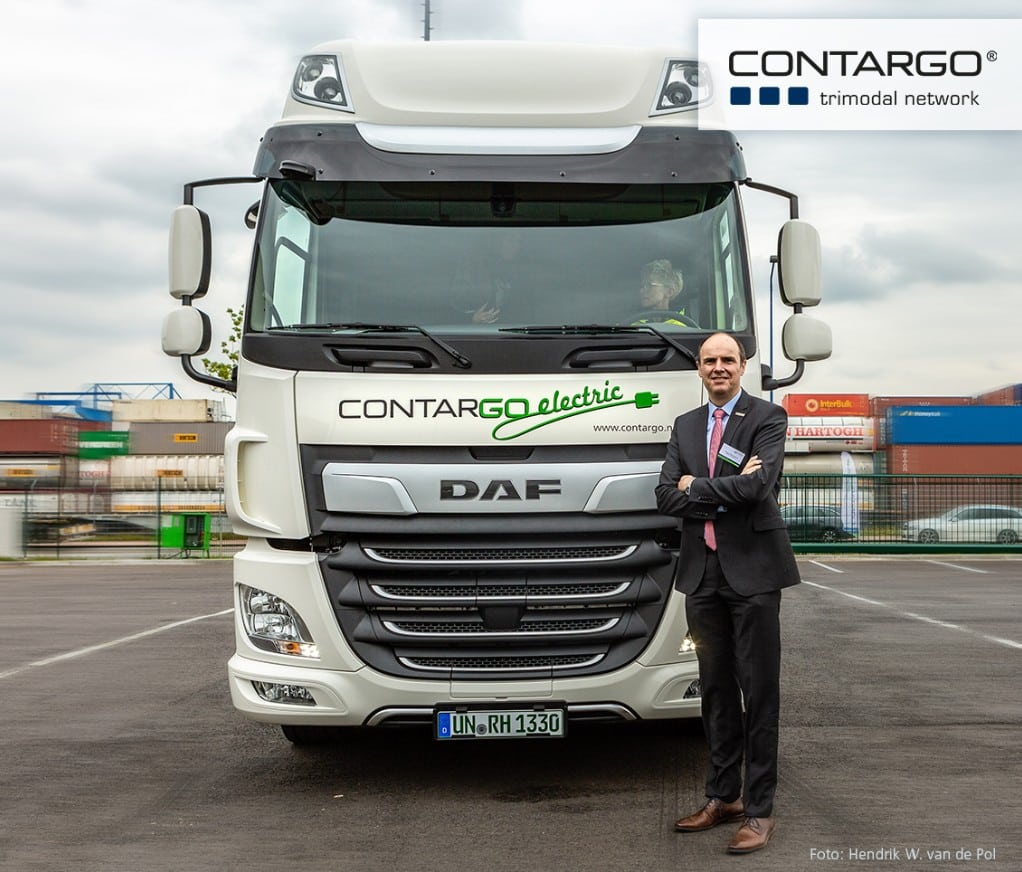
Cooperative Migros Ostschweiz – Consistent sustainability in transport through avoiding, shifting, and improving
The Cooperative Migros Ostschweiz is one of the largest private employers in Eastern Switzerland and is part of the Migros Group. Under the motto “Avoidance is the most effective sustainability measure,” the company has thoroughly revised its tour planning. Better utilization and optimized tour plans avoid empty trips and reduce truck kilometers. Long-distance transports are primarily shifted to rail. In the near future, the railway will even transport sensitive and perishable goods such as rolls and flowers.
Improvements in loading contribute to optimal vehicle utilization. The training of drivers focuses on economical and environmentally conscious driving. A professional truck simulator is used for driver training.
The company continuously analyzes fleet data. This allows Migros Ostschweiz to gain insights into the effects of different alternative drive types such as biogas and hydrogen on the operational environment and capability of the vehicles. In doing so, there is an increasing focus on regional production for the different fuels. Thus, Migros is transforming the Eastern Switzerland region from an importer to a producer of drive and fuel sources.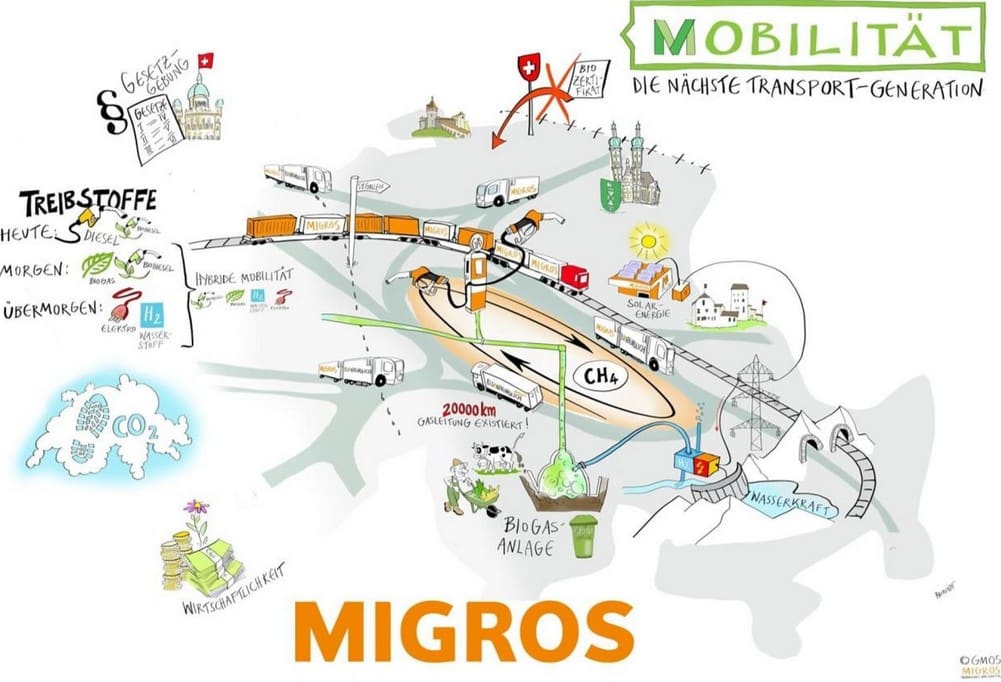
Photo: © Eco Performance Award