


Gebrüder Weiss and GFS Joint Venture for Package Transport in China
Dec 3, 2020 at 7:30 PMFederal Office of Transport and SBB Cargo Regulate Process for Corona Aid
Dec 3, 2020 at 7:48 PMFlexible, sustainable, reliable, and fast – with additional connections and more stops, the shuttle products Trailer Romania Xpress (TRX) and Trailer Med Xpress (TMX) from DB Cargo Logistics are now even more attractive for customers from all industries. Cologne will also be newly connected to these services.
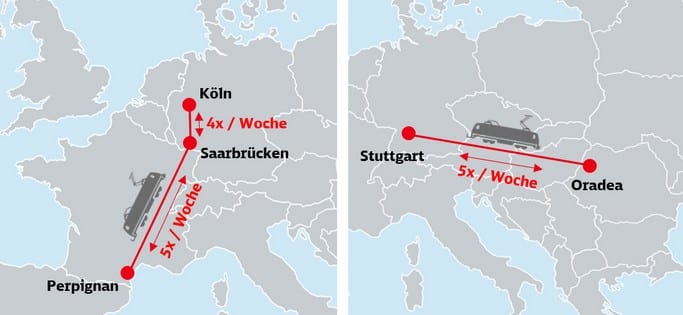
(Mainz) Since July, DB Cargo Logistics has been expanding its Automotive RailNet towards Southeast Europe and operates the Trailer Romania Xpress, or TRX, – a high-frequency shuttle system for craneable loading units – to Romania. The shuttle is suitable for all multimodal-compatible goods in trailers and containers. “The corridor product was initially planned for core customers from the automotive industry, their suppliers, and freight forwarders, but is also available to customers from other sectors,” notes Katharina Bockweg, Account Manager at DB Cargo Logistics. Even hazardous goods transports, such as batteries for electric vehicles, are potentially possible. The shuttle starts in Stuttgart: It takes the train two days to reach Oradea, the transport hub and economic center in northern Romania.
DB Cargo is expanding the services Trailer Romania Xpress (TRX) and Trailer Med Xpress (TMX)
Trailer Med Xpress now also from and to Cologne
Since 2018, the Trailer Med Xpress, or TMX, has been connecting the Mediterranean region by rail with Germany. Five times a week, the high-frequency shuttle for craneable mega trailers, swap bodies, and containers operates between Saarbrücken and Perpignan. This allows customers to integrate rail as an important part of their supply chain on this corridor and take advantage of the benefits of combined transport. The train covers the 1,000-kilometer route in less than 24 hours – reliably without traffic jams, rest periods, and toll costs. Not only for this reason is the shuttle a real alternative to trucks. Because sustainability has long been a competitive advantage and is no longer just a cost factor, rail fully plays to its strengths here: Compared to trucks, about 88 percent of CO2 is saved: With 800 kilograms of CO2 per truck that does not drive on the road and a capacity of 34 trucks per train, the shuttle saves up to 127 tons of CO2 with each trip.
Four times a week
DB Cargo Logistics is now complementing the corridor product with the location in Cologne, thereby currently connecting another economic region with the French and Spanish markets four times a week. It is also worth noting the possibility, similar to the Saarbrücken–Perpignan line, to transport craneable trailers with a profile of up to P400. “This makes us one of the few providers that can offer this profile through France in regular products,” says Daniel Toth, Account Manager at DB Cargo Logistics.
Highly flexible corridor product
The corridor products from DB Cargo Logistics are highly flexible and available to all customers from various segments, as interoperable wagons can also be used for containers. “We offer our customers various options to flexibly utilize the capacities on our trains,” says Andreas Weiss, Head of Sales and Operations Center at DB Cargo Logistics. “Especially in economically uncertain times like the current COVID-19 crisis, this is a real advantage.” It is important to note that round trips are not necessary but possible – DB Cargo Logistics also transports empty units back cheaply if needed, thus relieving the roads. And in combined transport, the 44-ton rule applies: trucks in the pre- and post-haulage may transport four tons more than normal trucks. With thousands of loading units per year, this is a real competitive advantage.
Photo: © DB Cargo; Oliver Lang / Graphics: © DB Cargo