
Contargo Expands Its Inland Shipping Activities in Benelux
Jul 24, 2020 at 7:00 AMDeutsche Post DHL Supports the Berlin Christopher Street Day
Jul 24, 2020 at 7:00 AMThe Federal Association of Logistics e.V. (BVL) publishes the new edition of the study ‘Trends and Strategies in Logistics and Supply Chain Management’. The study shows the status of a sustainable and digital transformation and was developed by BVL.digital GmbH and the Institute for Logistics and Management at TU Hamburg.
(Bremen) The new edition of the study ‘Trends and Strategies in Logistics and Supply Chain Management’ is now available. This provides stakeholders in the logistics sector with a guide that can be particularly useful in the confusing times of the Corona crisis. The study was developed by BVL.digital GmbH in collaboration with and under the scientific leadership of Prof. Dr. Dr. h. c. Wolfgang Kersten from the Institute for Logistics and Management at TU Hamburg. The focus was on the topics of digital transformation, data analytics, and sustainability.
Around 300 logistics professionals were surveyed between February 5 and March 11 – 16 percent from the retail sector, with the rest evenly split between industry and logistics services. The analyses refer comparatively to the previous edition of the study from 2016. The study addresses the sustainable and digital transformation in logistics and supply chain management, where both value creation and business models are adjusted. A central success factor lies in the holistic consideration of the dimensions of people, technology, and organization.
Interactive website facilitates classification
The study results are now available on the website www.bvl-trends.de. To illustrate them and facilitate classification, there are practical reports and statements from experts, podcasts, excerpts from webinars, or content from major logistics events such as the German Logistics Congress, corresponding to the trends identified through the survey. Additionally, useful interactive graphics are available in the data center, for example, on greenhouse gas emissions per country in Europe or the global risk landscape in 2020. “The creation of the website was a collaborative project, as we received valuable input from many sides of the BVL network. Visitors to the website thus have the opportunity to discover the trends in their various facets in a multimedia way,” says Dr. Christian Grotemeier, Managing Director of BVL.digital.
Survey respondents see more opportunities, fewer risks
“The study results indicate, among other things, a certain pressure to act, for example, regarding the digital transformation of business models – the implementation has not progressed as far as we would have expected,” says Prof. Wolfgang Kersten about the study. Some other key statements are: Almost all logistics professionals associate high opportunities with digitalization, but also risks. While opportunities are assessed slightly higher, risks are estimated to be somewhat lower than in 2016. The respondents expect both cost reductions and revenue increases from digitalization and anticipate rising demands on innovation capability.
The top three trends are, as in 2016, the digitalization of business processes, transparency in the value chain, and cost pressure. The sustainability trend is also among the top ten, and almost half of the companies rate their corresponding adaptability as high.
Implementation status of digitalization relatively low
When examining the status of digitalization in companies, it is noticeable that the level of implementation is relatively low, despite the high relevance that respondents attribute to this trend. This is particularly true for assistance systems such as Pick-by-Vision/AR, which about one-fifth of respondents have implemented. Last in terms of implementation status, despite a medium relevance rating, are autonomous trucks/cars.
In the area of future technologies from data analysis, logistics professionals still have potential for improvement. For example, while predictive analytics is attributed a relatively high relevance, the implementation status is below 50 percent.
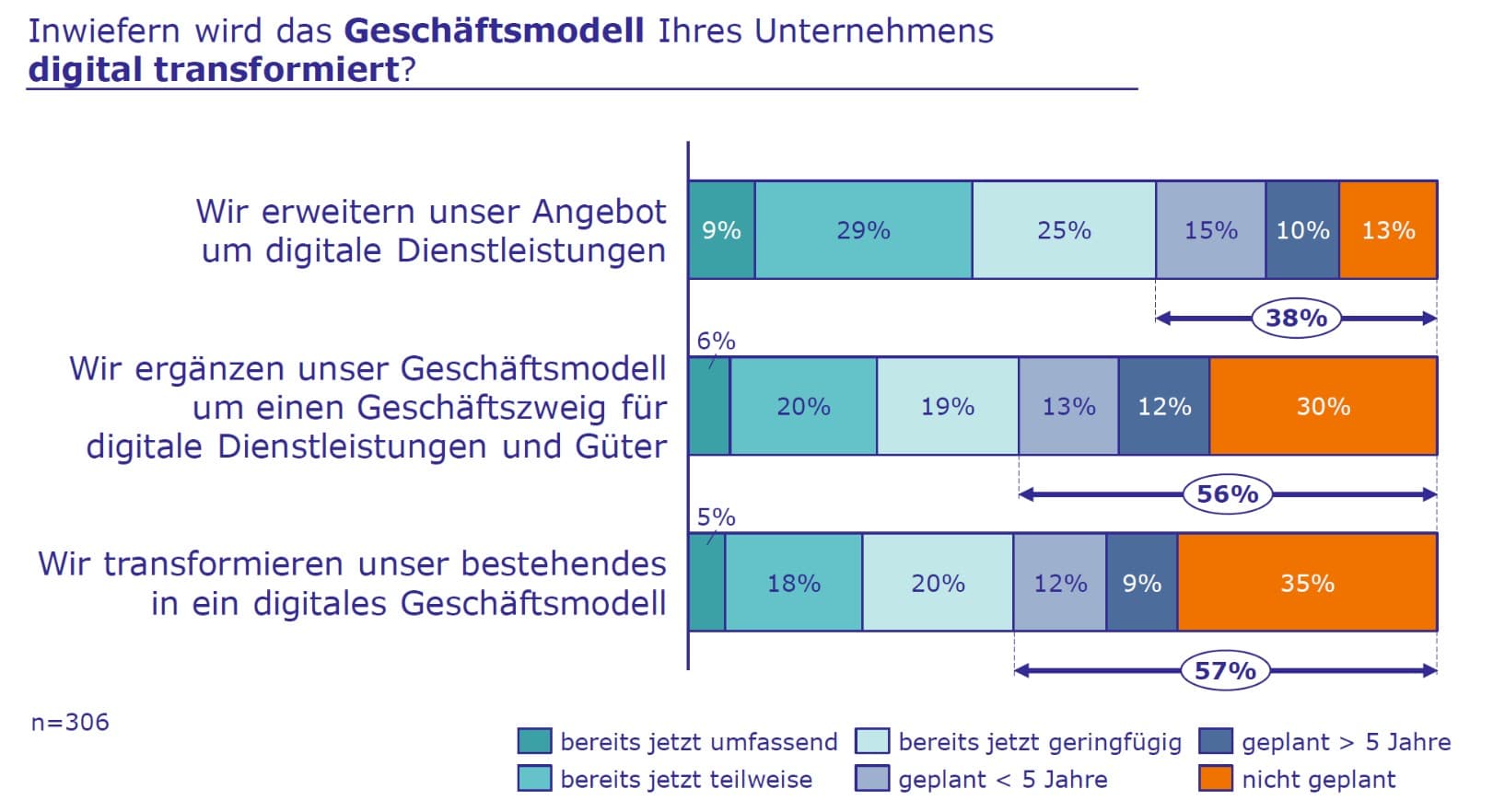
A focus on the digitalization of business models cannot currently be observed among respondents: 38 percent have no digital service offering, and more than half have no business branch for digital services and goods or no digital business model. Compared to 2016, there are hardly any differences: 62 percent (2016: 58 percent) plan to expand their offerings with digital services, 44 percent (2016: 39 percent) want to expand their business model with a digital branch, and 43 percent want to transform their existing business model into a digital one.

Sustainability in the responsibility of politics and customers
Around 100 logistics professionals participated in the in-depth study on sustainability, working in industry, retail, and logistics services in equal thirds. The results show, among other things, that they see the greatest responsibility for sustainability resting with politics (82 percent) and end customers (76 percent). However, logistics service providers (71 percent) and shippers from industry and retail (73 percent) are also attributed a high level of responsibility.
While respondents are already aware of the relevance of converting the truck fleet to alternative drives, implementation is still in its infancy. When asked which drive technology will prevail in the future, the majority is convinced of electric drives for short distances and hydrogen for long distances.
About a quarter of the surveyed logistics service providers receive “at least frequently” requests for more sustainable logistics and assess the trend as increasing. The same proportion of the surveyed shippers demands sustainability from their service providers for many transport orders. The crux lies in the economic dimension: only four percent of respondents rate their customers’ willingness to pay a premium for sustainability as high or very high.
Still potential in Advanced Data Analytics
About 80 logistics professionals participated in the in-depth examination of Advanced Data Analytics (ADA). ADA includes methods for value-creating analysis of data that enable predictive and prescriptive evaluations, e.g., through text mining or machine learning. About one-third of respondents reported using ADA beneficially. Although methods such as machine learning or automated decisions are attributed high relevance, only descriptive analytics (statistics) is used in the majority of companies (61 percent).
The biggest motivators for initiating an ADA project are the value-creating use of data and the desire for more transparency or understanding of an area. The three main goals are to optimize decisions, internal processes, and existing products and services. In many cases, experts are involved in the implementation. The relevance of technical success factors is rated high, while that of organizational factors is lower. This reflects a typical weakness – the currently insufficient focus on organization.
The study results and all further information can be found online at www.bvl-trends.de. In a video on the homepage, Prof. Wolfgang Kersten discusses the motivations and provides an initial classification of the results. The study and website will now be supplemented, updated monthly, and expanded with results on further trends.
Photo/Graphics: © Adobe Stock