Hellmann switches its France operations to GEODIS
Jul 2, 2020 at 8:29 AMFuture Project Autonomous Driving in Combined Transport Launched
Jul 3, 2020 at 7:01 AMKLU, Kühne Logistics University participates as a scientific partner in the newly established network ‘Autonomous Logistics in Rural Areas’. The network is coordinated by Evermind GmbH from Leipzig. The village shop could be revived in a version 4.0.
(Hamburg/Leipzig) Autonomous vehicles collect waste, deliver packages to homes, or transport fresh milk to the dairy – this is how the logistics of the future in rural areas could look. While cities face a housing shortage, entire rural areas are depopulating. Digital solutions are needed to bring goods and services to customers at acceptable costs, even in sparsely populated areas. As a scientific partner in the newly established network ‘Autonomous Logistics in Rural Areas’, KLU is involved in the development of such innovative logistics systems.
“For the so-called last mile in the city, there are already promising techniques and business models, as demonstrated by events like ‘Smart Urban Retail Day’ (SURday) and ‘Smart Urban Retail Night’ (SURnight) within the framework of the KLU research project SURTRADE (Smart Urban Retail Services). However, my concern is for rural areas with their low goods flows. Village shops are closing, parcel services operate with half-empty vehicles – supplying sparsely populated regions is hardly profitable anymore,” says Dr. André Ludwig, Associate Professor of Computer Science in Logistics, responsible for the network at KLU.
Package Delivery at Village Shop 4.0
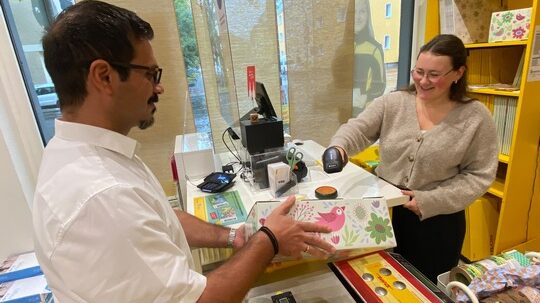
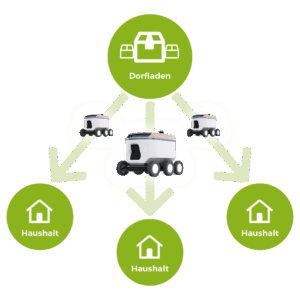 The network has identified initial use cases: the village shop could be revitalized in a 4.0 version. “The village shop still fulfills its function as a social center, but additionally becomes a hub for autonomous logistics,” explains Prof. Dr. Ludwig. Delivery services no longer deliver goods to the end customer but to the village shop. Employees hand them out directly or send them via an autonomous delivery system to the recipients. Autonomous flying is also conceivable, says Prof. Dr. Ludwig. “The use of drones can be implemented much more easily in rural areas than in cities, where it is mostly prohibited for good reasons.”
Autonomous Goods, Material, and Energy Flows
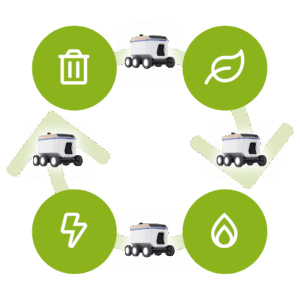 A second idea is to develop an autonomous flexible freight train. Self-driving containers would become commonplace on rural roads – electrically powered, autonomously steered, and capable of automatically coupling together. The application for local goods, material, and energy flows is diverse. Instead of large garbage trucks with long routes, a swarm of autonomous vehicles could exchange the bins. An example for agriculture: Autonomous vehicles transport fresh milk directly to the dairy. There are also application scenarios for the gas and electricity grid, and beyond that, the network is open to ideas and approaches that all serve one goal: to make rural regions economically strong and livable with the help of autonomous logistics.
Network ‘Autonomous Logistics in Rural Areas’
The network ‘Autonomous Logistics in Rural Areas’ includes twenty partners and is funded by the ‘Central Innovation Program for SMEs’. Medium-sized companies and research institutions receive grants for demanding research and development projects that lead to new products, technical services, or better production processes.
Evermind GmbH
The name of the company evermind GmbH from Leipzig has been associated with the digitization of business models since its founding in 1999. Our portfolio ranges from consulting to research and development to software development. Evermind is the initiator and manager of numerous cooperation networks and research projects. The focus areas are economic, secure, and sustainable infrastructures, particularly energy systems, healthcare, electromobility, and recently autonomous logistics.
Author: KLU/PR
Photo/Graphics: ® Evermind