


SSI Schäfer and La Costeña: A New Logistical Mindset
May 21, 2020 at 10:37 AMGLS Delivers Packages Emission-Free in Hamburg City Center
May 22, 2020 at 1:00 PMThe Study Society for Combined Transport e.V. (SGKV) expresses future thoughts on strengthening combined transport. The CT is one of the pillars of the European Green Deal for freight transport. The one-sided exemption from tolls for CNG and LNG-powered trucks is also criticized. Technology promotion must consider the overall CT system
(Berlin) Combined Transport (CT) utilizes the strengths of rail, road, and waterways and promotes as climate-friendly and flexible freight transport as possible. Approximately 800 million euros have been invested in the CT infrastructure of non-federal facilities over the last 20 years – this already saves about 2 million tons of CO2 annually today. Even during the COVID-19 crisis, CT has shown its capabilities across Europe: connecting regions, consolidating goods across regions, shifting long-distance transport from road to rail and waterways, and cooperating across national borders. Combined Transport is system-relevant.
It is therefore only logical that CT is one of the pillars of the European Green Deal for freight transport and the climate protection measures of the federal government. The crucial question is: How can CT be strengthened? And how should funding be designed to further advance the overall CT system? The answer lies in the nature of CT itself: Not individual modes of transport or technologies should be the focus of funding, but always the impact on the overall system. This means: All modes of transport must be treated equally, there must be openness to technology, and alternative drives and fuels must always be considered in their positive climate effect on the entire CT chain.
Equal Treatment of Modes of Transport Strengthens the Overall CT System
Planned toll exemption until 2023: Funding imbalance for the overall CT system. It is therefore not effective, to give an example, to provide consumption-dependent funding for CNG and LNG drives in trucks through the planned continuation of the toll exemption until 2023. This special status of trucks does not do justice to CT. Positively speaking: If trucks are funded at 18.7 cents per truck-km, then rail should also be funded at 6.54 euros per train-km.
Only with this equal treatment are we on track to achieve climate protection goals. To advance CT, it is therefore always necessary to look at the overall system. A cross-modal funding system prevents back-shifting effects and creates a better environmental balance for the entire transport system. And this cross-modal funding system includes, among other things, support for infrastructure and procurement, conducting measurement series, and retrofitting.
How Climate Efficient are Alternative Drives and Fuels?
This question must also be answered – in terms of the system benefit for CT as well as for the entire logistics. Further measurement series in real operation, test data, and neutral analyses are needed – the prerequisite for ensuring that funding achieves the highest possible effectiveness. Alternative truck drives and fuels are precisely used in CT: in road-bound pre- and post-haulage on the “first and last mile” as well as in heavy equipment in the terminal area. For example, efficient gas drives reduce fine dust and noise emissions, which is good for the entire transport chain.
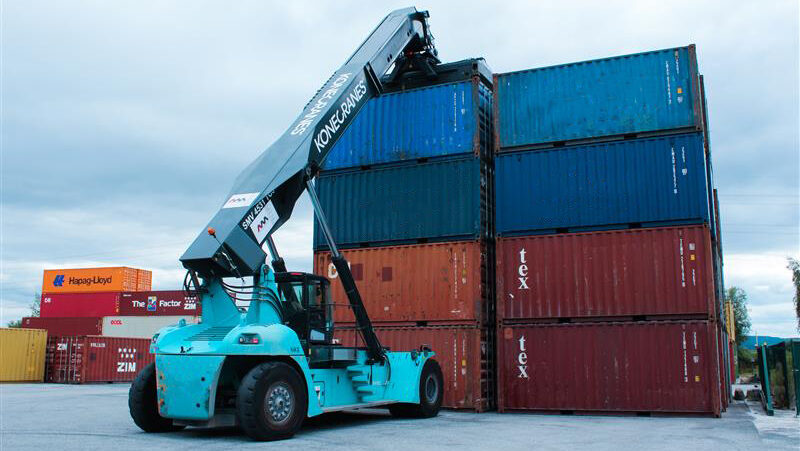
Photo: Adobe Stock RRF